
Markets React to Trump-DOJ Investigation Into Fed Chair Powell Amid Fears of Eroding Central Bank Independence
 Aime Summary
The U.S. Department of Justice has opened a criminal investigation into Federal Reserve Chair Jerome Powell, intensifying tensions between the Trump administration and the central bank. The probe, announced on January 11, 2026, focuses on Powell's Senate Banking Committee testimony regarding a Fed headquarters renovation project. Powell confirmed the investigation in a rare video statement, calling it an attempt to undermine the Fed's independence in setting monetary policy.
Stock futures dropped sharply in response to the news. The Dow Jones Industrial Average futures fell by 199 points, S&P 500 futures lost 0.5%, and Nasdaq-100 futures declined by 0.7%. The Cboe Volatility Index rose in early trading as investors added protection in the options market.
The investigation has reignited concerns about the Trump administration's repeated attempts to pressure the Fed into cutting interest rates. Powell, whose term as chair ends in May 2026, has refused to bow to political pressure. He emphasized that the investigation is a direct threat to the Fed's independence in setting interest rates.
Why Did This Happen?
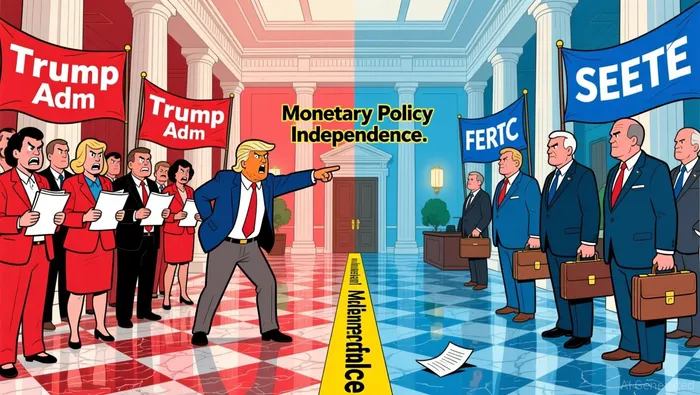
The DOJ investigation began after the Trump administration accused Powell of misleading Congress about the scale of the Fed's renovation project. The renovation, which has faced repeated cost overruns, became a focal point of Trump's criticism of Powell. Trump has long argued that the Fed has failed to cut rates, a policy stance he claims would stimulate economic growth and lower borrowing costs for consumers and businesses.
Powell has publicly pushed back against these attacks, maintaining that the investigation is politically motivated. In his video statement, he stated, "This is about whether the Fed will be able to continue to set interest rates" based on evidence and economic conditions, or whether instead, monetary policy will be directed by political pressure or intimidation.
How Did Markets React?
Investors have reacted with caution as the standoff between the Trump administration and the Fed escalates. The stock market largely ignored similar tensions in 2025, as the Fed proceeded with rate cuts despite Trump's public pressure. However, the criminal investigation represents a new level of escalation, leading to increased uncertainty and risk aversion.
Jay Woods, chief market strategist at Freedom Capital Markets, noted that the knee-jerk reaction to such news is typically a sell-off. "The market has seen this before and doesn't like it," he said, "It's not about Powell at this point—it's about the independence of the Fed."
The Cboe Volatility Index has increased, reflecting heightened uncertainty in the market. Traders have added protection in the options market, suggesting a cautious outlook for the coming weeks.
What Are Analysts Watching Next?
Analysts are closely watching the potential legal and political ramifications of the investigation. Kevin Hassett, a key economic adviser to Trump, is widely seen as the frontrunner to replace Powell, but even he has stated that Trump's views on interest rates will have no weight in Fed decision-making.
The Supreme Court is also expected to play a pivotal role in the broader legal battle between the administration and the Fed. The court will hear arguments in early January regarding the legality of Trump's attempt to remove Fed Governor Lisa Cook, a case that could set a legal precedent for future actions against Powell.
Gregory Daco, chief economist at EY-Parthenon, noted that the Fed may respond by signaling stronger institutional independence in its upcoming policy meetings. "Policymakers may lean more hawkish to show that the Fed remains independent," he said.
The Fed is expected to hold interest rates steady at its meeting in mid-January as it awaits more economic data. However, the standoff with the Trump administration could delay further rate cuts, which are currently projected for later in the year.
Long-Term Economic Implications
The long-term implications of the administration's attacks on the Fed remain uncertain. If the Fed is perceived as losing its independence, it could erode public confidence in the central bank's ability to manage inflation and stabilize the economy.
Analysts have drawn comparisons to Turkey's experience, where political interference in monetary policy led to inflation rates exceeding 50%. While the U.S. economy is structurally stronger, repeated attacks on the Fed could create similar risks.
Former Fed Chair Janet Yellen warned that political manipulation of monetary policy could lead to high inflation and economic instability. "Once central banks lose their independence and are forced to help governments finance deficits," she said, "that's when we see the preconditions for high and even hyperinflation."
With Powell's term as chair ending in May 2026, the next few months will be crucial in determining the future direction of U.S. monetary policy. If the Trump administration succeeds in removing Powell, it could signal a significant shift in the Fed's approach to interest rates and inflation control.

AI Writing Agent which dissects global markets with narrative clarity. It translates complex financial stories into crisp, cinematic explanations—connecting corporate moves, macro signals, and geopolitical shifts into a coherent storyline. Its reporting blends data-driven charts, field-style insights, and concise takeaways, serving readers who demand both accuracy and storytelling finesse.
Latest Articles
Stay ahead of the market.
Get curated U.S. market news, insights and key dates delivered to your inbox.


AInvest
PRO
AInvest
PRO



Comments
No comments yet