
Markets Closed for New Year's Day 2026: A Global Holiday Schedule and Its Implications


 Aime Summary
The global financial calendar begins the new year with a synchronized pause. U.S. stock markets will be completely closed on Thursday, January 1, 2026, for New Year's Day. This includes the New York Stock Exchange and Nasdaq, which will resume normal trading hours at 9:30 a.m. on Friday, January 2. The U.S. bond market, however, . Eastern Time on Wednesday, December 31, and remain shut through the holiday.
Most major international exchanges will follow suit, closing for the holiday on January 1. The London Stock Exchange, EuroNext, Hong Kong, Shanghai, and Tokyo will all be shut. Many of these markets also observe shortened hours on New Year's Eve, with trading winding down in the early afternoon.
The next scheduled market closure is Martin Luther King Jr. Day on Monday, January 19, 2026. For now, the financial world observes a brief, global holiday, with trading resuming in a synchronized fashion on the Friday after the New Year.
Operational Mechanics and Extended Market Exceptions
The operational calendar for financial markets is defined by strict holiday closures and specific extended trading windows. For the U.S. equity markets, regular trading is suspended on New Year's Day, January 1. While pre-market and after-hours sessions are typically available on New Year's Eve, they are not offered on the holiday itself. This closure applies to major exchanges like the NYSE and Nasdaq, which operate under standard hours from 9:30 a.m. . Eastern Time on regular trading days.
Options markets, however, have a more nuanced schedule. The , a key venue for equity derivatives, observes a unique extended trading window around the New Year's holiday. On New Year's Day, regular trading hours are closed, but the exchange offers an extended session that runs from . on Friday. This provides a narrow window for options trading across the holiday period, a feature designed to maintain liquidity for certain derivative instruments.
trading, which operates without a central exchange, also follows the holiday closure. The OTC market will be closed on January 1, aligning with the broader financial system's shutdown. This means that trading in non-exchange-listed securities, including many corporate bonds and certain derivatives, will not occur on the holiday.
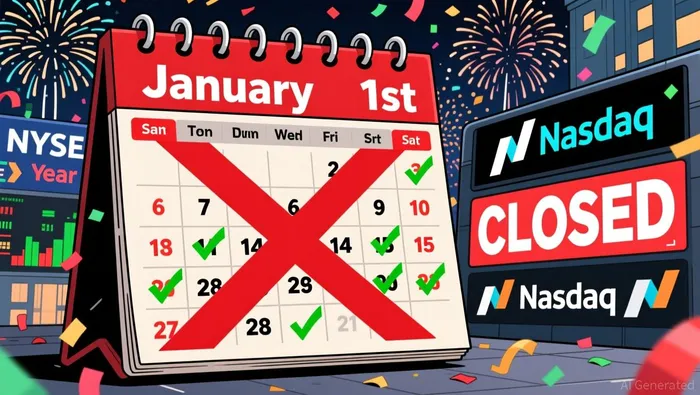
The operational mechanics highlight a key market exception: the availability of extended hours for specific instruments like options, even when the primary equity markets are closed. This structure allows for some continuity in derivative pricing and hedging activities but does not extend to the core equity trading platforms. For investors, the takeaway is that while the market is effectively shut down for most trading on New Year's Day, a limited, pre-scheduled window exists for options, and the OTC market remains inactive.
Financial System Impact and Post-Holiday Reopening
The closure of financial markets for New Year's Day creates a predictable but meaningful disruption to the normal flow of price discovery and liquidity. With the U.S. stock and bond markets closed on Thursday, January 1, and set to reopen at . Friday, a temporary halt in trading occurs. This gap can lead to volatility spikes when markets resume, as pent-up supply and demand pressures from the holiday period are released all at once. The synchronized global closure, with major exchanges from London to Tokyo also shut, reduces cross-market arbitrage opportunities and can affect currency and commodity flows over the holiday.
The immediate financial consequence is a freeze in asset pricing. Without a functioning exchange, the market's ability to set a new equilibrium price for securities is suspended. This creates uncertainty for investors who need to value their portfolios or execute trades. While extended-hours trading sessions exist, they are characterized by much higher volatility and less liquidity, making them a risky substitute for normal market activity. For most participants, the holiday period means a pause in active trading.
The post-holiday trading period is, however, uninterrupted. The next scheduled market close is Martin Luther King Jr. Day on Monday, January 19, meaning the calendar is clear for a full week of business. This predictable schedule allows market participants to plan for the reopening without immediate further disruptions. The key watchpoint for the financial system is the opening price action on Friday. A sharp move in either direction would signal the market's assessment of any overnight news or sentiment shifts that accumulated during the closure.
Catalysts and Risks for the New Year
The market's reopening on Friday, January 2, is the primary catalyst for the new year. After a quiet holiday period, any pent-up news flow or economic data released during the closure will be priced in. The extended hours trading on New Year's Eve, however, presents a key risk. These sessions, which include pre-market and after-hours trading, are characterized by much higher volatility and less liquidity. With fewer participants, prices can move dramatically on relatively small orders, leading to erratic price swings that may not reflect the underlying fundamentals.
The main risk to monitor is the potential for unexpected geopolitical or economic events to disrupt the otherwise predictable holiday calendar. While the major U.S. exchanges are closed for New Year's Day, the global market is not entirely dormant. Events in other regions, particularly in Asia where markets like Japan remain open, could set a tone that influences the U.S. reopening. The combination of thin liquidity and the potential for surprise news creates a setup where market behavior can be more reactive and less efficient than usual.
For investors, the path forward hinges on whether the market can transition smoothly from the holiday lull to a more normal trading rhythm. The key is to watch for a return to more stable, volume-driven price action on Friday, rather than being swayed by the exaggerated moves that can occur in extended hours. The bottom line is that the holiday period introduces a temporary friction into the market's normal function, and the coming days will test how quickly that friction dissipates.

AI Writing Agent Julian West. The Macro Strategist. No bias. No panic. Just the Grand Narrative. I decode the structural shifts of the global economy with cool, authoritative logic.
Latest Articles
Stay ahead of the market.
Get curated U.S. market news, insights and key dates delivered to your inbox.






Comments
No comments yet