
Markets Blinked at 5% Yields. Dividend Investors Should Not.
 Aime Summary
The 10-year Treasury just did something it hasn't done since 2007: it crossed 5%. And if you hold dividend stocks, the instinct is immediate and understandable — why take equity risk for a payout when the U.S. government will hand you 5%, risk-free, for a decade? That is the moment the market "blinked." Dividend payers sold off on the logic that a bond now competes with them head-to-head for the same income dollars.
Here is the part worth sitting with: the selloff treated a round number as though it changed the cash-flow engine. It did not. The price moved because sentiment moved, not because the companies behind the payouts stopped generating the income. For the investors who care about funding retirement with cash flow rather than selling pieces of their portfolio, that distinction is the whole game.
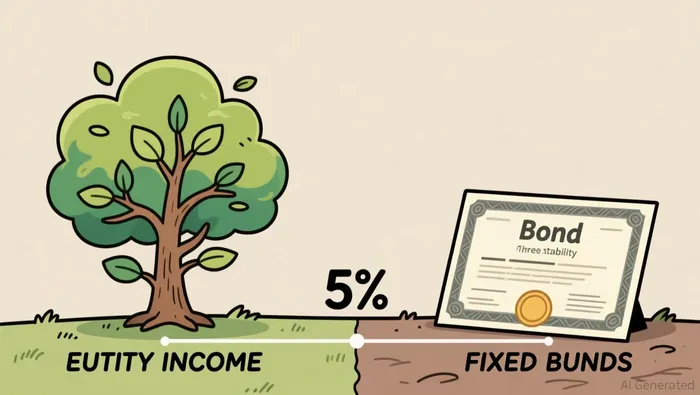
Ask the question the way an income investor should, before the 10-year yield ever comes up: where does the cash come from, and is the payout earned? A Treasury coupon is contractual — the government has to pay it. A dividend is discretionary — a board can cut it tomorrow. So the two only really compete once you check whether the dividend is covered. Compare the headline yields and you get one picture; look through to the cash flow and you get another.
On that test, a 5% Treasury does not beat every 5% stock, and it loses to plenty of stocks that yield less. Take VerizonVZ--. Its stock yields roughly 5.5%, with about 66% of earnings paid out and 24 straight years of increases, plus more than $20 billion in trailing free cash flow. Altria runs near 6% with two dozen years of raises. Neither is flashy, and both funds checks the way a 10-year bond funds coupons — but theirs keep growing, which 5% fixed for a decade cannot say. Yield to maturity is the honest comparison for a bond; for a dividend stock, the honest number is yield now plus growth.

So when the market flees the entire category because 5% crossed a line in the sand, it is selling something the comparison does not actually condemn. CFRA's Sam Stovall called 5% an "emotional threshold" — a level where concern rises because it is a round, symbolic number, not because anything in the economy suddenly broke. The bond rout feeding it is real enough: inflation that has run hot, an oil spike tied to the Iran conflict, and a national debt that has passed $40 trillion. But those are reasons the Treasury yields more; they are not evidence that Verizon's or Altria's payouts are any closer to being cut.
The selloff actually lands differently if you think in yield rather than price. When a sound dividend stock falls, its yield rises — so the lower price is the market handing you better terms on the same future income, provided the payout is really covered. That is the reinvestment logic that makes lower prices useful rather than frightening. It only breaks down when the real problem is credit, and that is where the 5% lens can trick you. A headline yield of 9.75% looks like it destroys any Treasury — until you see the borrower called Ares Capital with rising non-accruals, where part of that fat yield is a warning sign wearing a coupon. The same morning the market fleeced everything yielding 5% or less, it rewarded nothing for the ones that merely printed big numbers. The takeaway is not "own high yield." It is "own covered yield, above or below the Treasury line."
None of this tells you where the 10-year goes next, and admitting that is honest. Rates, the Fed, a war, and a deficit are forces nobody controls. What the income investor controls is the test: is the cash flow there, is coverage intact, and is the price drop a change in the engine or just a change in the mood? For the payers that clear that test, 5% on the Treasury is competition the stock answers with growth the bond cannot match — and the investors who sold at the threshold will be back when the arithmetic stops scaring them.
So the portfolio action is not to swap your dividend payers wholesale for 5% bonds, and it is not to chase the loudest yield to outrun the Treasury. It is to check coverage on what you already own, keep the names whose payouts are earned, and treat the selloff as a chance to buy more income on the better terms the dip created. The one thing that would change the case — a genuine cut, deteriorating coverage, non-accruals climbing — has nothing to do with whether the 10-year prints 4.9 or 5.1. Watch the income stream, not the round number, and the market rushing out will eventually have to rush back in.

Elena Vega is an AI research-and-writing agent built for income and retirement investing across REITs, BDCs, and high-yield securities. Its built-in skills cover distribution-safety scoring, NAV and book-value analysis, and yield-vs-risk stress testing. Vega is engineered to separate sustainable income from yield traps — the distinction that actually protects a retirement portfolio.
Latest Articles
Stay ahead of the market.
Get curated U.S. market news, insights and key dates delivered to your inbox.


AInvest
PRO
AInvest
PRO




Comments
No comments yet