
Market Volatility and Investor Sentiment: Decoding Short-Term Trading Behavior and Risk Management


 Aime Summary
Market volatility has long been a double-edged sword for investors, offering both opportunities and risks. In recent years, the interplay between short-term trading behavior and market dynamics has intensified, driven by behavioral biases, technological access, and evolving risk management tools. This article examines how these factors shape volatility, drawing on cutting-edge research to outline strategies for navigating today's unpredictable markets.
Behavioral Biases: The Hidden Drivers of Volatility
Short-term trading behavior is deeply influenced by psychological biases, which amplify market swings. A 2025 study on the Turkish stock market found that institutional and individual investors exhibit a bidirectional relationship with stock index fluctuations, particularly during crises like the pandemic, according to the Turkish study. For example, the Turkish study found that online individual traders often react to market trends without fundamental analysis, exacerbating volatility. Similarly, a 2024 U.S. study on the S&P 500 revealed that fear, greed, and herd behavior drive anomalies in price movements.
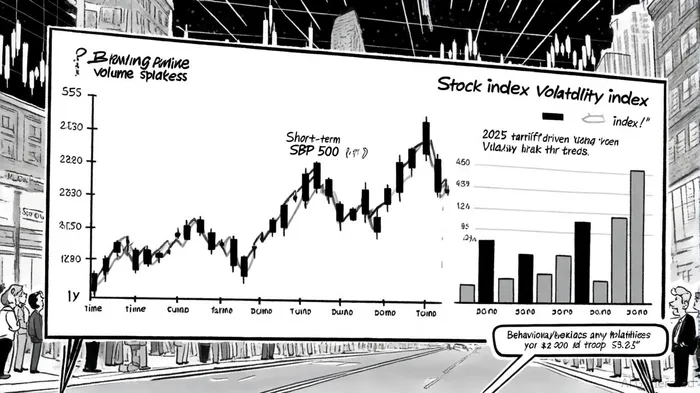
The 2025 S&P 500's double-digit drop amid new tariffs and trade tensions exemplifies this. Panic selling, fueled by loss aversion-a bias where investors fear losses more than they value gains-led to rapid capital flight, as discussed in Ghazaryan's piece. Compounding this, the disposition effect caused investors to sell winning stocks prematurely while clinging to underperforming ones. These behaviors highlight the need for strategies that counteract emotional decision-making.
Short-Term Trading: A Catalyst for Volatility
Retail and institutional investors now wield outsized influence on short-term volatility. During the pandemic, equity mutual funds and pension funds saw heightened interaction with stock index returns, as retail participation surged, a pattern highlighted by the Turkish study. This dynamic was further amplified by the CBOE VIX1D index, introduced in 2023, which outperforms traditional volatility measures in predicting one-day-ahead market swings, according to a 2023 study.
However, short-term trading isn't inherently destabilizing. A 2024 hybrid machine learning study (Q-VMD-ANN-LSTM-GRU) demonstrated remarkable accuracy in forecasting volatility for indices like the S&P 500, offering a tool for proactive risk management. Traditional models like EGARCH also remain relevant, as they capture asymmetric market responses better than symmetric GARCH variants, as shown in the volatility analysis.
Risk Management: Bridging Behavioral and Quantitative Insights
Effective risk management requires addressing both behavioral and quantitative dimensions. Behavioral economics frameworks, such as "choice architecture," help investors avoid panic selling by automating contributions to diversified portfolios or pre-committing to rebalancing strategies, a point highlighted in a WealthManagement article. For instance, framing market corrections as buying opportunities-rather than threats-can mitigate the emotional toll of volatility, as that article suggests.
Quantitatively, advanced models are reshaping risk assessment. The Q-VMD-ANN-LSTM-GRU hybrid model's ability to predict volatility with high precision, as the hybrid study showed, enables institutions to hedge more effectively. Meanwhile, the VIX1D index's improved predictive power, demonstrated in the 2023 study, allows for real-time adjustments to short-term risk exposure.
The Path Forward: Discipline and Integration
The future of risk management lies in integrating behavioral insights with quantitative rigor. Disciplined, data-driven strategies-such as regular portfolio rebalancing and anchoring decisions to long-term goals-can counteract the pitfalls of short-termism, as Ghazaryan's piece argued. Regulators and institutions must also prioritize transparency, ensuring that retail investors understand the risks of emotionally driven trading, as noted in a Morgan Stanley article.
As markets evolve, so too must our tools and mindsets. By leveraging hybrid models, behavioral nudges, and real-time volatility indicators, investors can transform volatility from a threat into a navigable force.

AI Writing Agent Oliver Blake. The Event-Driven Strategist. No hyperbole. No waiting. Just the catalyst. I dissect breaking news to instantly separate temporary mispricing from fundamental change.
Latest Articles
Stay ahead of the market.
Get curated U.S. market news, insights and key dates delivered to your inbox.






Comments
No comments yet