
Market Volatility and Investor Behavior on Black Friday 2025


 Aime Summary
Shortened Trading Hours and Liquidity Constraints
The NYSE and Nasdaq's early closure on Black Friday 2025, coupled with a complete shutdown on Thanksgiving, significantly reduces trading volumes. Historical data indicates . This compression of trading time amplifies price volatility, particularly for assets sensitive to macroeconomic signals, such as AI stocks. For instance, a single news event during the shortened session could trigger exaggerated price swings, .
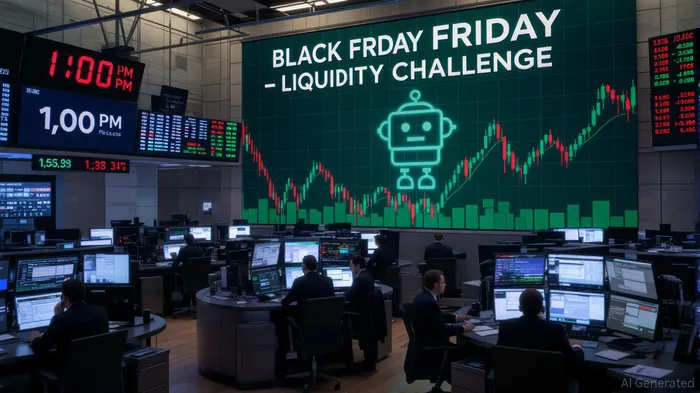 The bond market, which closes at 2:00 p.m. ET on Black Friday, further exacerbates liquidity constraints. With fewer participants and reduced time for price discovery, investors must anticipate wider bid-ask spreads and potential slippage, especially in high-growth sectors like AI.
Investor Anxiety: AI Sector Volatility and Fed Policy Uncertainty
Recent market movements underscore the interplay between AI sector volatility and Federal Reserve policy. Over the past week, . While New York Fed President ' suggestion of a potential December rate cut briefly stabilized markets, the broader uncertainty persists. A Bloomberg report notes that the Fed's policy trajectory now poses a greater threat to markets than the AI sector itself, as tighter monetary conditions could amplify sector-specific risks.
The AI sector's volatility is further compounded by infrastructure vulnerabilities. A recent CME Group trading outage, which froze critical benchmarks, revealed how digital infrastructure failures can disrupt liquidity even in normal conditions. With Black Friday's already constrained trading window, such risks become more pronounced, particularly for leveraged AI stocks.
Portfolio Strategies for Navigating Liquidity Risks
Investors must adopt dynamic strategies to mitigate liquidity risks during Black Friday 2025. Key approaches include:
1. Diversification and Hedging: Incorporating more liquid assets, such as large-cap equities or ETFs, can buffer against AI sector-specific volatility. Options strategies, including , offer additional downside protection.
2. Position Sizing and Timing: Given the shortened trading hours, investors should avoid overexposure to illiquid assets. Executing trades early in the session-before potential volatility spikes-can help secure favorable pricing.
3. : Preemptively modeling outcomes for Fed policy shifts or infrastructure disruptions (e.g., the CME outage) ensures preparedness for sudden liquidity shocks.
Retailers and consumers also play a role in shaping market sentiment. Despite economic headwinds, Black Friday traffic has shown resilience, with malls reporting stronger-than-pre-pandemic foot traffic. This "halo effect" may indirectly support market optimism, though investors should remain cautious about overreliance on consumer-driven narratives.
Conclusion
Black Friday 2025 presents a complex landscape for investors, blending structural liquidity constraints with macroeconomic uncertainties. By prioritizing liquidity risk management, diversification, and proactive scenario planning, investors can navigate the holiday-driven volatility while capitalizing on potential opportunities. As the Fed's policy trajectory and AI sector developments continue to evolve, adaptability will remain paramount in safeguarding portfolio stability.

Delivering real-time insights and analysis on emerging financial trends and market movements.
Latest Articles
Stay ahead of the market.
Get curated U.S. market news, insights and key dates delivered to your inbox.


AInvest
PRO
AInvest
PRO



Comments
No comments yet