
Market Selloff Deepens as Software, Services Lead Losses; Gold Hit by Algo Trading — What Happened?
 Aime Summary
As the fourth-quarter earnings season winds down, better-than-expected results have failed to push equities to fresh highs. Instead, the increasingly advanced capabilities of AI are posing mounting threats to traditional software and service industries. Whenever a startup rolls out an AI tool targeting a specific sector — or an established company delivers slightly softer guidance — investors respond with ruthless selling. Even seemingly unrelated precious metals like gold and silver have become collateral damage.
Just ahead of Friday's CPI release, U.S. stocks notched a third straight day of losses. The S&P 500 fell nearly 1.6%, while the Nasdaq 100 dropped more than 2%, marking the fifth time in the past 10 trading days that it has declined at least 1% in a single session. Spot gold slid more than 3%, once again falling below the $5,000-per-ounce threshold, while silver plunged over 11%. So what really happened?
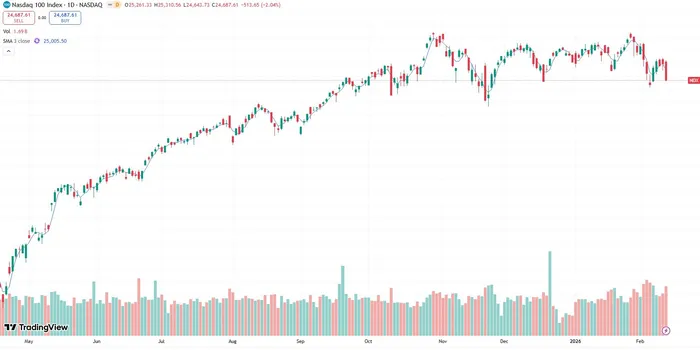
There was no major macroeconomic catalyst. Instead, the move looks like a release of pent-up anxiety as AI continues to pressure software, hardware, and service industries. Last week, Anthropic launched a legal automation tool on its Claude Cowork platform capable of reviewing contracts, drafting briefs, and generating automated responses. Meanwhile, ByteDance's Seedance 2.0 video-generation model sparked widespread debate online for its realism and rapid content production. Traditional software names are now facing the risk of a massive reshuffle in the AI era.
The software sector then sank further. Netflix and Palantir TechnologiesPLTR-- fell nearly 5%, while Shopify and Unity Software dropped more than 7%. AppLovinAPP-- tumbled over 12%. Although these companies recently posted earnings that beat expectations, most offered slightly softer guidance, intensifying concerns that AI could erode the industry's long-term growth trajectory.
The pressure extends well beyond software. A wide range of traditional industries is now under strain. Online insurance marketplace Insurify introduced an AI-powered tool this week that compares auto insurance rates using vehicle details, credit history, driving records, and other inputs. Financial software firm Altruist unveiled a new tax-planning service within its AI platform, Hazel, capable of instantly analyzing clients' 1040 forms, pay stubs, statements, meeting notes, emails, and custodial data to generate fully personalized tax strategies within minutes.
What began in software has now rippled into private credit firms, insurers, wealth managers, real estate services, logistics companies, and more. Jobs once viewed as secure "career moats" are increasingly seen as vulnerable to AI-driven disruption.
"The glaring theme underneath the surface — not just for tech, but across every corner of the market — is an aggressive 'shoot first, ask questions later' reaction to any AI headline," Jefferies trader Jeffrey Favuzza wrote in a client note Thursday.
Even hardware companies are feeling margin pressure from AI. Apple Inc. plunged 5%, marking its largest single-day decline since April 2025. Cisco Systems sank 12% after earnings, warning of weaker gross margins ahead. As the AI boom accelerates, soaring demand for computing power has pushed memory chip prices sharply higher, giving companies such as Samsung Electronics, SK Hynix, and Micron Technology greater pricing power.
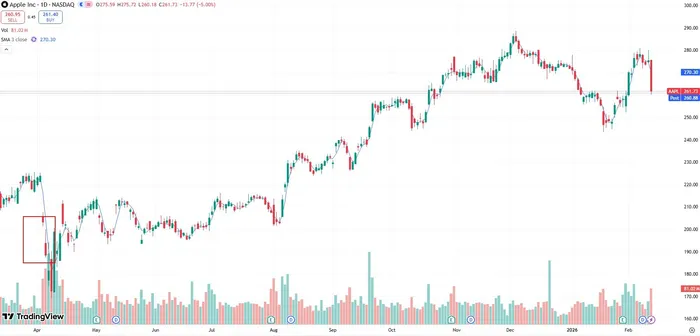
Apple has had to absorb LPDDR memory price increases of 80% or more for the iPhone, pressuring profitability. Hardware firms with less pricing leverage are under even greater strain. Meanwhile, the memory chip supercycle shows no sign of cooling, with much of this year's capacity already sold out, adding to near-term margin headwinds.
Notably, metals such as gold and silver were also caught in the crossfire. Analysts suggest that AI-driven risk aversion sparked the initial move, while algorithmic trading amplified the decline. Michael Ball of Bloomberg said the AI-driven risk-off tone in equities spilled into metals, with apparent algorithmic selling accelerating the drop. The sharp air-pocket decline resembled systematic strategy selling, as CTA models triggered momentum-driven de-risking once key technical levels were breached.
Margin calls likely compounded the move. Nicky Shiels, head of metals strategy at MKS PAMP SA, said some investors were forced to liquidate commodity positions to raise liquidity. "It all happened so quickly and feels like a risk-out move," she said, noting that in periods of extreme stress, even safe-haven assets like gold can be sold to meet liquidity needs.
Fawad Razaqzada of Forex.com argued that the sharp drop in gold does not necessarily signal the start of a sustained downtrend, but it does increase the likelihood of elevated near-term volatility. The market has cleared a significant pocket of downside liquidity, and the next move will hinge on how prices behave around key technical levels.
Despite the recent rout, many major banks still expect gold to resume its upward trajectory, citing persistent drivers such as geopolitical tensions, concerns about Federal Reserve independence, and a broader rotation away from traditional assets like currencies and sovereign bonds.
JPMorgan Private Bank forecasts gold could reach $6,000 to $6,300 per ounce by year-end, while Deutsche Bank AG and Goldman Sachs Group Inc. have expressed similarly bullish views.
Ultimately, sharp selloffs often create potential entry points. Excessive panic driven by worst-case assumptions can make high-quality companies more attractive at discounted valuations. While AI is undeniably transformative, at this stage it is primarily lowering barriers to entry. The mid- and high-end markets still face hurdles — including enterprise demand, regulatory compliance, and real-world operational stability — all of which will take time to prove out.
In extreme market conditions, disciplined position sizing and prudent asset allocation matter more than ever.

Crypto market researcher and content strategist with 3 years of experience in digital asset analysis and market commentary. Skilled at transforming complex blockchain data and trading signals into clear, actionable insights for investors. Experienced in covering Bitcoin, Ethereum, and emerging ecosystems including DeFi, Layer2, and AI-related projects. Passionate about bridging professional market research with accessible storytelling to empower readers and investors in the fast-evolving crypto landscape.
Latest Articles
Stay ahead of the market.
Get curated U.S. market news, insights and key dates delivered to your inbox.
AInvest
PRO
AInvest
PRO



Comments
No comments yet