
Market Resilience Amid Trump's Trade Tariffs: Opportunities in Global Equities
The U.S. trade wars of 2018–2020, marked by escalating tariffs on steel, aluminum, and Chinese imports, were expected to upend global markets. Yet equity prices remained stubbornly resilient, defying the economic headwinds. This disconnect between geopolitical risks and investor complacency presents a paradoxical opportunity: sectors and regions with inherent trade resilience—or those quietly adapting to tariffs—could outperform in a landscape where risks are underpriced.
A Timeline of Tariffs, and Markets' Indifference
The Trump administration's trade strategy began with Section 232 tariffs on steel (25%) and aluminum (10%) in 2018, targeting imports from allies like Canada and the EU. By 2020, tariffs on Chinese goods averaged 19.3%, covering two-thirds of U.S. imports from China, while China retaliated with 21% tariffs on $90 billion of U.S. exports. 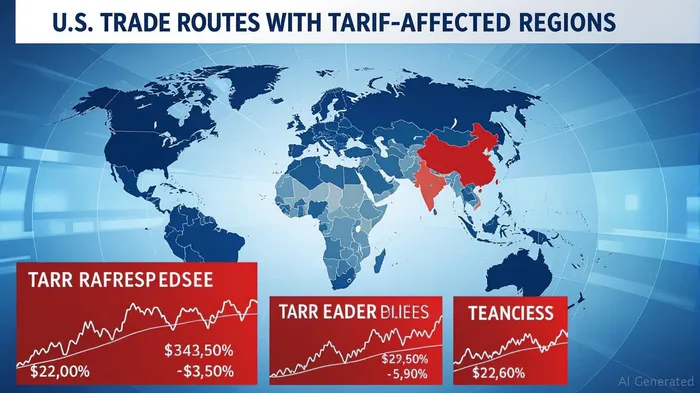 .
.
Despite these measures, markets barely flinched. The S&P 500 rose 40% between 2018 and 2020, while tech-heavy sectors like semiconductors and software outperformed cyclicals like autos and industrials. The disconnect? Investors focused on corporate earnings resilience, central bank stimulus, and the delayed economic impact of tariffs.
Sectoral Winners and Losers: Where the Market Got It Right
1. Technology: Diversification as a Shield
Tech stocks proved impervious to tariffs, with semiconductor companies like Intel (INTC) and Taiwan Semiconductor (TSM) outperforming the broader market. Why? Their global supply chains insulated them from U.S.-China trade frictions. Even as tariffs on Chinese imports surged, companies shifted manufacturing to Southeast Asia or Mexico, avoiding punitive duties.
2. Autos: Navigating Retaliation
The automotive sector faced headwinds, with U.S. auto tariffs threatening to disrupt global supply chains. Yet companies with diversified production fared better. For example, Toyota (TM), which produces 40% of its U.S. sales domestically, saw steadier earnings than peers reliant on Mexican or Chinese imports.
3. Agriculture: Subsidies Overcame Retaliation—Temporarily
Farmers bore the brunt of Chinese tariffs, with soybean prices plummeting 15% in 2018. However, U.S. government subsidies totaling $28 billion cushioned the blow, allowing agricultural equities to stabilize. The sector's recovery, however, relied on policy support rather than market fundamentals—a risk if subsidies dry up.
The Underappreciated Risks: Where the Market Might Be Wrong
While equities have shrugged off tariffs so far, complacency may be misplaced in three areas:
1. Semiconductor Supply Chains: The Next Tariff Flashpoint
The 2020s could see tariffs expand to advanced semiconductors, a sector already grappling with geopolitical tensions. Companies like NVIDIA (NVDA) and AMD (AMD) face risks as governments push for domestic chip production.
2. Auto Industry Vulnerabilities
Despite short-term resilience, automakers remain exposed to escalating auto tariffs. The U.S. imposed a 25% tariff on Mexican auto imports in 2020, forcing firms like General Motors (GM) to relocate production—a costly move that could pressure margins.
3. Emerging Markets: Collateral Damage
Tariffs distorted trade flows, redirecting Chinese imports to Vietnam and Mexico. While this boosted regional equities temporarily, overreliance on U.S.-China trade could backfire if global demand weakens.
Investment Strategy: Play Resilience, Avoid Complacency
Opportunity 1: Tech with Global Footprints
Invest in companies with diversified supply chains. Broadcom (AVGO) and ASML Holding (ASML), which operate across multiple regions, are well-positioned to navigate tariffs.
Opportunity 2: U.S. Steel and Aluminum Producers
Domestic steelmakers like Nucor (NUE) and Allegheny Technologies (ATI) benefited from 2018 tariffs, seeing price gains of 30%+ compared to global peers. While trade truces may temper this, long-term demand for infrastructure could sustain their growth.
Opportunity 3: Trade-Neutral Sectors
Healthcare and consumer staples, less reliant on global trade, offer defensive exposure. Johnson & Johnson (JNJ) and Procter & Gamble (PG) have outperformed tariffs-driven cyclicals.
Avoid:
- Auto manufacturers with heavy exposure to Mexican/Chinese imports.
- Agricultural commodities without direct subsidy support.
- Emerging markets overly tied to U.S.-China trade.
Conclusion: Riding the Disconnect
Markets have ignored tariff risks because earnings and policy support masked underlying vulnerabilities. Investors should exploit this complacency by favoring sectors that thrive in a fractured trade environment—global tech, U.S. industrial titans—and avoiding those at the mercy of geopolitical whims. As tariffs persist, resilience, not resistance, will define winners.
Stay diversified, but bet on adaptation.

Delivering real-time insights and analysis on emerging financial trends and market movements.
Latest Articles
Stay ahead of the market.
Get curated U.S. market news, insights and key dates delivered to your inbox.
AInvest
PRO
AInvest
PRO



Comments
No comments yet