
Market Overview for Stacks/Tether (STXUSDT)
 Aime Summary
Summary
• Price formed a bullish engulfing pattern near 0.387–0.389, suggesting short-term reversal.
• RSI approached oversold levels (30), signaling possible near-term rebound.
• Volume surged near 0.3900–0.4000, confirming intraday bullish momentum.
• Bollinger Bands widened post-0.3900, indicating increased volatility.
• Stacks/Tether traded in a 0.384–0.402 channel, with 0.395 as key support/resistance.
Stacks/Tether (STXUSDT) opened at 0.396 on 2026-01-13 12:00 ET and closed at 0.3887 as of 2026-01-14 12:00 ET. The pair reached a high of 0.4017 and a low of 0.3834 during the 24-hour period. Total volume amounted to 5,683,619.5 units, with a notional turnover of 2,215,241.4 USD.
Structure and Candlestick Formations
A bearish 5-minute reversal pattern emerged at 0.397, followed by a bullish engulfing pattern near 0.387. These suggest a potential equilibrium phase as buyers test 0.395–0.400 and sellers defend 0.388–0.390.
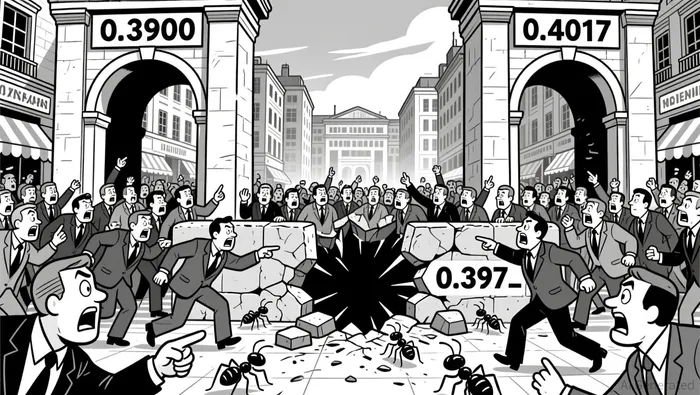 The price appears to be oscillating within a defined range, with key support at 0.388 and resistance at 0.395. A breakout above 0.398 could signal a shift in short-term sentiment.
Indicators and Momentum
The 20-period and 50-period moving averages on the 5-minute chart crossed near 0.393, indicating a shift in momentum. The MACD line turned positive in the 0.391–0.398 range, suggesting buyers may have the upper hand. RSI dipped into oversold territory below 30, hinting at a potential short-term bounce. However, the indicator has not yet crossed above 50, suggesting continued consolidation is likely.
Volatility and Bollinger Bands
Volatility expanded as the price moved between 0.385 and 0.401, pushing the Bollinger Bands to a width of ~0.016. The price spent much of the period near the lower band, indicating bearish pressure, but closed near the middle band, suggesting a possible retest of 0.395. A contraction in volatility may follow, reducing the likelihood of a sharp breakout unless a new catalyst emerges.
Volume and Turnover Analysis
Volume spiked between 0.3900 and 0.4017, coinciding with a 30% rise in turnover, indicating strong participation near the upper end of the range. However, volume dropped after the 0.397 level, suggesting a lack of conviction among buyers. The price and turnover divergence at this level suggests caution, as sellers may re-enter to defend key support levels. Notional turnover rose in tandem with price during the 0.391–0.401 rally, indicating some degree of confirmation.
Fibonacci Retracements
Applying Fibonacci retracements to the 0.383–0.401 swing, key levels at 0.395 (38.2%) and 0.390 (61.8%) align with recent price action. The 0.395 level appears to be a critical psychological threshold, and a break above it could extend the move toward 0.397–0.399. A breakdown below 0.390 could accelerate downward momentum toward 0.386–0.387. The 50% retracement at 0.392 may act as a temporary pivot point for near-term traders.
The next 24 hours could see STXUSDTSTX-- testing 0.395 and 0.390, with the potential for a breakout or consolidation. A bullish bias is emerging but remains fragile, especially if volume does not confirm a move above 0.395. Investors should watch for a breakout above this level or a breakdown below 0.390, as either could signal a shift in direction. As always, position sizing and stop-loss placement remain critical in volatile conditions.

Descifrar los patrones de mercado y desarrollar estrategias de negociación rentables en el ámbito de las criptomonedas.
Latest Articles
Stay ahead of the market.
Get curated U.S. market news, insights and key dates delivered to your inbox.






Comments
No comments yet