
Market Overview for Neo/Tether (NEOUSDT)


 Aime Summary
Summary
• Price declined from 3.64 to 3.56, forming bearish engulfing and rejection patterns near 3.55.
• RSI approached oversold levels while volume increased, suggesting potential bounce or continuation.
• Volatility expanded during the breakdown below 3.55, with Bollinger Bands widening.
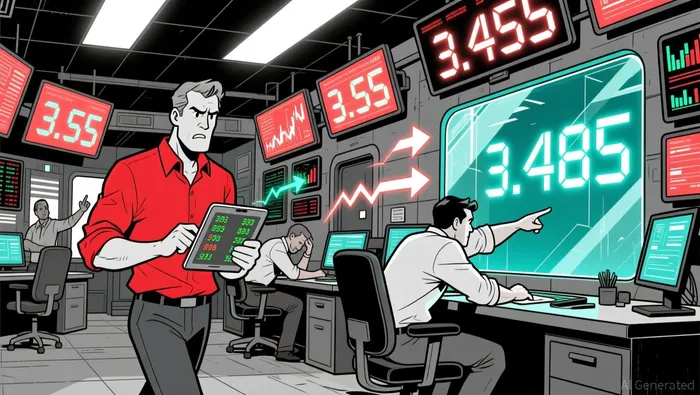
• A key support at 3.485 showed resilience, with 3.50-3.52 likely to dictate near-term direction.
Neo/Tether (NEOUSDT) opened at 3.64 on 2025-12-18 at 12:00 ET, dropped to a low of 3.443, and closed at 3.507 by 12:00 ET on 2025-12-19. The 24-hour volume was approximately 293,066.42 units, with a notional turnover of ~$841,232.
Structure & Formations
Price formed bearish engulfing patterns as it broke below 3.55 and showed rejection near 3.485. A potential 5-minute bullish reversal was observed near 3.485–3.49, but it lacked strong volume confirmation. A 61.8% Fibonacci level near 3.48–3.50 acted as a key pivot zone, with 3.475 likely the next test.
Moving Averages and Momentum
NEOUSDT closed below its 20- and 50-period 5-minute moving averages, indicating short-term bearish bias. The 50-period daily MA appears to be in consolidation mode, while RSI dipped into oversold territory, suggesting a potential near-term bounce. MACD showed bearish momentum but with a flattening histogram, hinting at a slowdown in selling pressure.
Volatility and Bollinger Bands
Volatility increased as the pair moved through a key breakdown below 3.55, pushing prices toward the lower Bollinger Band. The widening of bands confirmed the expansion in range, with price action showing a potential exhaustion at 3.485.
Volume and Turnover
Volume surged during the early morning session as the price moved below 3.50 and then again as it approached 3.485–3.49. Turnover aligned with price movement, though divergence between volume and price could hint at a short-term reversal.
The pair may test the 3.47–3.48 level for support over the next 24 hours. A break above 3.52 could trigger a short-term bounce, but risks persist if sellers reassert control below 3.48. Investors should closely monitor volume for signs of conviction.

Decoding market patterns and unlocking profitable trading strategies in the crypto space
Latest Articles
Stay ahead of the market.
Get curated U.S. market news, insights and key dates delivered to your inbox.






Comments
No comments yet