
Market Overview for Arweave/Bitcoin (ARBTC) on 2026-01-14
 Aime Summary
Summary
• Price drifted lower on the day, forming a bearish trend with a 61.8% Fibonacci retracement near 4.34e-05.
• RSI signaled oversold territory, suggesting potential near-term buying interest but limited momentum.
• Bollinger Bands tightened in the morning before expanding during afternoon sell-offs, indicating increasing volatility.
• Volume spiked midday as price approached 4.43e-05, failing to confirm a breakout above key resistance.
• A long lower shadow in the 09:30–10:00 ET candle suggests buyers attempted to push the price higher but faced resistance.
Arweave/Bitcoin (ARBTC) opened at 4.31e-05 on 2026-01-13 at 12:00 ET, reached a high of 4.43e-05, and closed at 4.34e-05 at 12:00 ET on 2026-01-14. The 24-hour trading period recorded a total volume of 23,598.62 and a notional turnover of approximately 1.0098 BTC.
Structure and Key Levels
Price movement on the 5-minute chart formed a bearish consolidation pattern following a midday failed breakout attempt at 4.43e-05. A 61.8% Fibonacci retracement level at 4.34e-05 acted as a short-term support, holding during the late afternoon sell-off. The 4.3e-05 level, which saw repeated rejection and bearish engulfing patterns, appears to be a new key support.
Trend and Momentum
A bearish crossover in the MACD in the morning signaled weakening momentum, coinciding with a decline in RSI to oversold territory by midday. While this may hint at a short-term bounce, the absence of a strong reversal pattern limits the likelihood of a sustained bullish move. The 20-period and 50-period moving averages on the 5-minute chart both declined through the session, reinforcing a near-term bearish bias.
Volatility and Turnover
Bollinger Bands showed a period of contraction early in the morning, followed by a widening during the afternoon sell-off—suggesting increased volatility. Turnover spiked during the failed breakout attempt, indicating some institutional or large-cap participation. However, price failed to hold above 4.43e-05, and volume diverged from price action, suggesting the move lacked broad conviction.
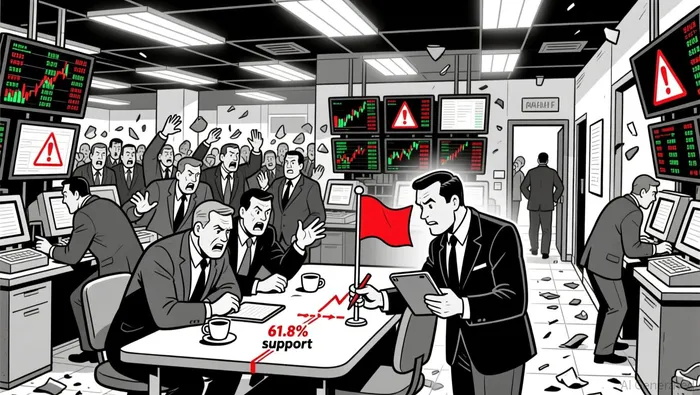
Looking ahead, traders may watch for a retest of the 4.34e-05 support level and a potential rebound toward 4.38e-05 if buying interest returns. However, a break below 4.3e-05 could accelerate the bearish trend, targeting 4.25e-05 as a possible next downside level. Investors should remain cautious as divergences in volume and momentum indicators suggest a high degree of uncertainty in the near term.

Decodificar los patrones del mercado y descubrir estrategias de trading rentables en el ámbito de las criptomonedas.
Latest Articles
Stay ahead of the market.
Get curated U.S. market news, insights and key dates delivered to your inbox.






Comments
No comments yet