
Market Holidays and Retail Seasonality: Navigating Volatility Around Thanksgiving and Black Friday


 Aime Summary
Historical Retail Sales Trends and Market Performance
Black Friday and the broader Thanksgiving weekend have long served as barometers for consumer confidence. From 2010 to 2025, U.S. retail sales during this period grew from $528.8 billion to $984.3 billion, with online sales surging from negligible figures to $10.8 billion in 2024 and projected to reach $11.7 billion in 2025. This exponential growth in e-commerce, driven by mobile commerce and AI-powered personalization, has created a direct link between retail performance and market indices. For instance, the S&P 500 rose 0.6% and the Dow Jones Industrial Average gained 0.4% in November 2024, coinciding with record-breaking Black Friday online sales.
However, the relationship between retail sales and market volatility is nuanced. While strong sales data typically boosts investor sentiment, macroeconomic headwinds-such as inflation and delayed economic data-can amplify volatility. The Cboe Volatility Index (VIX) reached its highest closing level since April 2025 amid concerns over consumer financial strain, as reflected in the University of Michigan Consumer Sentiment Index dropping to 50.3, near its 2022 low. This duality underscores the importance of contextualizing retail trends within broader economic narratives.
Stock Market Calendar and Trading Dynamics
The U.S. stock market's calendar around Thanksgiving and Black Friday introduces structural volatility. The market closes entirely on Thanksgiving Day (Thursday, November 26, 2026) and resumes trading on Black Friday with an early close at 1:00 p.m. Eastern Time. This pattern, consistent since at least 2024, creates liquidity constraints and algorithmic-driven price swings, particularly in thinly traded securities. Historical data shows that the S&P 500 has historically gained 0.5% on average during Thanksgiving week, with a 70% probability of positive returns. Yet, the reduced trading volume can exacerbate short-term volatility, as seen in 2025 when delayed retail sales reports and PPI data releases heightened uncertainty.
Retail Earnings and Behavioral Finance Insights
Retail earnings reports during the Thanksgiving-Black Friday period reveal shifting consumer behaviors and sector-specific opportunities. In 2025, off-price retailers like WalmartWMT-- and TJXTJX-- thrived amid inflationary pressures, with Walmart reporting a 4.5% rise in comparable sales and TJX raising full-year guidance. Conversely, middle- and upper-income shoppers curtailed spending at competitors like TargetTGT-- and Home Depot, leading to downward earnings revisions. These divergent outcomes highlight the role of behavioral finance: investors often overreact to short-term earnings surprises, creating mispricings that can be exploited.
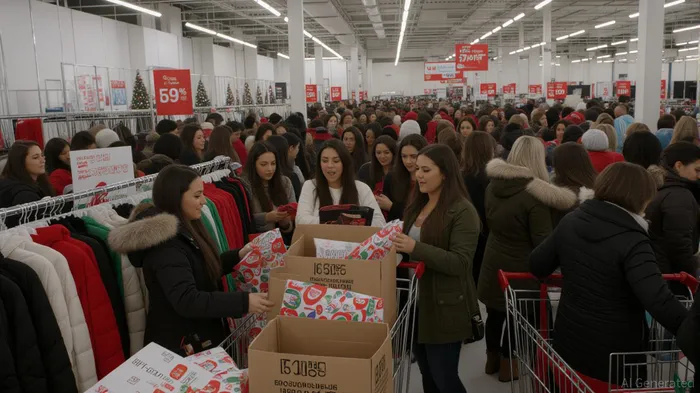
For example, Walmart's stock price surged 13% year-to-date in 2025, while Shopify's 36% gain was partly attributed to its Black Friday performance. Such movements reflect the "Santa Claus Rally" phenomenon, where positive holiday sales data sets the tone for year-end market gains. However, behavioral biases-such as anchoring to past sales figures or herd behavior around "hot" retail stocks-can distort valuations, particularly in a landscape where 69% of Black Friday purchases are made via mobile devices.
Short-Term Trading Strategies
Given these dynamics, traders should adopt strategies that balance retail seasonality with macroeconomic signals:
1. Sector Rotation: Overweight retail and e-commerce stocks (e.g., Walmart, Amazon) ahead of Black Friday, while hedging against volatility with VIX-linked options.
2. Event-Driven Plays: Capitalize on earnings surprises from retailers like Kohl'sKSS-- or Dell Technologies, which often report during the holiday period as per recent reports.
3. Volatility Arbitrage: Use the VIX's tendency to spike during delayed data releases to short-term trade volatility spreads as documented in economic analysis.
4. Sentiment Analysis: Monitor consumer sentiment indices and social media trends to anticipate shifts in spending patterns, such as the 2025 decline in average spending per person to $890.
Conclusion
The Thanksgiving-Black Friday period is a microcosm of behavioral finance principles, where retail seasonality, market structure, and investor psychology intersect. While historical trends suggest a positive bias for the S&P 500 and retail stocks, traders must remain vigilant to macroeconomic headwinds and liquidity constraints. By integrating retail sales data, earnings reports, and volatility metrics into their decision-making, investors can navigate this high-impact period with a disciplined, evidence-based approach.

Delivering real-time insights and analysis on emerging financial trends and market movements.
Latest Articles
Stay ahead of the market.
Get curated U.S. market news, insights and key dates delivered to your inbox.
AInvest
PRO
AInvest
PRO



Comments
No comments yet