
U.S. Market Holidays and Investor Behavior: How Reduced Trading Days Impact Short-Term Volatility and Strategy


 Aime Summary
Historical Performance: A Seasonal Rally Amid Holiday Closures
The Thanksgiving week has long been a bullish period for U.S. equities. Since 1928, the S&P 500 has posted positive returns approximately 60% of the time during this window, with the Wednesday before Thanksgiving and the half-day Black Friday session historically delivering the strongest gains. In 2025, this pattern held true: the S&P 500 surged 12.3%, while the Nasdaq rose 15.3% by mid-November, outpacing long-term averages. Retail stocks, such as WalmartWMT-- (WMT) and ShopifySHOP-- (SHOP), often lead the charge, as consumer spending during the Thanksgiving-to-Cyber Monday period accounts for roughly 70% of U.S. GDP and serves as a barometer for economic health.
However, the optimism isn't universal. Cyber Monday, the Monday following Thanksgiving, has historically seen the Dow Jones Industrial Average decline in two-thirds of cases, with an average drop of 0.40% over the past 25 years. This duality-positive momentum during the holiday week followed by a potential pullback-highlights the need for strategic positioning.
Volatility Dynamics: The VIX and the "Quiet" Holiday Week
While the Thanksgiving week is typically marked by modest price movements, volatility metrics like the Cboe Volatility Index (VIX) tell a more nuanced story. In November 2025, the VIX spiked to its highest closing level since April 2025, driven by concerns over the AI market bubble and anticipated Federal Reserve rate cuts. Yet, the overall market remained relatively calm during shortened sessions, with intraday swings muted by reduced liquidity. 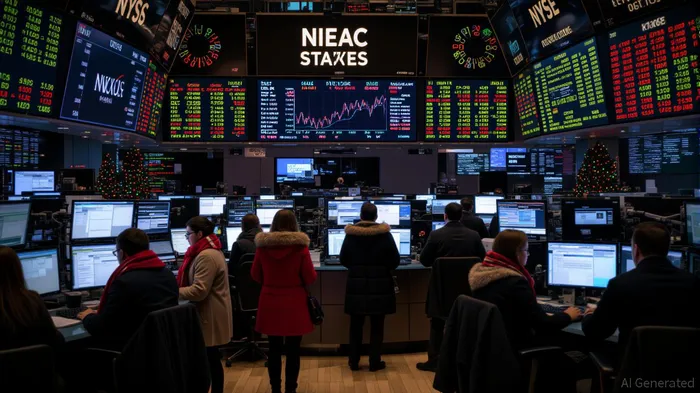 Trading volumes on Black Friday, for instance, often drop to as low as 45% of typical levels, limiting the potential for sharp price dislocations.
This environment creates a paradox: external macro risks elevate the VIX, but the holiday's structural constraints suppress volatility. For investors, this means hedging strategies must balance caution with the reality of limited market responsiveness. Traditional hedges, such as options or futures, may lose efficacy in low-volume settings, pushing traders to favor smaller position sizes or shorter-term options.
Investor Strategies: Adapting to the Holiday Rhythm
The Thanksgiving-Black Friday period demands tactical adjustments. Algorithmic traders, for example, often target Tuesdays during the holiday week, as historical data shows this day has delivered the strongest returns for the S&P 500. Retail-focused algorithms also capitalize on the surge in consumer activity, with stocks like Amazon (AMZN) and Walmart seeing average gains of 1.26% during the period.
Position sizing becomes critical in this low-liquidity environment. With slippage risks heightened, traders avoid overexposure to thinly traded names and instead focus on liquid blue-chip stocks or broad-market ETFs. Meanwhile, the shortened Black Friday session-closing at 1:00 p.m. ET-creates a "window of opportunity" for momentum plays, as late-day volatility is inherently curtailed.
Hedging, however, remains a challenge. The Federal Reserve's looming policy decisions and AI-driven market speculation introduce uncertainty, yet the holiday's structural constraints limit the effectiveness of traditional hedges. Investors often adopt a "wait-and-see" approach, deferring major adjustments until post-holiday sessions when liquidity normalizes.
The Road Ahead: From Holiday Rallies to Year-End Optimism
The Thanksgiving week's performance often sets the tone for the December "Santa Claus rally," a historical phenomenon where stocks surge on year-end optimism and portfolio rebalancing. With 2025's retail sales forecast to exceed $1 trillion-a 3.7% to 4.2% year-over-year increase-investors are primed to carry bullish sentiment into December. However, the AI-driven volatility and Fed policy risks will likely keep the VIX on edge, requiring a nuanced approach to year-end positioning.
For now, the holiday season reaffirms a timeless truth: markets are as much about psychology as they are about fundamentals. As the market closes early on Black Friday and reopens with a half-day session, investors must balance the cheer of consumer spending with the caution of macroeconomic headwinds.

Delivering real-time insights and analysis on emerging financial trends and market movements.
Latest Articles
Stay ahead of the market.
Get curated U.S. market news, insights and key dates delivered to your inbox.
AInvest
PRO
AInvest
PRO



Comments
No comments yet