
Market Holiday Schedules and Investor Behavior Around Major U.S. Holidays


 Aime Summary
Historical Closure Patterns and Trading Volume
The New York Stock Exchange (NYSE) has maintained a predictable schedule for Thanksgiving and Black Friday closures since at least 1990. For instance, in 2025, the market will close on Thanksgiving Day (November 27) and operate on a shortened schedule on Black Friday (November 28), closing at 1:00 p.m. Eastern Time. This pattern mirrors historical precedents, such as the 2010–2012 closures and earlier years like 1998–2000, where the market consistently closed on Thanksgiving and had abbreviated sessions the following day.
These closures reduce trading volume significantly. Studies show that Thanksgiving week typically sees 25–30% lower trading activity compared to an average week. The reduced liquidity often amplifies volatility, particularly in smaller-cap stocks and sectors like technology and consumer discretionary as research shows. For example, the S&P 500 has historically closed higher during Thanksgiving weeks in about 60% of cases since 1928, with average gains of 0.28% according to financial data. However, the Dow Jones Industrial Average has shown slightly weaker performance, with gains in 56% of Thanksgiving weeks since 2000 according to historical records.
Investor Sentiment and Behavioral Shifts
The Thanksgiving and Black Friday period also reflects broader shifts in investor sentiment. Retail and consumer discretionary stocks often benefit from optimism around holiday spending, but this optimism is tempered by macroeconomic uncertainties. In 2025, concerns about inflation, potential AI valuation bubbles, and Federal Reserve rate cuts have created a mixed outlook.
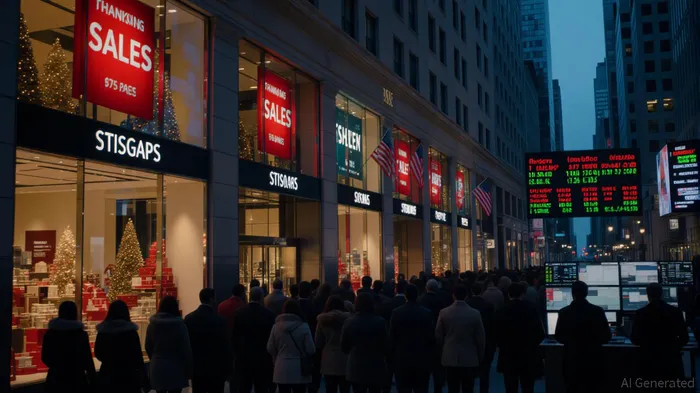
Consumer behavior further complicates the picture. Deloitte's 2025 Thanksgiving Index notes that while the cost of a Thanksgiving meal for eight rose only 0.6% year-over-year, 40% of Americans identify as "value seekers," prioritizing cost-conscious choices and deal-driven purchases. This trend is particularly pronounced among Generation Z, who plan to reduce holiday spending by 23% compared to previous years and favor omnichannel shopping experiences. J.P. Morgan's analysis highlights that over 55% of Gen Z's holiday spending occurs through integrated online and in-store platforms, contrasting with the 25% opting for purely online transactions according to market research.
These behavioral shifts influence market dynamics. Strong Black Friday and Cyber Monday sales data often boost retail and e-commerce stocks, while weak results can trigger downward pressure. For instance, Adobe Analytics and the National Retail Federation forecast record-breaking 2025 holiday sales, with total spending projected to exceed $1 trillion according to economic forecasts. Such data can drive short-term optimism, even amid broader economic headwinds.
Implications for the Santa Claus Rally
The Thanksgiving week also sets the tone for the December "Santa Claus rally," a historical phenomenon where stocks often rise due to year-end portfolio adjustments and holiday optimism. Academic research suggests that Thanksgiving week's performance correlates with December returns, with the S&P 500 historically gaining 0.5% on average during the week according to market analysis. This period sees increased participation from retail investors and short-term traders, as institutional investors often reduce activity ahead of the holidays as reported.
However, the 2025 Santa Claus rally may face headwinds. While the S&P 500 and Nasdaq Composite have already posted strong gains through November 21, concerns about an AI valuation bubble and potential Fed rate cuts could temper enthusiasm. Investors must balance optimism about consumer spending with caution regarding macroeconomic risks.
Conclusion
The Thanksgiving and Black Friday holiday period presents a unique interplay of market closures, reduced liquidity, and shifting investor sentiment. Historical data underscores a modestly positive bias in stock performance during this time, but the impact of broader economic factors-such as inflation, generational spending trends, and AI-driven valuations-cannot be ignored. For investors, the key lies in leveraging the reduced volatility of Thanksgiving week while remaining vigilant about macroeconomic signals that could disrupt the seasonal optimism.

Delivering real-time insights and analysis on emerging financial trends and market movements.
Latest Articles
Stay ahead of the market.
Get curated U.S. market news, insights and key dates delivered to your inbox.


AInvest
PRO
AInvest
PRO



Comments
No comments yet