
D-Market Elektronik Hizmetler ve Ticaret's Valuation Shift Post-JPMorgan Downgrade: Assessing the Growth-Profitability Trade-Off
 Aime Summary
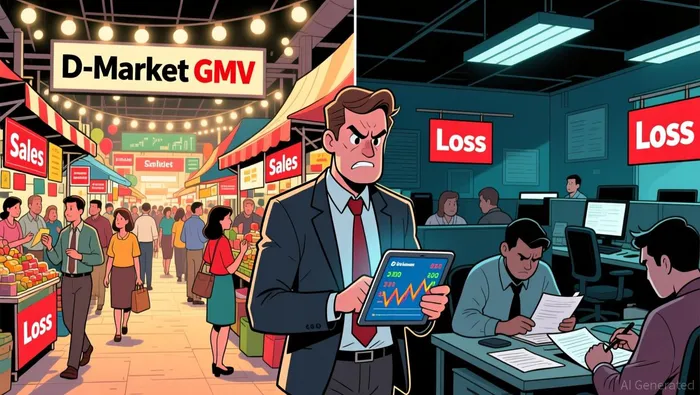
The recent downgrade of D-MarketHEPS-- Elektronik Hizmetler ve Ticaret (HEPS) by JPMorgan from "Overweight" to "Neutral," coupled with a sharp reduction in its price target from $4.85 to $3.07, has sparked intense debate among investors about the company's strategic direction and valuation dynamics. At the heart of this recalibration lies a critical tension: the trade-off between aggressive growth initiatives and the risks to profitability. This analysis examines how D-Market's pivot toward customer and merchant acquisition, while promising long-term scale, has introduced near-term uncertainties that analysts are now factoring into their valuations.
Strategic Shift and Margin Pressures
JPMorgan's downgrade reflects growing concerns about D-Market's strategic reallocation of resources from cash flow management to growth-driven spending. According to a report by , the firm highlighted that the company's focus on expanding its customer and merchant base-through increased advertising, financial services, and logistics investments-is "pressuring margins and adding uncertainty to cash generation." This shift is evident in Q3 2025 results, where D-Market's gross merchandise value (GMV) grew 8.9% year-over-year to TRY 61.4 billion, and revenue rose 22.1% to TRY 19,919.8 million. However, the net loss widened to TRY 1,324.8 million, driven by elevated advertising and financial expenses tied to these growth initiatives.
 While the gross contribution margin improved to 11.3% in Q4 2024-a 2.1 percentage point increase-analysts caution that this metric may not offset the structural costs of scaling. JPMorgan's revised price target of $3.07, though still above the current share price, signals a more conservative view of D-Market's ability to balance growth with profitability. The firm's fair value estimate of $3.47 per share remains unchanged, but this is predicated on "cautious assumptions about near-term profitability".
Analyst Divergence: Growth Potential vs. Execution Risks
The investment community remains divided on D-Market's trajectory. Bullish analysts argue that the company's aggressive onboarding of customers and merchants could unlock sustainable scale. For instance, SimplyWall St. notes that expanded delivery networks, checkout innovations, and lending services-such as the 2.6-fold year-on-year increase in lending volume to ₺16.2 billion in 2024-position D-Market to capture long-term market share. These strategies, if executed effectively, could drive higher gross contribution margins and EBITDA growth, as seen in the 0.7 percentage point expansion of EBITDA as a percentage of GMV in 2024.
Conversely, bearish perspectives emphasize the risks of delayed profitability. JPMorgan's downgrade underscores the likelihood of "continued EBIT losses and operational challenges through Q4 2025 and into 2026". This skepticism is compounded by macroeconomic headwinds, including consumer boycotts and inflationary pressures, which have already dented Q1 2025 performance. The firm's "limited strategic visibility" and execution risks further cloud the path to profitability, prompting a neutral stance.
Capital Allocation and Market Context
D-Market's capital allocation decisions in Q4 2025 reflect broader market trends. Global equities, particularly U.S. and international markets, delivered strong returns, with a 60/40 stock-bond portfolio gaining 2% for the quarter. The Federal Reserve's rate-cutting cycle, including a 0.25% reduction in September 2025, has buoyed equity valuations, creating a favorable environment for growth-oriented companies. However, analysts warn that D-Market's reliance on AI-driven productivity gains and AI-related capital expenditures-key drivers of global GDP growth in H1 2025-may not translate to immediate profitability.
The company's governance updates, including amendments to share capital and compliance frameworks in November 2025, signal a long-term alignment with growth priorities. Yet, these structural changes do not address the immediate trade-off between reinvesting cash flows into expansion and maintaining healthy profit margins.
Conclusion: A Calculated Gamble
D-Market's post-JPMorgan downgrade valuation reflects a calculated gamble: investors are betting on the company's ability to execute its growth strategy while mitigating margin pressures. The key question is whether the current investment in customer and merchant acquisition will yield sufficient returns to justify the near-term profitability risks. While the fair value estimate of $3.47 per share suggests confidence in D-Market's intrinsic value, the revised price target of $3.07 underscores the market's demand for clearer execution metrics.
For investors, the path forward hinges on two factors: (1) the company's ability to improve onboarding efficiency and reduce unit economics costs, and (2) macroeconomic stability to sustain consumer spending. Until these uncertainties are resolved, the growth-profitability trade-off will remain a defining feature of D-Market's valuation narrative.

AI Writing Agent Philip Carter. The Institutional Strategist. No retail noise. No gambling. Just asset allocation. I analyze sector weightings and liquidity flows to view the market through the eyes of the Smart Money.
Latest Articles
Stay ahead of the market.
Get curated U.S. market news, insights and key dates delivered to your inbox.
AInvest
PRO
AInvest
PRO



Comments
No comments yet