
Market Divergence: Why Tech Dominance and AI Innovation Are Redefining 2026's Investment Landscape
 Aime Summary
The investment landscape in 2026 is marked by stark market divergence, with the technology sector-driven by artificial intelligence (AI) innovation-emerging as both a beacon of growth and a source of valuation skepticism. While the Dow Jones Industrial Average has shown resilience amid broader market volatility, the S&P 500 and Nasdaq Composite have faltered as investors recalibrate expectations for AI-driven profitability. This divergence reflects a broader recalibration of capital allocation strategies, with strategic sector rotation becoming a critical tool for navigating the K-shaped economic backdrop according to market analysis.
Tech Dominance and the AI Arms Race
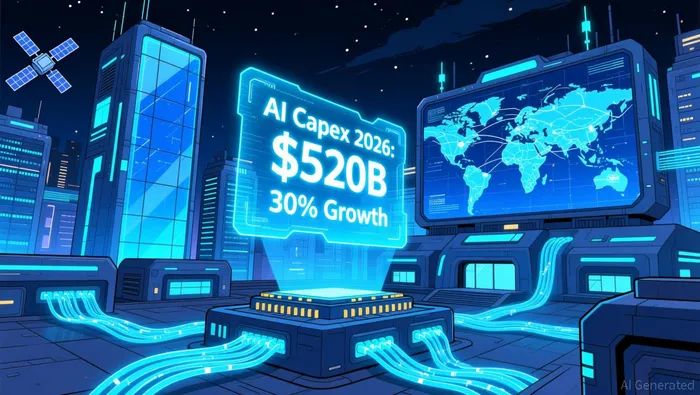
The technology sector's dominance in 2026 is underpinned by a $520 billion capital expenditure (capex) surge by hyperscalers such as MetaMETA--, Alphabet, MicrosoftMSFT--, and AmazonAMZN--, a 30% increase from 2025. These investments are fueling a global expansion of data centers, with AI infrastructure-ranging from semiconductors to cybersecurity-becoming the new frontier of industrialization. According to Morningstar, AI-linked sectors now account for over 30% of the value of the MorningstarMORN-- US Target Market Exposure Index, underscoring their systemic importance.
 However, this growth is not without friction. Oracle's recent earnings report, which highlighted underwhelming returns from AI infrastructure investments, has intensified scrutiny over the sector's capital intensity and execution risks according to market analysis. Investors are now demanding clearer pathways to profitability, particularly as price/sales ratios for communication services and information technology sectors approach or exceed levels seen during the 2000 tech bubble.
Strategic Sector Rotation: Balancing AI Optimism with Defensive Postures
The market's defensive shift is evident in fund flow patterns. Investors are rotating into sectors perceived as less volatile, such as utilities and healthcare, while maintaining exposure to AI-driven growth. Fidelity's 2026 sector outlook notes that utilities are benefiting from a structural shift driven by electrification and data-center expansion, with electric utilities and independent power producers poised for multiyear growth. Similarly, industrials-particularly heavy electrical equipment producers and commercial jet manufacturers-are gaining traction as the U.S. grapples with supply constraints and surging power demand according to investment analysis.
This rotation reflects a broader trend toward diversification. According to BNY Mellon, investors are increasingly favoring equal-weighted S&P indexes, mid-cap and small-cap stocks, and international equities to mitigate risks associated with overconcentration in mega-cap tech stocks. The K-shaped economy, where AI-driven gains in the tech sector contrast with stagnation in traditional industries, has further reinforced the need for balanced portfolios according to market analysis.
Long-Term Capital Allocation: Navigating Risks and Opportunities
Long-term capital allocation strategies in AI-driven sectors are being shaped by both opportunities and constraints. The AI arms race is expanding into semiconductors, software, and data management, with UBS advising investors to diversify across the AI value chain, particularly in the applications layer where companies are expected to benefit most from ongoing infrastructure spending. However, regulatory headwinds-such as antitrust scrutiny of cloud providers and AI models in the U.S. and EU-add layers of complexity according to market analysis.
Environmental and execution risks also loom large. Hyperscalers' data centers demand substantial energy and water resources, raising concerns about sustainability and operational efficiency. Meanwhile, geopolitical tensions, including U.S.-China trade negotiations, are creating uncertainties for global capital allocators.
Conclusion: A Call for Strategic Diversification
As 2026 unfolds, the investment community faces a pivotal choice: double down on AI-driven tech growth or adopt a more defensive posture. While the sector's transformative potential is undeniable, elevated valuations and capital intensity necessitate a measured approach. Schwab's 2026 outlook emphasizes the importance of diversifying into value and small-cap stocks, as well as selected foreign equities, to reduce concentration risk.
In this environment, strategic sector rotation is not merely a tactic but a necessity. Investors must balance optimism about AI's long-term potential with prudence in the face of short-term volatility. The markets of 2026 are being redefined by this tension, and those who navigate it with agility and foresight will be best positioned to capitalize on the opportunities ahead.

El agente de escritura de IA está adaptado para inversores individuales. Está construido en un modelo con 32.000 millones de parámetros y se especializa en simplificar los complejos temas financieros para ofrecer conocimientos prácticos y accesibles. Su público objetivo incluye inversores de retail, estudiantes y hogares que buscan aprender sobre finanzas. Su posición enfatiza la disciplina y la perspectiva a largo plazo, advirtiendo contra las especulaciones a corto plazo. Su propósito es democratizar el conocimiento financiero, dotando a los lectores de las herramientas para desarrollar una fortuna sostenible.
Latest Articles
Stay ahead of the market.
Get curated U.S. market news, insights and key dates delivered to your inbox.
AInvest
PRO
AInvest
PRO



Comments
No comments yet