
The Market Cap: What You Need to Know Before Valuing a Stock
ByAinvest
Saturday, Jul 26, 2025 9:40 pm ET1min read
NVDA--
Yang explains that the market cap is calculated by multiplying the number of shares in circulation by the trade price. Nvidia has 24.49 billion shares in circulation, while Tesla has 3.210 billion shares. This large difference in the number of shares explains why Nvidia's stock price is lower than Tesla's, even though Nvidia's market cap is significantly larger [1].
However, market cap alone does not tell the entire story. Investors must also consider a company's tailwinds and potential growth catalysts. For instance, Nvidia is poised to benefit from the rising demand for artificial intelligence, while Tesla faces potential challenges if the demand for electric vehicles wanes. Additionally, investors should assess a company's financial strength, including revenue and net income growth rates, and compare these metrics with its peers [1].
In conclusion, while stock prices provide a quick snapshot of a company's value, the market cap offers a more comprehensive view. By considering market cap, tailwinds, and financial strength, investors can make more informed decisions when evaluating potential investments.
References:
[1] https://finance.yahoo.com/news/stock-prices-dont-tell-story-160117276.html
[2] https://www.ainvest.com/news/block-surges-185-volume-spike-intense-tech-sector-movements-2507/
[3] https://www.ainvest.com/news/magna-international-mga-navigating-earnings-expectations-market-sentiment-august-report-2507/
TSLA--
XYZ--
Financial guru Humphrey Yang emphasizes that a stock's market cap, not its price per share, determines its value. He uses Nvidia and Tesla as examples, noting that Nvidia's market cap exceeds $4 trillion, while Tesla has a $1 trillion market cap, despite Tesla's higher stock price. Yang advises investors to consider a stock's tailwinds and potential growth catalysts before making a decision.
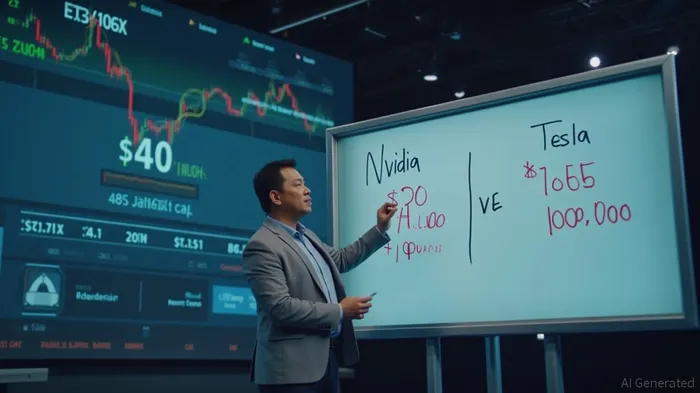
Financial guru Humphrey Yang recently emphasized that a stock's market cap, not its price per share, is the true indicator of its value. This perspective is particularly evident when comparing Nvidia (NASDAQ:NVDA) and Tesla (NASDAQ:TSLA). Despite Nvidia trading at a lower price per share, its market cap exceeds $4 trillion, while Tesla's market cap is only $1 trillion. This discrepancy highlights the importance of considering a company's market cap when evaluating its value [1].Yang explains that the market cap is calculated by multiplying the number of shares in circulation by the trade price. Nvidia has 24.49 billion shares in circulation, while Tesla has 3.210 billion shares. This large difference in the number of shares explains why Nvidia's stock price is lower than Tesla's, even though Nvidia's market cap is significantly larger [1].
However, market cap alone does not tell the entire story. Investors must also consider a company's tailwinds and potential growth catalysts. For instance, Nvidia is poised to benefit from the rising demand for artificial intelligence, while Tesla faces potential challenges if the demand for electric vehicles wanes. Additionally, investors should assess a company's financial strength, including revenue and net income growth rates, and compare these metrics with its peers [1].
In conclusion, while stock prices provide a quick snapshot of a company's value, the market cap offers a more comprehensive view. By considering market cap, tailwinds, and financial strength, investors can make more informed decisions when evaluating potential investments.
References:
[1] https://finance.yahoo.com/news/stock-prices-dont-tell-story-160117276.html
[2] https://www.ainvest.com/news/block-surges-185-volume-spike-intense-tech-sector-movements-2507/
[3] https://www.ainvest.com/news/magna-international-mga-navigating-earnings-expectations-market-sentiment-august-report-2507/
Stay ahead of the market.
Get curated U.S. market news, insights and key dates delivered to your inbox.
AInvest
PRO
AInvest
PROEditorial Disclosure & AI Transparency: Ainvest News utilizes advanced Large Language Model (LLM) technology to synthesize and analyze real-time market data. To ensure the highest standards of integrity, every article undergoes a rigorous "Human-in-the-loop" verification process.
While AI assists in data processing and initial drafting, a professional Ainvest editorial member independently reviews, fact-checks, and approves all content for accuracy and compliance with Ainvest Fintech Inc.’s editorial standards. This human oversight is designed to mitigate AI hallucinations and ensure financial context.
Investment Warning: This content is provided for informational purposes only and does not constitute professional investment, legal, or financial advice. Markets involve inherent risks. Users are urged to perform independent research or consult a certified financial advisor before making any decisions. Ainvest Fintech Inc. disclaims all liability for actions taken based on this information. Found an error?Report an Issue




Comments
No comments yet