
The Market Says 15% Chance of a US Invasion of Iran. The War Is Already 5 Months Old.
 Aime Summary
The US and Iran have been trading fire since February. A tanker just got hit in the Strait of Hormuz. US embassies are telling Americans to leave. And yet Polymarket prices a full-scale invasion at just 15.5 cents -- a 5.4x payout if you think this conflict has further to escalate. Here's the bet the crowd may be underestimating.
The US-Iran conflict, which began with airstrikes in February 2026, has now stretched into its sixth month with no end in sight. What started as a limited campaign has metastasized into a blockade of the Strait of Hormuz, repeated strikes on shipping, and a pattern of ceasefire announcements that collapse within days. The question on Polymarket's biggest geopolitical market -- "Will the U.S. invade Iran before 2027?" -- has attracted over $56 million in volume, making it one of the platform's most-traded events of the year. At 15.5c for "Yes," the crowd is betting that the current conflict stays where it is: airstrikes and naval pressure, not a ground invasion.
That 15.5c price implies a lot of confidence that the war stays limited. But the last week alone has thrown up a series of signals that cut the other way. On July 31, the Wall Street Journal reported that President Trump had ordered a new military offensive against Iran that could begin "as early as this weekend." By August 2, CNBC reported Trump had called off a planned attack after reaching an "outline of a deal." Then on August 4, Reuters covered a tanker struck in the Strait of Hormuz, with Trump claiming talks were "going on right now" while Iran flatly denied any negotiations were taking place. Hours later, Trump hinted at an "unutilized" military option -- a phrase that, in context, read like a ground invasion being kept on the table.
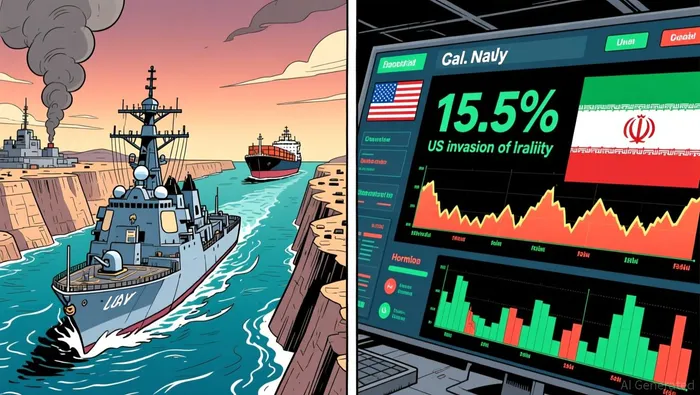
The whiplash is the point. The market has been volatile -- Yes briefly touched 24.5c in late July after the offensive order was reported -- but it's settled back down to 15.5c as the diplomatic track reasserted itself. The question is whether that re-pricing is right, or whether the market is treating every ceasefire announcement as permanent when the pattern has been the opposite.
Here's the case for the long shot. The US has already committed to this conflict in a way that would have seemed unthinkable a year ago: a naval blockade, repeated airstrikes on Iranian infrastructure, and a reported willingness to escalate. Pakistani intelligence officials told dpa they fear Trump may order a ground offensive -- a view shared by analysts who see the administration's "last chance" framing as a setup for a larger operation. The US embassy in Baghdad warned Americans to leave the region, a standard pre-de-escalation step that also happens to be a standard pre-escalation one. The Strait of Hormuz shipping disruptions are already creating global economic pressure that invites a decisive move.
The counterargument is real. Iran's leadership has shown no interest in capitulating, as Business Standard's analysis of Iranian strategy lays out: Tehran reads US urgency as leverage and plays for time. A ground invasion of Iran would be a massive undertaking -- a country of 88 million with rugged terrain and a history of grinding foreign powers down. Forbes military analysts are deeply skeptical of Iran's ability to launch its own ground offensives, but the reverse is also true: a US invasion would be costly, unpopular, and unpredictable. Trump has repeatedly threatened large operations only to pull back at the last moment.
The math on the trade: $100 at 15.5c buys about 645 shares. If Yes resolves, that's $645 back -- a $545 profit, or roughly 5.4x. If No, the stake goes to zero. The resolution date is December 31, 2026, so there are about five months left for the situation to play out. That's a lot of time for the current pattern -- escalate, threaten, negotiate, repeat -- to break one way or the other.
The smartest way to think about this market is not as a prediction of the future, but as a disagreement about a pattern. The crowd sees a president who threatens and backs down. The contrarian case says the pattern changes when the status quo the US is currently fighting -- an Iranian nuclear program on an accelerated timeline, a blockade that hurts global energy markets, and a defiant Tehran that won't negotiate -- becomes unsustainable. One of those readings is wrong, and the gap between them is the trade.
Open this market on Polymarket ->
Summary
The US-Iran conflict is five months old but Polymarket's "Will the U.S. invade Iran before 2027?" market prices a full-scale invasion at just 15.5c. Between a new offensive order, a canceled attack, contradictory talk of negotiations, and a ship hit in the Strait of Hormuz -- all within the past week -- the market's calm may be mispricing the probability of escalation. The 5.4x payout reflects a real risk, not a sure thing, and the five-month window leaves room for the situation to shift. This is a trade idea, not financial advice. Prediction markets carry risk, and odds change.
_43ca838f1775813865579.png?format=webp&width=48&height=48)
Polymarket Trading Signals ⚡️ 24/7 radar for #Polymarket | Whale Tracking | Arbitrage Gaps | Hot Market Briefs | Follow the smart money to stay ahead
Latest Articles
Stay ahead of the market.
Get curated U.S. market news, insights and key dates delivered to your inbox.


AInvest
PRO
AInvest
PRO




Comments
No comments yet