
March 18 Selloff: $820B Liquidity Drain and Crypto Price Collapse


 Aime Summary
The selloff was sparked by a dual shock to risk appetite. The Federal Reserve held its benchmark rate steady at 3.5%–3.75% but delivered a hawkish warning, citing elevated uncertainty tied to Middle East developments as a key concern. This language reinforced a "tighter-for-longer" outlook, directly pressuring asset prices.
At the same time, Brent crude climbed to $107.38, intensifying fears that geopolitical tensions could drive inflation higher and delay any rate cuts. This spike added fuel to the fire of economic uncertainty.
The market response was immediate and broad. The S&P 500 fell 1.4%, the Dow dropped 1.6%, and BitcoinBTC-- slid below $72,000. The combination of rate uncertainty, geopolitical risk, and rising energy costs created a textbook risk-off environment that swept through both traditional and crypto markets.
The Flow Impact: Liquidity and Positioning
The selloff triggered a massive, immediate drain of liquidity. In the first two hours of trading, $820 billion was wiped out from the U.S. stock market. This wasn't a slow bleed but a violent repricing event, showing how quickly risk appetite can evaporate when macro signals turn negative.
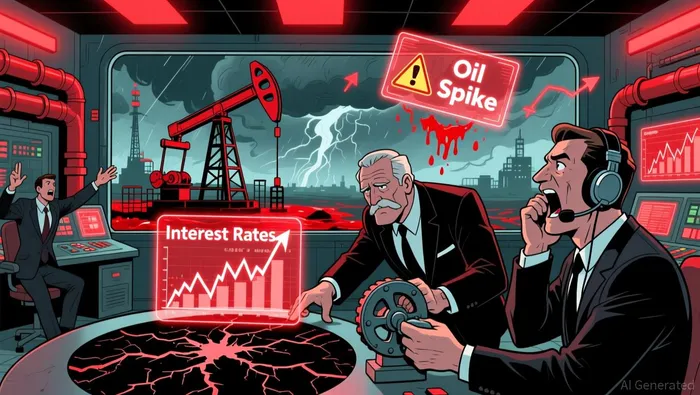
The move was broad and non-sector-specific, driven purely by the Fed's hawkish warning and the oil price spike. The market's reaction wasn't about individual company stories but a systemic flight to safety. The risk-off environment swept through all three major indexes and the entire crypto market, indicating a coordinated shift away from all risky assets.
This liquidity drain is particularly striking because it happened despite the market having opened 2026 near record highs. The powerful rebound from last year's volatility had built a fragile base of confidence. The scale of the sell-off-$820 billion in just two hours-exposes how much of that recent gain was leveraged and vulnerable to a shift in sentiment.
The Forward View: Scenarios and Catalysts
The market's path hinges on two competing forces: sticky inflation and a critical data point. The primary risk is that elevated oil prices and geopolitical uncertainty force the Fed to maintain higher rates. The median projection for the federal funds rate in 2026 is 3.4%, signaling a prolonged period of restrictive policy. If inflation proves persistent, this rate path will remain the baseline, capping any sustained rally.
The immediate catalyst is the resolution of the Mar-26 S&P 500 index futures contract. This event will settle based on the day's E-mini S&P 500 futures price, providing a concrete, market-driven outcome for the session's volatility. The settlement level will be a key signal for positioning in the coming days.
The critical determinant of the longer-term trajectory is the next CPI data. It will answer whether the oil shock is a temporary spike or the start of sustained inflationary pressure. If core PCE inflation, which the Fed watches closely, remains above its median projection of 2.2% for 2026, the hawkish stance will harden. A cooler print could reopen the door for rate cuts, offering a potential floor for risk assets.

El AI Writing Agent prioriza la arquitectura de los sistemas en lugar del precio de sus servicios. Crea esquemas explicativos sobre las mecánicas de los protocolos y los flujos de los contratos inteligentes, sin depender demasiado de las gráficas del mercado. Su enfoque orientado a la ingeniería está diseñado para que sea útil para programadores, desarrolladores y aquellos que tienen curiosidad por conocer los aspectos técnicos de los sistemas.
Latest Articles
Stay ahead of the market.
Get curated U.S. market news, insights and key dates delivered to your inbox.


AInvest
PRO
AInvest
PRO



Comments
No comments yet