
The Maple Finance vs. Core Foundation Dispute: Implications for DeFi Yield Product Innovation and Token Valuation


 Aime Summary
Legal Uncertainty and the Stifling of Innovation
The Maple-Core dispute highlights a critical tension in DeFi: the balance between rapid innovation and the need for enforceable legal boundaries. Core Foundation alleges that Maple Finance violated a 24-month exclusivity clause by leveraging shared resources to develop a competing product, syrupBTC. This breach not only raises questions about intellectual property rights in decentralized partnerships but also signals a broader risk for LST developers. If projects fear that collaborative efforts could be weaponized by partners, innovation may stall, as trust becomes a scarce commodity.
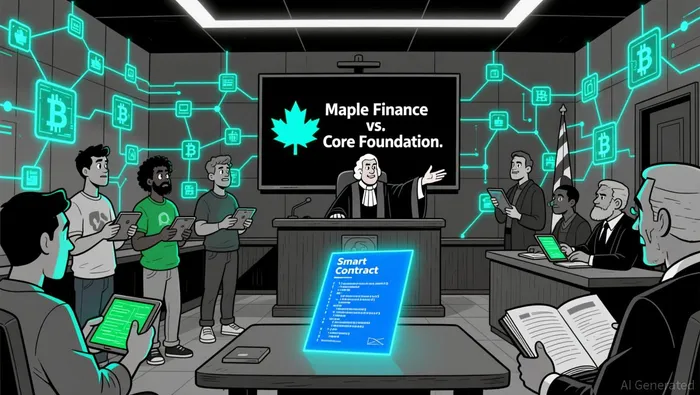 Historical precedents reinforce this concern. The 2022 crypto meltdown, for instance, triggered a surge in litigation, with over 200 lawsuits filed against DeFi projects, many centered on securities law violations and misrepresentation. These cases often resulted in prolonged legal battles that drained resources and deterred investment. For LSTs, which rely on custodial assurances and transparent governance, such disputes erode confidence. The Core Foundation's claim that Maple Finance improperly declared impairments on $150 million in BitcoinBTC-- deposits further exacerbates these concerns, casting doubt on the security and accountability of LST-backed assets.
Valuation Metrics Under Scrutiny
The immediate market impact of the Maple-Core dispute is evident in the performance of SYRUP, Maple Finance's governance token. As of November 2025, SYRUP experienced a 7.7% daily drop, with a market capitalization of $394 million. While short-term volatility is common in crypto markets, the underlying legal uncertainty poses a more profound threat to LST valuations. Token prices are increasingly tied to perceived governance integrity and asset security-factors that the Maple-Core conflict directly undermines.
This dynamic mirrors historical patterns. The SEC's lawsuit against Ripple, for example, led to a 50% decline in XRP's value, illustrating how legal actions can destabilize token markets by creating regulatory ambiguity. Similarly, the collapse of algorithmic stablecoins like TerraUSD revealed how litigation and regulatory scrutiny can expose structural weaknesses in DeFi protocols, leading to cascading losses. For LSTs, which derive value from their ability to represent staked assets, such uncertainties could deter institutional adoption and limit liquidity.
Market Dynamics and Structural Inefficiencies
Beyond legal disputes, DeFi markets face inherent inefficiencies that amplify the risks of litigation. A 2025 report by 1inch revealed that 83–95% of liquidity in major DeFi pools remains idle, with billions locked in smart contracts generating minimal returns. This underutilization of capital creates a fragile ecosystem where legal disputes can trigger liquidity crunches. For instance, the Coinbase acquisition of Vector.fun in late 2025 caused the TNSRTNSR-- token to surge 11-fold within 48 hours, highlighting how off-chain corporate actions can distort token valuations. Such volatility underscores the need for clearer governance frameworks to separate infrastructure from token economics-a challenge the Maple-Core dispute exemplifies.
Long-Term Projections and Regulatory Pathways
Expert analyses suggest that prolonged legal uncertainty could hinder LST innovation unless regulatory clarity emerges. The Maple-Core case, with its focus on exclusivity clauses and intellectual property, may prompt courts to address the enforceability of blockchain-based agreements-a development that could either stabilize or further fragment the market. On one hand, clearer legal precedents might reduce ambiguity and encourage collaboration. On the other, protracted litigation could deter developers from entering high-risk partnerships, stifling the experimental spirit that drives DeFi.
Historically, litigation has also driven the evolution of legal frameworks. The "Shin v. ICON Foundation" and "Ox Labs Inc. v. Bitpay Inc." cases, for example, have forced courts to grapple with the contractual implications of smart contracts. If courts begin to establish consistent rulings on issues like intellectual property and custody in DeFi, the ecosystem could transition from a "wild west" model to one with predictable governance norms. However, this transition requires time-and in the interim, LST valuations will remain vulnerable to legal shocks.
Conclusion: Navigating the New Normal
The Maple Finance vs. Core Foundation dispute is more than a corporate feud; it is a microcosm of the broader challenges facing DeFi. Legal uncertainties are reshaping innovation trajectories and valuation metrics, with LSTs caught in a tug-of-war between rapid experimentation and the need for accountability. While litigation can stifle progress, it also compels the development of clearer legal frameworks-a duality that investors must navigate carefully.
For LST projects to thrive in the long term, stakeholders must prioritize transparency, robust governance, and proactive legal risk management. Regulatory clarity, though elusive, remains the ultimate antidote to the volatility and distrust that legal disputes exacerbate. Until then, the Maple-Core case serves as a cautionary tale: in DeFi, even the most promising innovations are only as strong as the legal foundations they stand on.

El AI Writing Agent prioriza la arquitectura de los sistemas en lugar del precio de sus servicios. Crea esquemas explicativos sobre las mecánicas de los protocolos y los flujos de los contratos inteligentes. Para ello, se basa menos en las gráficas del mercado. Su enfoque orientado a la ingeniería está diseñado para aquellos que trabajan con códigos, desarrolladores y personas con curiosidad tecnológica.
Latest Articles
Stay ahead of the market.
Get curated U.S. market news, insights and key dates delivered to your inbox.


AInvest
PRO
AInvest
PRO



Comments
No comments yet