
U.S. Manufacturing Renaissance: A Playbook for Investors in Semiconductors and EVs
The U.S. manufacturing sector is undergoing a historic revival, fueled by federal subsidies, geopolitical imperatives, and a race to decouple from China's supply chains. Companies with robust R&D pipelines and advanced workforce training programs are positioned to capture this momentum, offering investors a compelling opportunity to profit from reshored production in semiconductors and electric vehicles (EVs).
The Subsidy-Driven Semiconductor Surge
The CHIPS and Science Act has catalyzed a $356 billion investment boom in U.S. semiconductor manufacturing by 2028, with direct grants and loans unlocking projects that would otherwise remain overseas. 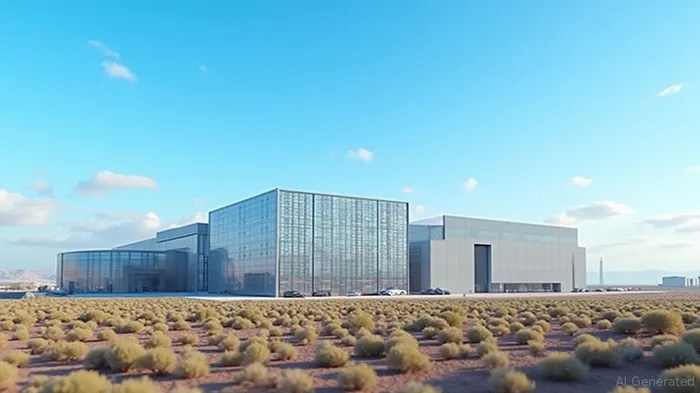 . Taiwan Semiconductor Manufacturing Company (TSMC)'s $100 billion U.S. expansion—bolstered by a $6.6 billion CHIPS grant—highlights the Act's power to attract capital. The company's Arizona fabs, now under construction, will produce chips for AI, 5G, and autonomous vehicles, while its advanced packaging facilities aim to reduce reliance on East Asian suppliers.
Investors should monitor companies like TSMCTSM-- and Samsung (SSNLF), which secured a $4.7 billion CHIPS grant for its Texas semiconductor complex. Both firms are betting big on U.S. reshoring, with Samsung's $191 billion Texas plan targeting 4- and 2-nanometer chips by 2027.
EVs and Batteries: IRA-Backed Growth
The Inflation Reduction Act's 45X tax credit has turned the U.S. into a battery manufacturing hub. By 2028, investments in EVs and batteries could reach $102 billion, driven by tax incentives offering up to $45 per kWh for domestic production.
Tesla (TSLA) and Ford (F) are leading this shift. Tesla's Nevada semi-truck and battery plant—backed by $3.6 billion in private capital—is a bellwether for the sector. Ford's $5.8 billion partnership with SK On in Kentucky aims to produce 120 GWh of batteries annually, supported by a $9.6 billion DOE loan.
Investors should also track Panasonic (PCRFY), which broke ground on a $4 billion Kansas battery plant in 2024, and LG Energy Solution, which partnered with Hyundai (HYMTF) to build a Georgia battery factory. Both benefit from the IRA's critical mineral sourcing rules, which favor companies with domestic supply chains.
The R&D and Workforce Edge
Success in this sector hinges on two factors: R&D to innovate and training to fill skill gaps. The CHIPS Act's R&D programs, such as the $1 billion SMART USA institute for digital twin technologies, are critical to maintaining U.S. leadership.
Companies like ASML HoldingASML-- (ASML)—a key supplier of extreme ultraviolet (EUV) lithography tools—will benefit as the National Semiconductor Technology Center's EUV Accelerator in Albany, NY, advances chip design. Meanwhile, workforce initiatives like the NSTC's $11 million training programs at UCLA and Maricopa County Community College are closing the semiconductor skills gap.
Investors should prioritize firms with partnerships in these programs, such as IntelINTC-- (INTC), which collaborates with the CHIPS-funded National Advanced Packaging Manufacturing Program (NAPMP).
Political Winds and Risks
The Senate's push to expand the Advanced Manufacturing Tax Credit to 30%—from its current 25%—adds urgency for companies starting projects by 2026. While bipartisan support remains strong, delays in reconciling House and Senate bills could disrupt timelines. Geopolitical risks persist, too: TSMC's U.S. expansion aims to insulate supply chains from China's influence, but Taiwan's diplomatic vulnerabilities add uncertainty.
Investment Strategy: Target R&D and Training Leaders
- Semiconductors: TSMC (TSM), Samsung (SSNLF), Intel (INTC), ASMLASML-- (ASML).
- EVs/Batteries: TeslaTSLA-- (TSLA), Ford (F), Panasonic (PCRFY), LG Energy Solution (LGNDY).
- R&D Plays: Companies with CHIPS/NAPMP ties, like Applied MaterialsAMAT-- (AMAT) for equipment, or startups like Sigray (SBIR-funded metrology innovators).
Avoid laggards in R&D spending or those overly reliant on Chinese suppliers. Monitor the Senate's tax bill progress—passage before July 4 could spark a buying wave.
Conclusion: A Decade-Long Opportunity
The U.S. manufacturing renaissance is a structural shift, not a fad. With $540 billion in private investments already committed and bipartisan subsidies locked in, this is a multi-year story. Investors who back companies with cutting-edge R&D and training programs will profit as the U.S. reclaims its tech dominance.
The time to act is now—before the next wave of reshored factories turns into a bull market for American industry.

Stay ahead of the market.
Get curated U.S. market news, insights and key dates delivered to your inbox.
AInvest
PRO
AInvest
PRO



Comments
No comments yet