
U.S. Manufacturing Payrolls Underperform, Signaling Sector Rotation Risks: Strategic Reallocation in a Slowing Industrial Economy
 Aime Summary
The U.S. manufacturing sector, long a cornerstone of cyclical economic growth, is showing signs of structural fragility. As of November 2025, manufacturing payrolls stood at 12.70 million, a 0.57% decline from November 2024 and a marginal drop from October 2025. While these figures may seem modest, they signal a deeper shift: a sector that once drove industrial momentum is now grappling with persistent labor shortages, rising skill requirements, and a mismatch between automation-driven productivity and employment growth. For investors, this underperformance demands a reevaluation of sector positioning and hedging strategies in a macroeconomic environment increasingly defined by stagflationary pressures.
The Structural Weakness of Manufacturing
The decline in manufacturing payrolls is not a sudden collapse but a gradual erosion of momentum. Over the past year, the sector has faced a dual challenge: a 4.2% average vacancy rate in Q3 2025 (with 25% of manufacturers reporting vacancy rates above 5%) and a labor force aging at an accelerating pace. Compounding this, total compensation costs for production workers hit $46.30 per hour in Q2 2025, with benefits accounting for one-third of that total. These costs, coupled with unit labor costs rising at 2.0% annually, are squeezing margins and forcing manufacturers to prioritize automation over hiring.
The National Association of Manufacturers (NAM) underscores that structural labor shortages are no longer cyclical but entrenched. Over one-third of manufacturing executives now rank workforce skills as their top concern, a shift from traditional worries about tariffs or supply chains. This signals a long-term reallocation of capital toward robotics, AI-driven logistics, and smart manufacturing—sectors that promise efficiency but offer limited employment upside.
Infrastructure-Linked Industries: Vulnerable to the Slowdown
Infrastructure-linked industries, including construction and energy, are particularly exposed to manufacturing's slowdown. The construction sector, for instance, reported 88% of firms facing open craft worker positions in 2025, exacerbated by immigration enforcement actions that displaced 10% of workers in some firms. Tariffs on steel and aluminum have further strained margins, with material costs rising 5–10% for projects reliant on imported inputs.
The One Big Beautiful Bill Act (OBBBA) introduced incentives like the 48D Advanced Manufacturing Investment Credit, which increased to 35% for projects after December 31, 2025. While these policies aim to spur reshoring, they also highlight the sector's reliance on government support. For investors, this raises questions about the sustainability of infrastructure-linked growth in a political climate where policy shifts could abruptly alter cost structures and demand.
Healthcare: A Defensive Anchor in a Volatile Market
Amid the uncertainty, healthcare construction has emerged as a relative safe haven. The sector's Producer Price Index (PPI) rose just 0.6% year-over-year in July 2025, reflecting stable demand for essential infrastructure. Unlike data centers or semiconductors, which face volatile capital expenditures, healthcare projects are less sensitive to interest rate fluctuations and geopolitical risks.
However, healthcare is not immune to broader pressures. Labor shortages in construction—where 450,000 workers are estimated to be missing—threaten project timelines, while tariffs on materials like copper and steel add 5–10% to costs. Despite these challenges, the sector's defensive characteristics—inelastic demand, regulatory tailwinds, and a focus on long-term care—make it a compelling hedge against industrial sector volatility.
Strategic Sector Tilts and Hedging Strategies
For investors navigating this landscape, the key lies in balancing exposure to high-growth, policy-driven sectors with defensive positioning. Here's how to approach it:
- Tilt Toward Healthcare and Tech-Driven Infrastructure:
- Healthcare: Allocate to companies like HCA Healthcare (HCA) or UnitedHealth Group (UNH), which benefit from demographic-driven demand.
Tech-Linked Infrastructure: Target sub-sectors supporting AI and automation, such as industrial machinery (e.g., Caterpillar (CAT)) and energy-efficient systems (e.g., Siemens Energy (ENR1.F)).
Hedge Against Stagflation with Short-Term Treasuries and Gold:
- Short-Term Treasuries: Use ETFs like iShares 1–3 Year Treasury (SHV) to protect against rising rates.
Gold: Position in SPDR Gold Shares (GLD) to offset inflationary pressures.
Sector Rotation ETFs:
- Industrials ETFs: Consider iShares U.S. Industrial (IYJ) for exposure to resilient sub-sectors.
Healthcare ETFs: Use XLV to capitalize on defensive positioning.
Short-Selling Vulnerable Sectors:
- Target overleveraged infrastructure firms with weak balance sheets, such as Martin Marietta Materials (MLM), which faces margin compression from material tariffs.
Conclusion: Navigating the New Normal
The U.S. manufacturing payroll decline is not a temporary blip but a symptom of a sector in transition. As industrial growth shifts from labor-intensive to capital-intensive models, investors must adapt by reallocating capital to sectors with structural tailwinds—like healthcare—and hedging against macroeconomic risks. The path forward requires a disciplined approach: balancing cyclical bets on AI-driven infrastructure with defensive positioning in essential services. In a world where policy and technology drive outcomes, agility and foresight will separate resilient portfolios from those left behind.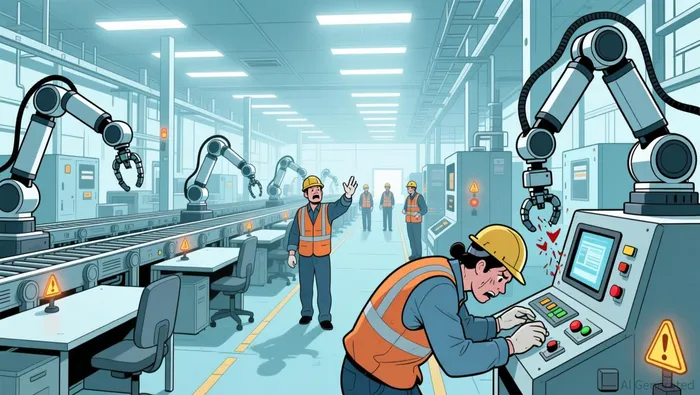

Stay ahead of the market.
Get curated U.S. market news, insights and key dates delivered to your inbox.


AInvest
PRO
AInvest
PRO



Comments
No comments yet