
U.S. Manufacturing Contraction: Sector-Specific Investment Strategies Amid Persistent Tariff Uncertainty
 Aime Summary
The U.S. manufacturing sector remains mired in contraction, with the ISM Manufacturing New Orders Index registering 47.1 in July 2025—a 0.7-point improvement from June but still well below its 12-month moving average of 48.3. This six-month streak of contraction underscores fragile demand, driven by unresolved trade policy disputes and geopolitical volatility. For investors, the challenge lies in identifying sectors poised to weather—or capitalize on—this environment while avoiding those most exposed to systemic risks.
The Sectoral Divide: Winners and Losers in a Weakening Cycle
The July ISM report highlights a stark divergence across industries. Four sectors—Apparel, Plastics & Rubber, Primary Metals, and Miscellaneous Manufacturing—reported growth in new orders, while eight, including Computer & Electronic Products and Machinery, saw declines. This divergence reflects the uneven impact of tariffs, supply chain bottlenecks, and shifting consumer priorities.
1. Plastics & Rubber: Resilience Amid Structural Weakness
Despite broader manufacturing contraction, the Plastics & Rubber sector has shown surprising resilience. In May 2025, the industry reported growth in new orders and production, though supplier deliveries slowed due to tariffs and logistical delays. However, stock prices for leading firms like LyondellBasell (LYB) and Trinseo (TSE) have plummeted by 33–40% since January 2025, outpacing the S&P 500's 7% gain. This disconnect between operational performance and market sentiment suggests overcorrection.
Investors should monitor second-quarter earnings reports for clues on cost absorption and pricing power. For now, the sector's exposure to energy and raw material prices remains a headwind, but its role in essential goods (e.g., automotive and construction) could provide a floor. A defensive play might involve ETFs like XTL, which tracks materials and industrial stocks, while hedging against currency risks for firms with heavy Asian sourcing.
2. Apparel, Leather & Allied Products: Tariff Whiplash and Pricing Pressures
The Apparel sector's performance is a case study in policy-driven volatility. While the July ISM report noted growth in new orders, the sector faces a 37% short-run price surge for apparel and 39% for shoes due to 2025 tariffs—the highest effective rates since 1934. These costs are disproportionately borne by lower-income households, dampening demand. Stock underperformance in companies like PVH (PVH) and Gildan Activewear (GIL) reflects these challenges.
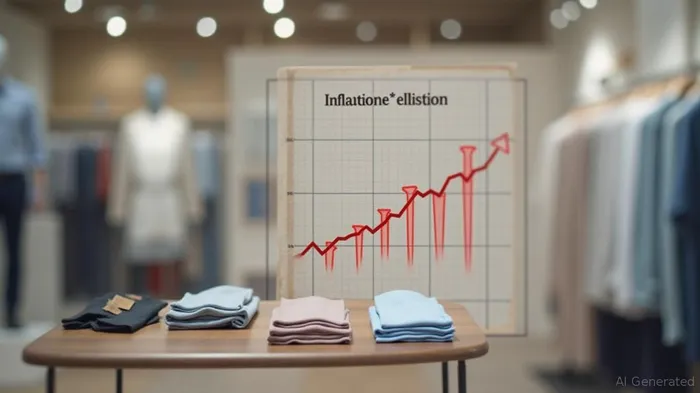
Investors should avoid overexposure to this sector unless there's clarity on tariff adjustments or a shift to nearshoring. However, niche players with diversified supply chains or vertical integration (e.g., Nike's (NKE) regional manufacturing hubs) could offer asymmetric upside if consumer demand stabilizes.
3. Primary Metals: Commodity Cycles and Geopolitical Risk
Primary Metals, another July growth sector, faces a dual threat: rising raw material costs and the risk of further tariff escalations. The May 2025 PMI for this sector contracted to 46.7, with employment and production declining. The sector's reliance on global trade—especially for rare earth materials—makes it vulnerable to U.S.-China policy shifts.
Investors should prioritize firms with low-cost production assets (e.g., CopperCorp (CCO)) or those leveraging green energy transitions (e.g., Nucor (NUE) in steel). However, the sector's high sensitivity to interest rates and trade policy means volatility will persist.
Strategic Recommendations for Navigating the Downturn
- Defensive Positioning in Resilient Sectors: Focus on industries with inelastic demand, such as Pharmaceuticals or Semiconductors, which saw minimal contraction in Q2 2025. ETFs like XLV or XLF offer diversified exposure.
- Hedge Against Currency and Tariff Risks: For sectors like Apparel and Plastics, use commodities futures or currency options to mitigate import costs.
- Monitor Policy Catalysts: The Federal Reserve's rate trajectory and potential tariff rollbacks could trigger sector rotation. Use options strategies (e.g., straddles on SPY) to capitalize on volatility.
Conclusion: Patience and Selectivity in a Fragmented Market
The U.S. manufacturing sector's contraction is far from uniform. While tariffs and trade uncertainty dominate headlines, pockets of strength—such as in Plastics & Rubber and Primary Metals—suggest opportunities for selective investors. However, the key to success lies in aligning strategies with granular sector dynamics, not just macro trends. As the ISM index inches toward a potential bottom, those who navigate the sectoral divide with precision will be best positioned to capitalize on the next phase of recovery.

Stay ahead of the market.
Get curated U.S. market news, insights and key dates delivered to your inbox.
AInvest
PRO
AInvest
PRO



Comments
No comments yet