
Manufacturing's 10-Month Slide Hits New Low as Healthcare Drives Jobs
 Aime Summary
The U.S. Markit Manufacturing for December 2025, , underscores a sector in prolonged contraction. This reading, the lowest of the year, , with only the Computer & Electronic Products industry bucking the trend. While the broader economy remains in expansion, . For investors, this signals a critical inflection point: the industrial base is weakening, while service sectors like healthcare are surging.
The Manufacturing Malaise: A Structural Shift
The PMI's subindices reveal a sector grappling with multiple headwinds. , while input costs for metals, energy, and electronics persistently rise. Panelist commentary highlights tariffs, high interest rates, and weak consumer demand as key culprits. For example, the Transportation Equipment industry reports 2026 customer orders at historically low levels, while Machinery firms describe “trough conditions” exacerbated by borrowing costs.
This environment suggests that manufacturing is not merely cyclical but structurally challenged. The sector's inability to rebound despite a 68-month overall economic expansion indicates a reallocation of capital and labor toward services. Investors must ask: Is this a temporary slowdown or a permanent shift?
Healthcare's Resilience: A New Economic Anchor
Contrast this with the healthcare services sector, . , . The Bureau of Labor Statistics notes that without healthcare, the U.S. .
This growth is driven by demographic tailwinds: an aging population demanding chronic care, rising prevalence of age-related diseases, and a shift toward home health and ambulatory services. Even as manufacturing and metals/mining sectors contract, healthcare employment continues to expand, with ambulatory services and nursing facilities leading the charge.
Metals and Mining: A Sector in Retreat
The metals and mining industry, part of the broader goods-producing sector, has fared poorly. Job losses in mining and logging, coupled with stagnant hiring in manufacturing, reflect a sector struggling with soft demand and inflationary pressures. , with only one of six major industries expanding.
For metals and mining, the outlook is further clouded by policy-driven headwinds. Tariffs on critical inputs like aluminum and steel, combined with high interest rates that dampen capital-intensive projects, have stifled growth. Meanwhile, supply chain bottlenecks persist, particularly for electronic components, which are vital to both manufacturing and healthcare sectors.
Investment Strategies: Positioning for Divergence
Given these trends, investors should adopt a sector-specific approach:
- Hedge Against Manufacturing Weakness with Healthcare Exposure
- ETFs: Consider healthcare-focused ETFs like XLV (Health Care Select Sector SPDR) or IYH (Health Technology).
- Equities: Target companies in ambulatory care (e.g., HCA Healthcare), home health (e.g., Amedisys), and medical device manufacturers (e.g., Medtronic).
Rationale: The aging population and chronic care demand ensure long-term growth, even as manufacturing struggles.
Selective Exposure to Undervalued Metals and Mining
- Value Plays: Look for undervalued miners with strong balance sheets, such as Caterpillar (industrial equipment) or Freeport-McMoRan (copper).
Rationale: While the sector remains in contraction, .
Short-Term Hedging Against Inflation
- Commodities: Gold and energy ETFs (e.g., , Energy Select Sector SPDR) can offset inflationary pressures in manufacturing.
- Rationale: Persistent input cost inflation, particularly in metals and energy, may force central banks to delay rate cuts, preserving commodity prices.
Preparing for 2026: Key Data Releases and Policy Shifts
Investors should closely monitor early 2026 data releases, including the January 2026 PMI and Q4 2025 GDP figures. A further contraction in manufacturing could accelerate policy responses, such as targeted fiscal stimulus or rate cuts. Conversely, a surprise rebound in manufacturing orders might signal a sectoral rebalancing.
Policy shifts will also be critical. The Department of Government Efficiency's impact on federal contracts and immigration policies could either exacerbate labor shortages in manufacturing or ease them. Similarly, healthcare sector pressures—such as potential Medicare reimbursement cuts—could temper its growth trajectory.
Conclusion: A Divergent Path Forward
The U.S. economy is increasingly bifurcated: a resilient healthcare sector and a struggling manufacturing base. For investors, this divergence demands a nuanced strategy. While manufacturing's challenges are structural, healthcare's growth is demographic-driven and durable. Metals and mining, meanwhile, offer speculative value but require careful timing.
As 2026 approaches, the key will be balancing long-term exposure to healthcare's tailwinds with tactical plays on potential manufacturing rebounds. The PMI, while a lagging indicator, provides a critical lens through which to view these shifts—and to position portfolios accordingly.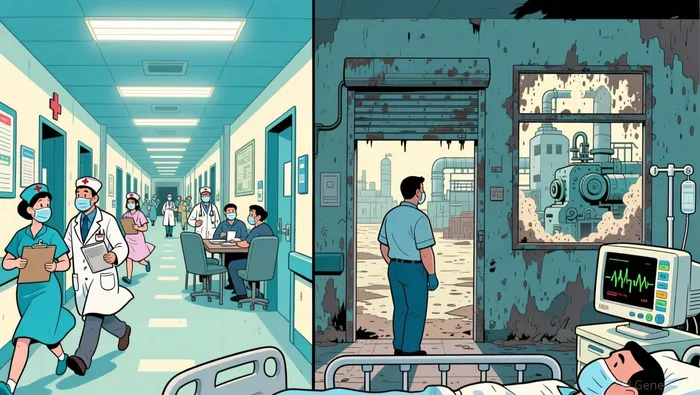

Stay ahead of the market.
Get curated U.S. market news, insights and key dates delivered to your inbox.
AInvest
PRO
AInvest
PRO



Comments
No comments yet