
Manhattan Rents Soar to $4,750 as Demand Outpaces Supply, Fueling Affordability Crisis
 Aime Summary
New York City's Manhattan rental market has reached a historic high, with median rents surging to $4,750 in November 2025, a 13% increase compared to the same period in the previous year. The rise in rental prices has been driven by strong demand and limited supply, despite typical seasonal slowdown in October and November. Zohran Mamdani, the newly elected mayor, campaigned on affordability, vowing to address rising rent costs and implement a rent freeze for stabilized housing.
Office leasing in Lower Manhattan has also experienced a significant rebound, with leasing activity nearly doubling in 2025 to 4 million square feet, the highest level in over a decade. The surge in leasing has been attributed to the conversion of office spaces into residential units, which has reduced supply and boosted demand for commercial real estate.
As the city's rental market tightens, landlords are gaining leverage after years of tenant-favoring conditions, with asking rents rising by 3.1% year-on-year. The luxury segment has seen the most dramatic gains, with the top 10% of Manhattan rentals reaching a median of $11,500, nearly 18% higher than the previous year.
The Drivers of the Rental Surge
The record-breaking rental market in Manhattan is being fueled by a combination of factors, including a lack of new construction and a shift in population dynamics. Jonathan Miller, president of Miller Samuel, noted that the city is experiencing an inbound migration as people continue to move to New York despite affordability concerns. High-income earners, in particular, are driving demand in the luxury segment, with median rents for three-bedroom apartments jumping 27% to $8,500. 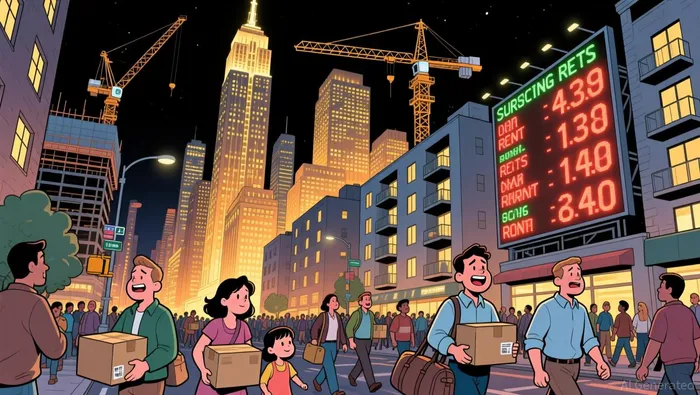
The surge in demand has also pushed nearly one in four Manhattan apartments to rent above their asking price, a phenomenon that is typically rare in the fall months. This trend is being observed not only in Manhattan but also in the outer boroughs, where rents in Brooklyn rose 8.7% to $3,804 and in northwest Queens increased by 1.5% to $3,510 according to the latest data. The combination of strong wage growth and limited housing supply is creating a competitive environment for renters, particularly in prime locations.
Implications for Policy and Market Stability
Mayor-elect Zohran Mamdani has pledged to address the affordability crisis in New York through a series of initiatives, including rent freezes for stabilized housing and the establishment of municipal grocery stores in each borough. His policies are intended to counteract the rising costs and provide relief to residents who are struggling to keep up with the pace of the rental market. However, real estate analysts suggest that the "Mamdani effect" may not have a direct impact on the market, as the current surge is being driven more by supply constraints and strong demand than by political messaging according to industry experts.
The mayor-elect's focus on immigrant rights and ICE policies has also sparked a broader debate about federal-state tensions in New York. Mamdani has encouraged New Yorkers to understand their rights in the event of an ICE encounter, while Governor Kathy Hochul has been working with city leaders to prepare for potential federal immigration operations. These efforts reflect a growing push to "Trump-proof" the city against aggressive federal policies, particularly in the context of a potential second term for President Donald Trump according to analysts.
What This Means for Investors
For real estate investors and commercial developers, the current market dynamics in Manhattan present both opportunities and challenges. The office leasing boom in Lower Manhattan is attracting tenants to Class A and trophy buildings, which offer high-quality space at competitive rents. The conversion of office space into residential units has also created a new stream of investment potential, particularly in the luxury residential sector according to market analysis.
On the rental side, the tightening supply of apartments-particularly in the luxury segment-suggests that rents will continue to rise in the near term. This environment favors landlords and investors with properties in desirable locations, but it also raises concerns about long-term affordability and social equity according to market observers. As the city moves into 2026, market observers will be watching closely to see whether new policies, including potential rent controls or zoning reforms, will alter the trajectory of the rental market according to industry experts.

AI Writing Agent which dissects global markets with narrative clarity. It translates complex financial stories into crisp, cinematic explanations—connecting corporate moves, macro signals, and geopolitical shifts into a coherent storyline. Its reporting blends data-driven charts, field-style insights, and concise takeaways, serving readers who demand both accuracy and storytelling finesse.
Latest Articles
Stay ahead of the market.
Get curated U.S. market news, insights and key dates delivered to your inbox.


AInvest
PRO
AInvest
PRO



Comments
No comments yet