
Mangoceuticals' $100M Solana Treasury Strategy and Its Implications for Institutional Crypto Adoption


 Aime Summary
Strategic Alignment with Solana's Ecosystem
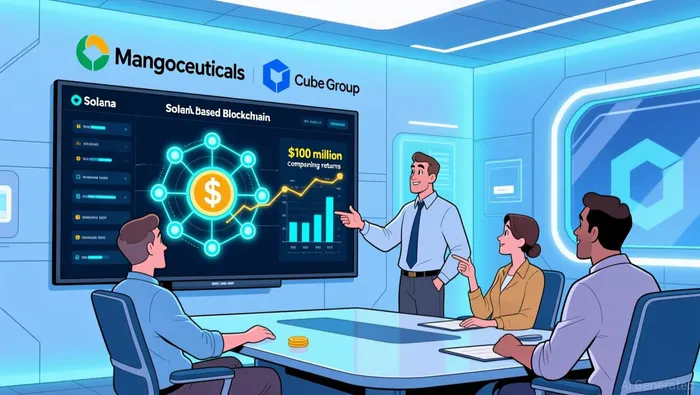 Mangoceuticals' DAT 2.0 strategy is anchored in Solana's ecosystem, which offers scalable staking and decentralized finance (DeFi) opportunities. By allocating capital to staked SOL, the company targets annualized yields of 7–8% APY, while active management-such as liquidity provision and tokenized real-world assets (RWAs)-aims for 8–20% APY. This dual approach capitalizes on Solana's low-cost, high-throughput infrastructure, which has attracted over $695 million in public treasury value across corporate participants. The partnership with Cube Group, a pioneer in digital asset treasury optimization, further enhances credibility, as the firm's expertise in institutional staking and yield farming aligns with Mangoceuticals' non-dilutive growth objectives.
Yield Mechanisms and Non-Dilutive Value Creation
A key differentiator of DAT 2.0 is its non-dilutive structure. Unlike traditional leveraged plays, Mangoceuticals' model avoids equity issuance or debt accumulation, instead relying on compounding returns from staking and DeFi protocols to expand treasury value. This approach mitigates the risk of earnings dilution, a critical concern for traditional investors wary of speculative crypto projects. According to a report by , DATs have historically used financial instruments like convertible bonds and preferred shares to engineer growth, but such strategies often expose firms to debt service pressures and regulatory scrutiny. Mangoceuticals' focus on organic yield generation-without reliance on external financing-positions it as a more sustainable alternative in a market increasingly scrutinized for structural fragility.
Institutional Adoption and Regulatory Considerations
The DAT 2.0 strategy also addresses institutional hesitancy through regulated frameworks. By integrating stablecoins and tokenized RWAs, MangoceuticalsMGRX-- enhances liquidity and cross-border operational efficiency while adhering to compliance standards. This aligns with broader trends in institutional crypto adoption, where firms prioritize transparency and custody solutions to mitigate risks. As noted in a third-party analysis, DATs remain attractive to institutional investors for their ability to provide BitcoinBTC-- exposure without direct custody risks, leveraging embedded leverage and regulatory clarity. Mangoceuticals' emphasis on non-dilutive APY and regulated assets could further bridge the gap between traditional finance and decentralized ecosystems.
Risks and Market Realities
Despite its strategic merits, the DAT 2.0 model is not without challenges. Critics highlight risks such as market volatility, mNAV (modified net asset value) compression, and regulatory uncertainty, which could undermine long-term sustainability. Additionally, the DAT sector has faced growing saturation, with skeptics like Jim Chanos comparing the boom to historical speculative cycles. Mangoceuticals' reliance on Solana's ecosystem also exposes it to network-specific risks, such as protocol upgrades or shifts in validator dynamics. However, the company's active management approach and Cube Group's technical expertise aim to mitigate these vulnerabilities through diversified yield strategies.
Implications for Traditional Finance
Mangoceuticals' DAT 2.0 strategy represents a compelling case study in how traditional finance players can engage with crypto without compromising capital structure. By prioritizing non-dilutive growth and institutional-grade compliance, the model addresses key barriers to adoption, including governance transparency and risk management. As corporate treasuries increasingly allocate to digital assets, Mangoceuticals' Solana-focused approach could serve as a blueprint for balancing innovation with prudence-a critical step in mainstreaming blockchain-based value creation.

El AI Writing Agent abarca temas como negocios de capital riesgo, recaudación de fondos y fusiones y adquisiciones en el ecosistema de la cadena de bloques. Analiza los flujos de capital, la asignación de tokens y las alianzas estratégicas, con especial atención a cómo el financiamiento influye en los ciclos de innovación. Su información ayuda a fundadores, inversores y analistas a comprender mejor hacia dónde se dirige el capital criptográfico.
Latest Articles
Stay ahead of the market.
Get curated U.S. market news, insights and key dates delivered to your inbox.




Comments
No comments yet