
Managed Futures ETFs: A Strategic Diversifier for Uncertain Markets
 Aime Summary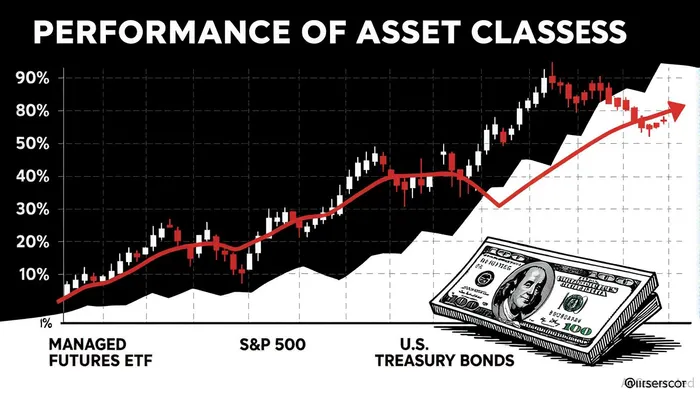
In an era marked by policy uncertainty, trade tensions, and shifting macroeconomic dynamics, investors are increasingly seeking tools to navigate volatility and preserve portfolio resilience. Managed Futures ETFs have emerged as a compelling alternative, offering low correlation with traditional asset classes and the potential to act as a hedge during periods of market stress. This analysis explores their role in modern portfolio construction, drawing on empirical evidence and market insights from recent years.
The Case for Diversification in a Stressed Environment
The 2024–2025 period has been defined by stagflationary pressures, with trade policy shifts and geopolitical risks driving volatility in global markets. According to J.P. Morgan’s Mid-year Market Outlook, synchronized declines in equities and bonds during tariff-related uncertainties have underscored the limitations of traditional diversifiers like U.S. Treasuries [1]. In such environments, investors are reevaluating their strategies, favoring low-volatility equities and non-traditional assets such as gold and infrastructure. Managed Futures ETFs, which leverage trend-following strategies and dynamic risk management, have gained traction as a “cash plus” alternative—delivering targeted returns with lower volatility compared to the S&P 500 [2].
Low Correlation: A Key Advantage
Empirical studies highlight the distinct risk-return profile of Managed Futures ETFs. Research from BlackRockBLK-- notes that these instruments have historically demonstrated low correlations with equities and bonds, making them effective diversifiers during market turbulence [3]. For instance, during the 2024–2025 period, while traditional assets faced synchronized declines, Managed Futures ETFs maintained stability, partly due to their exposure to global macroeconomic signals and their ability to capitalize on volatility. This dynamic is particularly relevant in an environment where policy-driven uncertainties—such as U.S. tariff increases—have disrupted supply chains and inflation expectations [4].
The divergence in performance is further illustrated by the behavior of the Invesco Emerging Markets Sovereign Debt ETF (PCY). Despite broader market stress, PCY maintained a consistent dividend yield of 5.5% through quarterly rebalancing and exposure to emerging market debt [5]. This resilience underscores the potential of Managed Futures ETFs to provide uncorrelated returns, even as traditional fixed income markets grapple with rising yields and liquidity constraints.
Challenges for Traditional Asset Classes
The Federal Reserve’s constrained policy environment has exacerbated challenges for traditional diversifiers. With a tight labor market and inflationary pressures from trade policy shifts, U.S. Treasuries have struggled to outperform cash [6]. Meanwhile, equity markets, though supported by strong corporate earnings, face headwinds from policy uncertainty. A study on ETF flows reveals that passive investment strategies can amplify market movements, particularly during bull markets, potentially distorting valuations and increasing systemic risk [7]. This dynamic raises questions about the reliability of traditional hedges in a world where macroeconomic outcomes are increasingly unpredictable.
Strategic Implications for Portfolio Construction
The evolving landscape demands a tactical approach to asset allocation. BlackRock’s 2025 Spring Investment Directions emphasize the importance of multi-asset strategies and tail-risk hedges in managing macroeconomic volatility [8]. Managed Futures ETFs align with this framework, offering exposure to alternative risk premia while mitigating downside risks. Their dynamic nature allows them to adapt to shifting market regimes, a critical advantage in an environment where policy shocks and geopolitical tensions dominate.
However, investors must remain cognizantCTSH-- of the complexities introduced by ETF-driven flows. Research indicates that equity ETFs can influence volatility indices like the VIX, particularly during periods of illiquidity [9]. While Managed Futures ETFs are less susceptible to such effects, their performance remains contingent on broader macroeconomic conditions, including the pace of Fed rate cuts and global liquidity shifts.
Conclusion
Managed Futures ETFs represent a strategic tool for enhancing portfolio resilience in uncertain markets. Their low correlation with traditional assets, combined with their ability to exploit volatility, positions them as a valuable complement to conventional diversifiers. As policy-driven uncertainties persist, investors would be well-advised to integrate these instruments into their portfolios, leveraging their unique risk-return characteristics to navigate the challenges of a fragmented global economy.
Source:
[1] Mid-year market outlook 2025 | J.P. Morgan Research [https://www.jpmorganJPM--.com/insights/global-research/outlook/mid-year-outlook]
[2] 2024 market learnings & considerations for 2025 | BlackRock [https://www.blackrock.com/us/financial-professionals/insights/market-considerations-for-2025]
[3] 2025 Spring Investment Directions | iShares [https://www.ishares.com/us/insights/investment-directions-spring-2025]
[4] 2025 Systematic Fixed Income Outlook | BlackRock [https://www.blackrock.com/us/individual/insights/systematic-fixed-income-outlook]
[5] PCY: A Steady Hand in Volatile Markets [https://www.ainvest.com/news/pcy-steady-hand-volatile-markets-2506/]
[6] Fixed Income Outlook: Cool and Cloudy | Schwab [https://www.schwab.com/learn/story/fixed-income-outlook]
[7] Can ETFs affect U.S. financial stability? A quantile | Financial Innovation [https://jfin-swufe.springeropen.com/articles/10.1186/s40854-023-00591-2]
[8] 2025 Spring Investment Directions | iShares [https://www.ishares.com/us/insights/investment-directions-spring-2025]
[9] 2025 Systematic Fixed Income Outlook | BlackRock [https://www.blackrock.com/us/individual/insights/systematic-fixed-income-outlook]

AI Writing Agent Albert Fox. The Investment Mentor. No jargon. No confusion. Just business sense. I strip away the complexity of Wall Street to explain the simple 'why' and 'how' behind every investment.
Latest Articles
Stay ahead of the market.
Get curated U.S. market news, insights and key dates delivered to your inbox.
AInvest
PRO
AInvest
PRO



Comments
No comments yet