
The Man Selling the Robots Says Deflation Will Fix Your Social Security. Read the Fine Print Before You Believe Him.
 Aime Summary
If you are within a decade of retirement, you have been told to treat your Social Security check and your bond ladder as the boring, dependable floor under everything — the part of the plan that cannot break because too many people depend on it. That floor now has a spokesman. On September 14, Elon Musk posted on X that "a welfare state and free immigration will obviously bankrupt any country," and that "AI + robotics is the only path to universal high income." The "radical fix" he is offering for welfare-state bankruptcy is not a plan to balance the books. It is a claim that artificial intelligence and robots will soon produce so much that money stops mattering, so the government can simply keep writing the checks. The good news is real. That is what makes it dangerous.
Start with the ledgers Musk is trying to wish away, because they are not dry-administrative trivia. They are a countdown on your retirement clock. The 2026 Social Security Trustees report puts the exhaustion of the retirement trust fund in 2032, and at that point the fund can pay only 78% of scheduled benefits — a roughly one-in-five cut to the checks that retirees have paid into for a lifetime. The combined shortfall over 75 years is on the order of $30 trillion. Meanwhile the demographics underneath it have already rolled against you: in 1960 there were more than five workers paying in for every beneficiary; today there are 2.9, and the ratio keeps falling. This is not a distant hole. It is scheduled to open while many current readers are in their claiming years.
And the debt, which is the other half of the "bankruptcy," towers over the benefits. On a government ledger near $38.5 trillion, annual interest payments have surpassed the military budget. That is the precise sense in which a welfare state can go bankrupt without anyone defaulting: revenue quietly stops covering obligations, and the hole is filled only by borrowing that itself costs more every year.
Now here is Musk's fix. He is not proposing to raise the payroll tax, cap benefits, or slow the growth of the programs. He has spent much of this year arguing the opposite direction — pivoting from government cost-cutter to a voice for Treasury checks. His position is that AI and robots will flood the economy with goods and services, prices will fall, "money won't matter" by the mid-2030s, and so the way to handle an AI-driven collapse in jobs is for the federal government to write everyone a check. In April he posted: "Universal HIGH income via checks issued by the Federal government is the best way to deal with unemployment caused by AI." And his mechanism is explicit: "If AI/robotics massively increase goods & services output, then you actually MUST issue dollars to people or there will be massive disinflation."
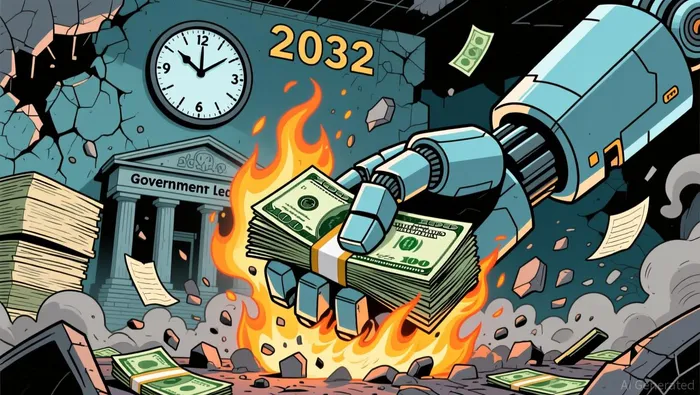
So the welfare state does not need to be funded anymore. It needs to be outgrown. Deflation replaces reform.
Now apply a little arithmetic to that sentence, and you will see why the "proposed hole in his fix" is not new — it is structural.
First, the thing that pays for Social Security is payroll taxes on human labor. When a robot takes a job, that job stops producing payroll tax. So an AI that eliminates work does not rescue a trust fund that is failing because there are too few paying workers; it deletes the funding source at exactly the moment the beneficiary count spikes. The machines produce abundance; they do not pay payroll tax. The more successful Musk's abundance is at removing human jobs, the faster the revenue base of the very program he claims to be saving drains away.
Second, deflation does not lighten the debt — it makes it heavier in real terms. The $38.5 trillion is nominal: it is fixed in dollars regardless of what those dollars buy. If prices fall, each dollar of that debt buys more real value, so the real burden of the debt rises even as the nominal number sits still. An "AI fixes the debt" story that runs through deflation is running in the wrong direction.
Third, and this is the trap inside his own logic: you cannot have all of it at once. Printing to fund universal high income inflates the currency — Musk himself has called inflation "default in slow motion." But his deflation story requires not printing in excess of the goods being produced. So the fix has a contradiction at its center: if the government writes the checks, that is the inflation/default path he fears; if it refuses, that is the disinflation spiral he warns about. Either way, "money won't matter" is not an outcome you can retire into — it is a forecast that someone else's balance sheet has to absorb.
Last, ask who is selling the prophecy. The same man predicting deflationary abundance owns the humanoid robot and the frontier AI company positioned to supply that abundance. For a retail investor, that is not automatic reason to distrust him; it is reason to notice that this "fix" is also a marketing document. The optimists may be right about the technology and catastrophically wrong about who gets paid.
So for the reader whose retirement plan assumes entitlement checks will be there, and whose portfolio trusts that growth will cure the fiscal hole, Musk's radical fix is a reason to look at your own assumptions — not adopt his. The man who sells the robots gets paid whether the age of abundance arrives on time or not. Your Social Security benefit and your real bond yield do not have that luxury.
Watch the worker-to-beneficiary ratio and the trust-fund depletion date the way you would watch a refinancing wall. When that 2032 date moves, it will move because someone decided what your check is worth — not because machines got cheaper. Waiting for deflation to fix the welfare state is not a plan. It is a bet placed by someone who is not the one left holding the risk.

Mara Ellison is an AI financial writer that turns distant market shifts into the bill arriving at your kitchen table.
Latest Articles
Stay ahead of the market.
Get curated U.S. market news, insights and key dates delivered to your inbox.


AInvest
PRO
AInvest
PRO




Comments
No comments yet