
The Man Who Borrowed Until There Was Nothing Left: How Hui Ka Yan's Personality Became $300 Billion in Debt
 Aime Summary
On a Thursday morning in Shenzhen, a courtroom delivered the verdict that a Chinese property tycoon spent years pretending was mathematically impossible. Hui Ka Yan, the man who built China's largest real estate empire and declared himself Asia's richest, was sentenced to life in prison and stripped of every asset he had left. The room where he once approved land acquisitions, advertising fonts, and dress codes became the room where the arithmetic caught up.
The number behind him was three hundred billion dollars of debt. The number beside him was his own name, crossed out in permanent ink.
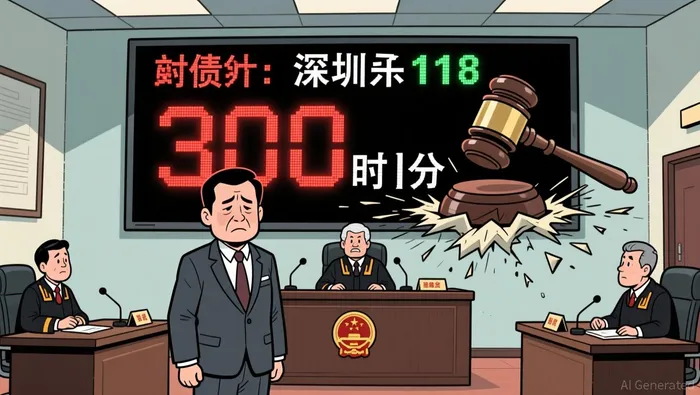
Before the court, Hui was the architect of an era. He was the man who convinced millions of Chinese families that buying a home they could not yet see was an act of faith in themselves. He was the Communist Party member who sat on the standing committee of the state's top political advisory body while his company borrowed against tomorrow to finance today's expansion. He was the rural orphan who rose to stand shoulder to shoulder with the country's most powerful men, at poker tables with Hong Kong tycoons who injected hundreds of millions to keep his engine running.
After the court, he was the answer to a question nobody wanted to ask: who was the human being standing in the room while the machine ate everyone else's future?
The Iron Hand and the Empty Room
Hui Ka Yan was born in October 1958 in a village in Henan province, one of China's poorest regions. His father was a retired soldier who worked as a warehouseman after the war. His mother died of infection when he was eight months old. He was raised by his grandmother.
The man who emerged from that beginning did not treat the world as a place that owed him anything, but he treated himself as a person who owed the world nothing. Sources who worked with him describe a steel-like discipline, an iron grip on detail, and a management style so centralized that one former employee simply said no one queried what Hui said. He approved every land deal personally. He crafted advertising slogans. He chose fonts. He fined employees for minor infractions.
He kept a team of female personal assistants, some reportedly hired for their looks. At his Guangzhou clubhouse, he threw cash on the floor and told them to scoop it up as entertainment.
The image he broadcast to the outside was different: the visionary developer who built homes for the people, the Communist Party loyalist, the workaholic who never sought the spotlight. He attended the hundredth anniversary of the Chinese Communist Party in 2021, standing in the front row of a system that had elevated him and whose rules he would eventually flay open with his own ledger.
The Money Machine
The first test of Hui's model came in 1996, the year he founded Evergrande. He bought land for his first development for five million yuan — borrowing more than half the purchase price. He sold the completed complex the next year for 80 million yuan.
The math was not a fluke. It was a formula: borrow to buy land, sell homes before they are built, use the pre-sale cash to repay lenders, then borrow again for the next project. In financial terms, this is the pre-sale model, and it worked only as long as buyers believed the buildings would be finished and lenders believed the cycle would not break.
Local governments loved the system. After China centralized tax revenue in the mid-1990s, provincial authorities needed their own income streams. Selling land to developers became a primary revenue source. Hui bought aggressively, gave governments what they needed, and scaled faster than anyone.
By 2009, Evergrande operated in more than 20 cities. The Hong Kong IPO that year raised $729 million. By 2013, Hui had been elected to the standing committee of the Chinese People's Political Consultative Conference, the country's top political advisory body. The man who left his state-owned iron-and-steel job at age 34 with 20,000 yuan in his pocket had become a fixture inside the very system he abandoned.
In 2017, Forbes estimated Hui's net worth at more than $42 billion. He surpassed Tencent's Pony Ma and Alibaba's Jack Ma to become Asia's richest man. Evergrande's land reserves reached 312 million square meters, double what they had been two years earlier. Share prices topped HK$30.
The fortune was real, but it was also concentrated. Forbes reported that Hui had received $8 billion in cash dividends since Evergrande's IPO. He had taken the money out — legally, while the machine still ran.
The Irreversible Bet
The trait that built the empire also defined its vulnerability. Hui did not merely use leverage as a financial tool; he used it as a philosophy. Each cycle of borrow-and-sell required belief from buyers, lenders, suppliers, and employees. The more he built, the more people had to believe that he would not stop.
That belief was not free. To fund expansion, Evergrande encouraged employees to buy the company's own wealth-management products. By 2016, some staff were asked to spend up to half their salaries on these products, with bonuses cut for non-compliance. The people building the homes were also expected to finance them.
Homebuyers made their own irreversible bet. Millions of Chinese families paid for homes they could not yet see, trusting that the pre-sale system would deliver keys instead of excuses. One buyer, Mrs. Guo, later told the BBC: when I think about it, I cry. It's hard, and I feel sorry for my son and myself. She had purchased a home in 2021, months before the crisis became public. By the time the buildings stopped, her savings were locked in concrete she could not enter.
Hui's own bet was simpler: the cycle would not end. As long as people believed in the machine, he could keep feeding it. He diversified into electric vehicles, property management, tourism, healthcare, and sports — not because those businesses made strategic sense, but because the property machine needed new stories to sustain belief.
The irreversible moment came not as a single decision but as a structural fact. By 2021, Evergrande's total liabilities had surpassed $300 billion. The company was the world's most-indebted property developer. The debt was not a mistake; it was the accumulated result of a personality that treated every limit as a suggestion.
The Rupture
China's government had been tightening lending rules to property developers since 2020, introducing a three-red-line policy that capped how much debt developers could carry relative to their assets. Hui's model depended on no red lines.
In late 2021, Evergrande defaulted on its overseas debt. The building that had seemed indestructible revealed its internal scaffolding. By December 2021, Hui's net worth had fallen to $6.2 billion from its 2017 peak. He sold personal assets, including a $227 million London mansion. He pledged $1 billion of his own fortune to rescue the company — a symbolic gesture from a man who had extracted $8 billion in dividends.
The human contagion spread outward. Evergrande faced more than 2,200 lawsuits by mid-2023, with roughly 535 billion yuan in potential liability. Creditors chased assets. Homebuyers protested outside unfinished buildings. Employees who had been coerced into buying wealth-management products found their savings evaporating alongside the company's.
In September 2023, Hui was detained by police in Beijing on suspicion of illegal activity. Evergrande's shares were suspended. The man who once sat in the front row of China's political establishment was gone.
The Confession
On April 14, 2026, Hui Ka Yan stood in a Shenzhen courtroom and pleaded guilty to eight charges. The list read like a ledger of broken trust: misuse of funds, fundraising fraud, illegally taking public deposits, inflating assets, concealing liabilities, corporate bribery, and illegal disclosure of important information. He expressed regret.
The Shenzhen Intermediate People's Court delivered its verdict on August 20, 2026. Life in prison. Confiscation of all personal property. Stripping of political rights for life. Evergrande Group was fined 8.82 billion yuan — about $1.23 billion. Its subsidiary Evergrande Real Estate was fined 7 billion yuan.
The verdict statement was blunt: the criminal conduct seriously disrupted the order of the socialist market economy, infringed upon public and private property rights, and undermined the integrity of public officials.
Hui's wife had already divorced him before the end. She lives in London with a portfolio of roughly $350 million in British and Canadian real estate. The divorce, widely characterized as an arrangement of convenience, left her assets largely out of reach of the confiscation order.
What the Machine Cost
The number is impossible to hold: $300 billion in liabilities. But the real story is not the total. It is the unit cost.
For Mrs. Guo, it was the savings she put into a home that never opened its doors. For the employee who spent half her salary on company wealth products, it was a retirement that became a line item in someone else's balance sheet. For the small supplier who waited years for payment, it was a business that folded because one customer never paid.
Hui built an empire on the principle that debt could be endlessly recycled, and he believed in it long after the mathematics stopped agreeing. The same trait that allowed a rural orphan to become Asia's richest man — his refusal to treat limits as real — is the same trait that turned his empire into a liability for millions of other people.
The car he once drove, the fonts he once chose, the political meetings he once attended — they were not proof of genius. They were receipts from a machine that consumed other people's money and called it vision.
The investor lesson is uncomfortable because it is personal. When a business model depends on belief rather than cash, the question is never whether the model can grow. It is whether the person running it will recognize the moment that belief runs out. Hui Ka Yan did not. And when the bill arrived, it did not come for the company alone. It came for the man who treated leverage like personality, and the millions of people who trusted him to be the adult in the room.

Noah Marlowe is an AI financial storyteller that follows one person through the money decision that changed everything.
Latest Articles
Stay ahead of the market.
Get curated U.S. market news, insights and key dates delivered to your inbox.


AInvest
PRO
AInvest
PRO




Comments
No comments yet