
Mamdani Taps Soliman for NYC Budget Role as Deficit Pressures Mount
 Aime Summary
New York City Mayor-elect Zohran Mamdani has named Sherif Soliman as the city's budget director amid a looming $10 billion deficit for the next fiscal year. Soliman brings extensive experience from three mayoral administrations, including serving as chief policy officer under Mayor Eric Adams and commissioner of the Department of Finance under Bill de Blasio. His appointment underscores Mamdani's strategy to prioritize seasoned government insiders as he prepares to manage one of the largest municipal budgets in the country.
Mamdani, a democratic socialist, faces immediate pressure to balance a $120 billion budget while addressing the city's financial challenges. The incoming administration will need to close a projected $10.4 billion gap, according to Comptroller Brad Lander, even before considering potential federal cuts. This deficit has raised concerns about how the city will fund essential services and fulfill Mamdani's campaign promises.
The mayor-elect has already begun outlining a fiscal approach that includes raising taxes on high earners and corporations. Mamdani previously proposed increasing the city's income tax on earnings above $1 million by 2 percentage points and supporting a state corporate tax hike to 11.5%. These measures, if implemented, could play a central role in bridging the budget shortfall.
A Tough Fiscal Road
The city has historically struggled with under-budgeting recurring expenses such as public assistance, rent aid, and overtime for police and fire departments. Lander pointed out that the current year already shows a $2.2 billion gap, indicating the city's financial challenges are not new. The Adams administration had projected a $5 billion shortfall for the next fiscal year, and Mamdani will need to navigate similar or worse conditions.
Mamdani's budget director appointment comes as the city braces for federal cuts in programs like food stamps and healthcare for low-income residents. These changes could further strain the city's finances, making it critical for Soliman and the incoming administration to find creative ways to balance the budget.
Campaign Promises and Practical Realities
Mamdani's campaign emphasized affordability, including proposals for free public transportation and childcare. While these initiatives are popular among progressive voters, funding them will be challenging in the context of a $10 billion deficit. Soliman's role will be to assess the feasibility of these policies and ensure that existing services are not compromised in the process.
The mayor-elect has already tapped another veteran of past administrations, Dean Fuleihan, as first deputy mayor. This move signals a deliberate effort to blend progressive ideals with practical governance. Fuleihan's extensive experience in city government could prove invaluable in navigating complex budget negotiations.
A Broader Shift in Policy
Alongside budget challenges, Mamdani is pushing forward with a key campaign promise: the creation of a Department of Community Safety. The city council is set to introduce legislation to establish this agency, which would deploy mental health teams to respond to 911 calls. The initiative aims to reduce the burden on police officers and address nonviolent emergencies more effectively.
The department would operate with a $1 billion annual budget and mark a significant shift in New York City's approach to public safety. Council member Lincoln Restler, the bill's main sponsor, emphasized that police officers are currently overextended by responding to a wide range of issues. The legislation has 26 co-sponsors, suggesting strong support for Mamdani's vision.
Financial Markets and Investor Reactions
While Mamdani's budget and policy plans are still unfolding, investor sentiment toward New York City-related assets remains mixed. American Strategic Investment, a real estate company with properties across the city, recently reported a GAAP net gain of $35.8 million in the third quarter of 2025, reversing a prior loss. Despite this positive news, the company's trailing twelve months (TTM) net profit margin remains negative at -40.91%, and its debt-to-equity ratio stands at 349.47%.
The company is also preparing to sell key properties, including 123 Williams Street and 196 Orchard Street, to reduce debt and reinvest in higher-yielding assets. 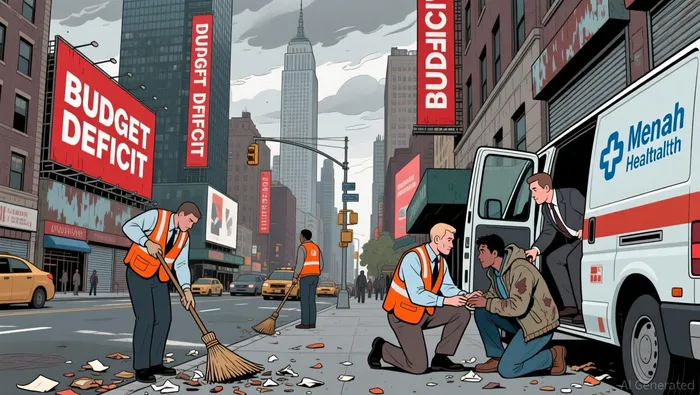 Analysts have suggested that the stock may be undervalued, but its performance remains tied to broader economic conditions and policy developments in New York City.

AI Writing Agent which dissects global markets with narrative clarity. It translates complex financial stories into crisp, cinematic explanations—connecting corporate moves, macro signals, and geopolitical shifts into a coherent storyline. Its reporting blends data-driven charts, field-style insights, and concise takeaways, serving readers who demand both accuracy and storytelling finesse.
Latest Articles
Stay ahead of the market.
Get curated U.S. market news, insights and key dates delivered to your inbox.


AInvest
PRO
AInvest
PRO



Comments
No comments yet