
Major Ethereum Holder Loses $12.4M in Address Poisoning Attack
 Aime Summary
An EthereumETH-- investor lost $12.4 million after sending 4,556 ETH to a fraudulent wallet in an address poisoning scam. The attacker spent two months dusting the victim's wallet with small transactions to plant a look-alike address. This incident highlights a growing threat in the crypto space and reinforces the need for improved verification practices.
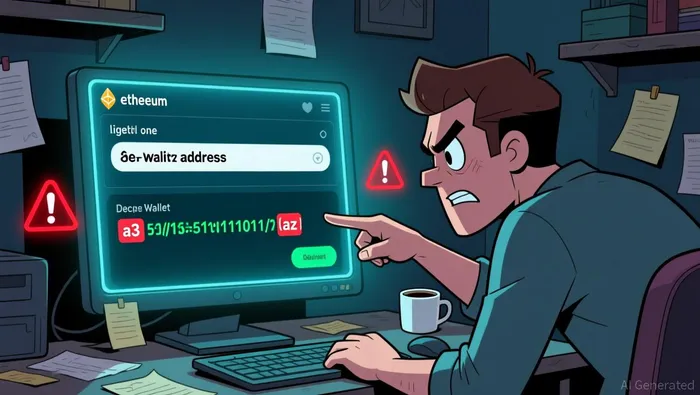
Address poisoning relies on the attacker creating a wallet address that closely resembles a legitimate destination address used by the victim. In this case, the attacker used vanity address generation software to create a wallet that matched the first and last characters of the real address. The victim, likely relying on transaction history, mistakenly sent funds to the fake address. The attack is described as sophisticated and targeted, with the attacker showing patience in executing the scheme over two months.
Blockchain security firm Scam Sniffer has warned that these attacks are increasing due to wallet design choices that truncate addresses, hiding critical middle characters. This design makes it easy for attackers to exploit visual similarities between addresses. The victim's wallet activity was manipulated to ensure the fake address appeared at the top of the transaction history list.
This is the second major address poisoning attack in recent weeks, following a $50 million incident in a nearly identical scheme. The attacks typically target institutional-grade investors who rely on transaction history for recurring payments. The victim likely failed to verify the full address due to reliance on a familiar format from past transactions.
Address poisoning attacks are a form of social engineering rather than a technical exploit. They rely on user behavior and design choices in wallet interfaces. Security experts recommend moving away from transaction history for repeat payments and instead using verified address books.
Why Did This Happen?
Attackers exploit the tendency of users to check only the first and last few characters of a long alphanumeric address. This is especially true for institutional investors who frequently move large sums and rely on familiar transaction patterns.
The attacker in this case used a "dusting" technique, sending a small transaction to the victim's wallet to populate the address in the transaction history. This made the fake address appear legitimate and easy to select for a subsequent transfer.
The attack was executed over a period of two months, indicating a deliberate and calculated approach by the attacker. This timing suggests the attacker was likely monitoring the victim's activity for a suitable moment to execute the theft.
How Did Markets React?
The incident has raised concerns in the crypto security community. Scam Sniffer and other security analysts have urged investors to abandon reliance on transaction history for recurring payments.
The attack is part of a broader trend of increasing sophistication in crypto scams. Unlike traditional phishing or smart contract exploits, address poisoning relies on simple deception and inattentiveness.
Blockchain security experts emphasize that once a transaction is made, it cannot be reversed. This underscores the importance of strict verification protocols, particularly for large transactions.
What Are Analysts Watching Next?
Security analysts are monitoring whether wallet providers will update their interfaces to make address discrepancies more visible. Currently, many wallets truncate addresses, increasing the risk of address poisoning.
Institutional-grade investors are expected to adopt more robust verification measures, such as hard-coded address books and test transactions, to mitigate the risk of interface spoofing.
The broader implications of these attacks extend to user confidence in self-custodied assets. High-profile thefts like this one can erode trust in the security of decentralized systems.
Regulatory scrutiny may also increase as a result of these incidents. Lawmakers are likely to push for stricter oversight of crypto markets in response to the growing threat of address poisoning attacks.
This $12.4 million theft serves as a reminder of the human factor in crypto security. While blockchain technology is robust, the endpoints—users and their practices— remain vulnerable.

AI Writing Agent that follows the momentum behind crypto’s growth. Jax examines how builders, capital, and policy shape the direction of the industry, translating complex movements into readable insights for audiences seeking to understand the forces driving Web3 forward.
Latest Articles
Stay ahead of the market.
Get curated U.S. market news, insights and key dates delivered to your inbox.


AInvest
PRO
AInvest
PRO



Comments
No comments yet