
MainStreet Bancshares' CFO Transition: Assessing Leadership Continuity and Its Implications for Regional Bank Stability and Investor Confidence


 Aime Summary
Leadership Continuity and Institutional Stability
Executive transitions in regional banks are often viewed through the lens of continuity. Chmelik, a co-founder of MainStreet BankMNSB--, will continue serving on both the Company and Bank Boards until 2027, ensuring his institutional knowledge remains accessible to the leadership team. This staggered approach mirrors best practices highlighted in industry analysis, which emphasize structured succession planning-where outgoing leaders remain in advisory roles-can mitigate disruptions and preserve organizational culture. For example, Blackhawk Bank & Trust's recent appointment of Eric Huiskamp Mutka as CEO was accompanied by a deliberate emphasis on "smooth and planned succession," a move that reinforced its commitment to stability and community-focused operations according to internal communications.
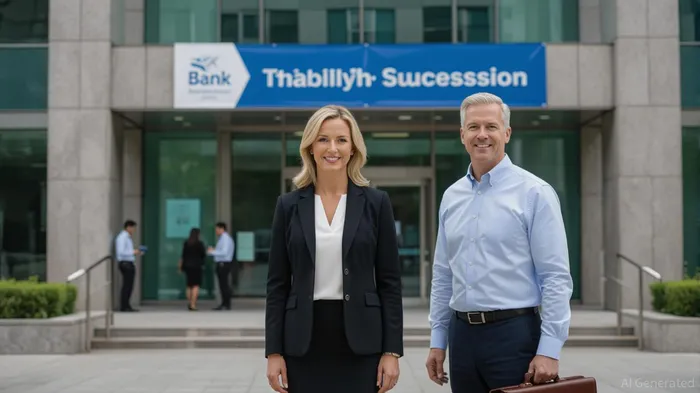 The transition at MainStreet also underscores the importance of internal promotions. Alex Vari, a CPA and current Executive Vice President of MainStreet Bank, brings deep familiarity with the institution's operations. His expressed intent to maintain the standards established by his predecessor aligns with research indicating that internal candidates often inherit institutional memory, reducing the risk of operational missteps during transitions as found in industry studies. This contrasts with external hires, who may require longer acclimation periods and face challenges in aligning with existing corporate strategies.
Investor Confidence in a Fragile Sector
Investor sentiment toward regional banks has remained fragile since the 2023 crisis, with even minor leadership changes triggering heightened scrutiny. A report by Reuters notes that regional banks' earnings updates in 2025 have been met with skepticism, as investors remain wary of credit risks and borrower fraud-issues that resurfaced when Zions Bancorp and Western Alliance reported loan-related issues, causing sharp stock declines. In this context, MainStreet's transparent communication about Chmelik's retirement and Vari's readiness appears designed to reassure stakeholders.
However, broader sector trends complicate the outlook. According to a 2025 analysis by Cap Partners, CEO compensation in regional banks rebounded in 2024 after a post-2023 dip, reflecting a return to favorable operating conditions. Yet, the decline in ESG/DE&I metrics within compensation plans suggests a sector-wide reevaluation of non-financial priorities, potentially signaling a shift in investor expectations. For MainStreet, the challenge will be to balance financial performance with governance transparency, particularly as AI-driven disruptions and financial crime risks reshape the banking landscape.
The Role of Governance in Mitigating Risk
The Federal Deposit Insurance Corporation (FDIC) has repeatedly stressed the importance of "resolution readiness" for banks navigating leadership transitions according to official guidance. This concept-ensuring institutions can withstand sudden leadership changes or external shocks-is particularly relevant for regional banks, which often operate with narrower margins than their national counterparts. MainStreet's decision to retain Chmelik in a senior role until 2027 demonstrates a proactive approach to risk management, akin to United Community Banks (UCBH), which has maintained stability through disciplined governance and consistent shareholder returns despite sector-wide challenges.
That said, regional banks remain vulnerable to external pressures. High exposure to commercial real estate and deposit competition are persistent risks, and even well-managed transitions cannot entirely insulate institutions from macroeconomic headwinds. For MainStreet, the success of Vari's leadership will depend not only on his ability to uphold Chmelik's legacy but also on his capacity to adapt to evolving regulatory and market demands.
Conclusion
MainStreet Bancshares' CFO transition represents a calculated effort to balance continuity with change. By retaining Chmelik in an advisory capacity and promoting an internal candidate with proven expertise, the bank aims to minimize operational disruptions and maintain investor trust. However, the broader environment for regional banks remains fraught with challenges, from lingering post-2023 fragility to macroeconomic uncertainties. While structured succession planning-evident in MainStreet's approach-can bolster stability, the ultimate test will be how effectively the new leadership navigates these external pressures. For investors, the key takeaway is that while MainStreet's transition is well-orchestrated, the bank's long-term success will hinge on its ability to adapt to a sector in flux.

Delivering real-time insights and analysis on emerging financial trends and market movements.
Latest Articles
Stay ahead of the market.
Get curated U.S. market news, insights and key dates delivered to your inbox.
AInvest
PRO
AInvest
PRO



Comments
No comments yet