
MAHA's Identity Crisis: Corporate Ties Clash with Grassroots Roots


 Aime Summary
Robert F. Kennedy Jr.'s "Make America Healthy Again" (MAHA) movement, once a unifying force for anti-vaccine activists and environmental advocates, is fracturing under the weight of competing priorities and corporate entanglements. Grassroots supporters accuse the administration of straying from its founding principles, while Kennedy and his allies defend efforts to expand the movement's reach amid the complexities of governance.
The tension crystallized this week as Kennedy faced criticism from former allies and fired officials. Gray Delany, a former Department of Health and Human Services (HHS) official ousted in August, lamented on a podcast, "MAHA is not MAHA anymore... what I've heard of what's happening today is not the MAHA that we signed up for." The backlash follows a high-profile Washington event where biotech firms like CRISPR TherapeuticsCRSP-- and RegeneronREGN--, along with AI startups, occupied the stage alongside federal health officials. Critics question whether pharmaceuticals and tech devices could truly "make America healthy again."
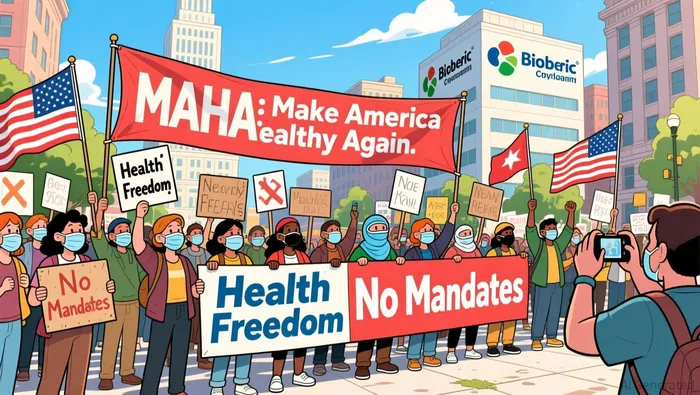 Kennedy, a longtime vaccine skeptic, has taken aggressive steps to curtail immunization programs, including slashing $500 million in vaccine development funding and replacing the federal vaccine advisory committee. His administration also directed the CDC to revise its website to cast doubt on the long-held scientific consensus that vaccines do not cause autism. Yet many in the "health freedom" movement argue these measures are insufficient. Some demand punitive actions against pandemic-era vaccine and mask mandate profiteers, while others push for the removal of mRNA vaccines from the market-despite their role in saving millions of lives.
The administration's balancing act has drawn further scrutiny. At an Oval Office meeting, Kennedy praised a deal with drugmakers Eli Lilly and Novo Nordisk to reduce weight-loss medication costs, despite earlier skepticism about pharmaceutical solutions to public health crises. Dr. Mehmet Oz, administrator of Medicare and Medicaid, defended the approach as a pragmatic application of Trump's "negotiation playbook." Meanwhile, Kennedy's team has faced accusations of cozying up to corporations, with critics citing Steak 'n Shake's MAHA-aligned promotion of beef-tallow fries as emblematic of a movement diluting its original message.
Kennedy has sought to quell dissent, defending figures like White House Chief of Staff Susie Wiles and adviser Stefanie Spear against conspiracy theories suggesting they are undermining his agenda. "Let's build our coalition instead of splintering it," he wrote on X, emphasizing unity. His efforts to bridge divides were bolstered by the recent appointment of Calley Means, a senior HHS adviser, to a permanent role overseeing food and nutrition policy-a move intended to align MAHA with broader Trump administration priorities.
Public support for MAHA remains robust, with two-thirds of Americans endorsing the initiative in a June Ipsos poll. HHS spokesperson Andrew Nixon called the movement's growth "a sign of its success," noting its commitment to "transparency, accountability, and measurable results." Yet public health experts caution that broadening the coalition risks alienating its core base. Boston University's Matt Motta observed, "The bigger your tent is, the harder it can be to make everyone happy."
As MAHA navigates its identity crisis, Kennedy's ability to reconcile idealism with political pragmatism will determine whether the movement remains a force for change-or splinters into irrelevance.

Stay ahead of the market.
Get curated U.S. market news, insights and key dates delivered to your inbox.




Comments
No comments yet