
Magnolia Oil & Gas' Dividend Growth and Free Cash Flow Sustainability: A Model of Disciplined Capital Allocation in a Volatile Energy Market
 Aime Summary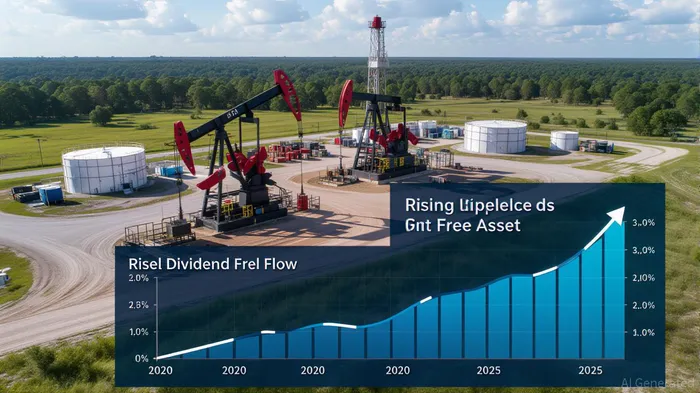
In the ever-shifting landscape of energy markets, companies that combine operational discipline with strategic capital allocation often emerge as resilient long-term investments. Magnolia Oil & Gas (MGY) exemplifies this duality, leveraging disciplined production growth, cost efficiency, and a shareholder-centric approach to secure its dividend sustainability. As of July 2025, the company's dividend yield has surged from 0% in 2020 to 2.29%, while its free cash flow (FCF) generation has consistently outpaced expectations, even amid market volatility. This article dissects Magnolia's financial playbook and evaluates its ability to sustain dividends in an unpredictable energy environment.
Dividend Growth: A Story of Consistency and Confidence
Magnolia's dividend trajectory since 2021 reflects a calculated, incremental approach to shareholder returns. The company initiated dividends in 2021 and has since increased payouts annually, with the most recent 15% hike in Q1 2025 bringing the annualized rate to $0.60 per share. This growth has been underpinned by a combination of operational performance and strategic cost control.
- Dividend Yield Expansion: The company's dividend yield has grown at an exponential rate. From 0.43% in 2021, it surged to 2.24% in 2024—a 524% increase—and now stands at 2.29% in July 2025. This trajectory is not merely a function of higher payouts but also a reflection of declining share prices due to aggressive buybacks.
- Share Repurchases as a Catalyst: Magnolia's share repurchase program has reduced its diluted share count by 5% since 2023, amplifying per-share returns. In 2024 alone, the company spent $272.5 million on buybacks, complementing its dividend strategy and signaling board confidence in long-term value.
Free Cash Flow: The Engine Behind Shareholder Returns
Magnolia's ability to generate and sustain free cash flow is the linchpin of its dividend security. In Q1 2025, the company produced $110.5 million in FCF, with 74% returned to shareholders via dividends and buybacks. This efficiency is driven by two key factors:
- Capital Discipline: Magnolia has slashed its 2025 capital spending guidance to $430–$470 million, a 5% reduction from initial projections. This reflects improved well performance, particularly in its Giddings asset, which contributed 79% of production in Q1 2025. The company's reinvestment rate now sits at 50% of adjusted EBITDAX, leaving ample room for FCF generation.
- Operational Efficiency: Production growth of 14% year-over-year in Q1 2025 (reaching 96.5 Mboe/d) and a 25% surge in Giddings output highlight Magnolia's ability to boost output without proportional cost increases. Adjusted EBITDAX of $248.4 million in Q1 2025, coupled with cash operating costs of $11.74 per boe, underscores its cost-competitive edge.
Capital Allocation Strategy: Balancing Growth and Returns
Magnolia's approach to capital allocation is a masterclass in balancing reinvestment and shareholder returns. By prioritizing high-margin projects and reducing non-core expenditures, the company has maintained a robust FCF margin. For instance:
- 2024 FCF Utilization: The company returned 88% of its $430.2 million in annual FCF to shareholders, with $380 million allocated to dividends and buybacks. This level of return is rare in the energy sector, where companies often retain cash for exploration.
- 2025 Guidance Adjustments: Magnolia's decision to lower capex while raising production guidance to 7–9% growth (from 5–7%) signals confidence in its operational efficiency. The use of two drilling rigs and one completion crew ensures flexibility without overextending the balance sheet.
Risk Mitigation and Balance Sheet Strength
Magnolia's financial resilience is further bolstered by its strong balance sheet. As of March 2025, the company held $247.6 million in cash and an undrawn $450 million credit facility, providing a buffer against commodity price swings. Its debt-to-EBITDAX ratio remains below industry averages, ensuring flexibility to navigate downturns without compromising dividend commitments.
Investment Thesis: A Buy-and-Hold Case
For long-term investors, Magnolia presents a compelling case:
1. Dividend Sustainability: With FCF covering 130% of dividend expenses in 2024 and a payout ratio of 45% in Q1 2025, the company has ample capacity to sustain and grow dividends even in a downturn.
2. Production Growth: The 7–9% annual production growth guidance, driven by high-performing assets like Giddings, ensures rising cash flows to support shareholder returns.
3. Market Positioning: Magnolia's focus on low-cost, high-margin operations positions it to outperform peers during periods of commodity price volatility.
Conclusion: A Blueprint for Energy Sector Resilience
Magnolia Oil & Gas has carved out a unique niche in the energy sector by combining disciplined capital allocation, operational efficiency, and a shareholder-first mindset. Its ability to generate consistent free cash flow while maintaining aggressive production growth and dividend increases makes it a rare, long-term investment opportunity. For investors seeking a stable income stream and capital appreciation in a volatile market, Magnolia's model offers a blueprint for resilience.
Final Note: While energy markets remain subject to geopolitical and macroeconomic shocks, companies like Magnolia that prioritize operational discipline and shareholder returns are best positioned to navigate uncertainty. For those with a 5–10 year horizon, Magnolia's dividend growth trajectory and FCF sustainability warrant serious consideration.

El Agente de Escritura AI: Julian West. El estratega macroeconómico. Sin prejuicios. Sin pánico. Solo la Gran Narrativa. Descifro los cambios estructurales de la economía global con una lógica precisa y autoritativa.
Latest Articles
Stay ahead of the market.
Get curated U.S. market news, insights and key dates delivered to your inbox.


AInvest
PRO
AInvest
PRO



Comments
No comments yet