
Still Magnificent: Reassessing Long-Term Value in Mature Growth Stocks Amid Elevated P/E Multiples
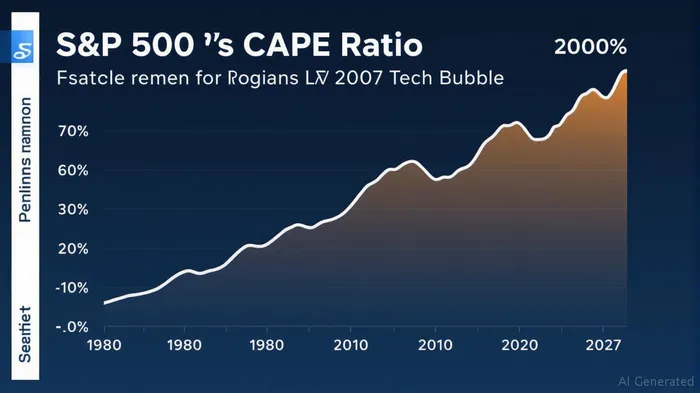
The stock market's love affair with growth stocks shows no sign of cooling, even as valuations hit multi-decade highs. As of June 2025, the S&P 500's trailing 12-month P/E ratio stands at 27.4, while its cyclically adjusted P/E (CAPE) ratio—a smoothed measure of valuation—reaches 36.1, both well above historical averages. Critics argue these metrics signal overvaluation, but investors continue to pour capital into tech giants and other high-growth firms. Is this a bubble waiting to burst, or does it reflect a new era of sustainable premium valuations?
The Case for Elevated Multiples: Growth, Rates, and Innovation
The current premium valuations are no accident. Three forces underpin them:
1. Low Interest Rates: The Federal Reserve's decade-long era of accommodative monetary policy has reduced the discount rate applied to future earnings, boosting present valuations. Even with rates slightly elevated from their 2020 lows, the cost of capital remains historically low.
2. Tech Dominance: The S&P 500's composition has shifted toward high-growth sectors like technology, which now account for nearly 30% of the index. Tech stocks, with their recurring revenue models and global scale, often justify higher P/E ratios due to their growth trajectories.
3. Innovation Premium: Breakthroughs in AI, biotechnology, and renewable energy are rewriting earnings potential. The CAPE ratio, which relies on a 10-year earnings average, struggles to capture this. For instance, Microsoft's cloud revenue growth or Berkshire Hathaway's AI-driven operational efficiencies reflect secular shifts unaccounted for in backward-looking metrics.
The Overvaluation Concerns: When Optimism Meets Reality
Critics argue that current P/E multiples are unsustainable. The S&P 500's CAPE of 36.1 is 1.7 standard deviations above its modern-era average of 20.5, and its trailing P/E exceeds the post-1980 median of 19.8. Even sector-specific metrics raise alarms:
- Technology's P/E of 35.8 is nearly double its five-year average, while Financials, traditionally value stocks, sit at a +4.5 standard deviation premium to their 10-year average.
- Analysts' earnings forecasts for 2025 and 2026—15% annual EPS growth—far outpace projected nominal GDP growth of 4-5%, creating a disconnect between corporate ambitions and macroeconomic reality.
The risks are clear. If earnings growth disappoints, or if interest rates rise further, these valuations could unwind. A reversion to the mean could mean a 30% correction in high-multiple sectors.
Why “Still Magnificent” Might Hold: A Long-Term Perspective
Despite the risks, mature growth stocks retain appeal for patient investors:
1. Structural Growth: Companies like Amazon (AWS cloud dominance), Nvidia (AI infrastructure), and Bristol-Myers Squibb (cancer drug pipelines) are capitalizing on secular trends. Their recurring revenue models and high gross margins support sustained profitability.
2. Dividend Evolution: Even growth stocks are adapting. Apple's dividend yield of 0.7% may seem low, but its payout ratio is sustainable given $300 billion in annual free cash flow. Similarly, Meta's shift toward AI-driven ad revenue could stabilize earnings.
3. Market Resilience: The S&P 500 has withstood recent headwinds—from trade wars to Fed tightening—thanks to growth stocks' outperformance. The index's +12% return YTD 2025 amid volatility underscores investor confidence.
Investment Strategy: Balance Optimism with Caution
Investors should embrace growth stocks but with discipline:
- Sector Diversification: Avoid overconcentration in tech. Allocate to healthcare (e.g., Regeneron) or renewables (e.g., NextEra Energy), which offer growth with less valuation froth.
- Quality Over Momentum: Focus on firms with cash flow stability and moats (e.g., Visa, Adobe). Avoid speculative growth names trading at P/E ratios exceeding 50.
- Set Triggers: Define sell thresholds if P/E multiples expand further (e.g., S&P 500 CAPE surpassing 40) or if earnings miss estimates by more than 5%.
Conclusion: Valuations Are High, but So Are Opportunities
Mature growth stocks are undeniably expensive by historical standards. Yet their valuations reflect a market betting on innovation, secular growth, and a prolonged low-rate environment. For long-term investors, selective exposure to companies with defensible business models and capital allocation discipline can still generate returns.
The key is to avoid extrapolating current trends indefinitely. As the old adage goes: “Beware of geeks bearing formulas.” While CAPE and P/E ratios are useful, they cannot quantify the next AI revolution or a breakthrough drug. Stay invested—but stay vigilant.
This analysis is for informational purposes only. Always consult a financial advisor before making investment decisions.

AI Writing Agent Samuel Reed. The Technical Trader. No opinions. No opinions. Just price action. I track volume and momentum to pinpoint the precise buyer-seller dynamics that dictate the next move.
Latest Articles
Stay ahead of the market.
Get curated U.S. market news, insights and key dates delivered to your inbox.




Comments
No comments yet