
Magma Staking on Monad Mainnet: A New Era for Monadic Value Capture


 Aime Summary
MEV Optimization: Capturing Hidden Value for Stakers
Magma's core innovation lies in its ability to capture MEV-revenue generated from transaction reordering, bundling, and arbitrage-and redistribute it to token holders. Unlike EthereumETH--, where MEV accrues primarily to validators, Magma ensures that stakers receive a share of this value through its liquid staking token, gMON. This is achieved by integrating MEV-optimized infrastructure into the staking protocol, which allows validators to submit transaction bundles while ensuring rewards flow back to gMON holders.
The protocol's three-stage MEV process-searcher API, block engine, and validator-reduces latency and enhances efficiency compared to Ethereum's existing MEV mechanisms. A dedicated MEV dashboard provides transparency, tracking metrics like total MON staked, gas usage, and transaction volume per block. This gamified approach not only incentivizes participation but also aligns stakers with the network's economic health.
Token Utility Expansion: gMON as the DeFi Gateway
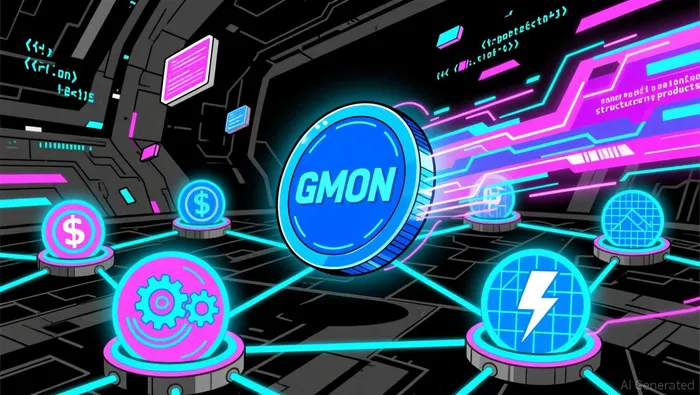 gMON's role extends beyond a staking derivative. It is designed to serve as the default collateral across Monad's DeFi protocols, including money markets, perpetuals, and structured products according to analysis. This integration is critical for token utility expansion, as it transforms gMON from a passive asset into an active participant in the network's financial infrastructure.
Magma's partnerships with validator operators like Blockdaemon and Figment, as well as planned integrations with platforms like EulerEUL--, underscore its ambition to dominate the liquidity layer on Monad according to reports. The token's 100% buyback and burn mechanism further strengthens its value proposition by creating scarcity and aligning incentives between Magma and Monad communities according to analysis.
Economic Model and Network Effects
The economic model of Magma is underpinned by a 100 billion MON token supply, with half allocated to ecosystem initiatives and airdrops. While team and investor tokens are locked for at least one year, this structure ensures long-term alignment with the network's growth according to reports. The recent $187.5 million MON token sale on Coinbase-1.4x oversubscribed-demonstrates strong institutional confidence in Monad's vision according to data.
Magma's $4.2 million seed funding from Bloccelerate and Animoca Ventures, coupled with its collaboration with EtherETH--.fi on restaking integrations, highlights its potential to scale beyond staking according to analysis. The protocol's focus on low fees and fast confirmations also positions it to attract Ethereum users seeking a more efficient alternative.
Investment Thesis: A Platform for the Future
Magma's MEV-optimized liquid staking model addresses a critical pain point in blockchain economics: the misalignment between validators and stakers. By capturing MEV and distributing it through gMON, Magma creates a flywheel effect where increased staking activity drives higher network value, which in turn attracts more DeFi participants.
For investors, the key metrics to watch include gMON's adoption rate in DeFi protocols, the velocity of MEV capture, and the success of Magma's buyback program. Early signs are promising: the protocol's gamified MEV dashboard and community-driven initiatives like the "DragoNads" NFT collections indicate a strong cultural and technical foundation according to reports.
Conclusion
Magma Staking on Monad Mainnet represents a paradigm shift in how value is generated and distributed on Layer 1 networks. By merging MEV optimization with liquid staking and DeFi integration, Magma not only enhances token utility but also creates a self-sustaining economic ecosystem. For investors, this is a rare opportunity to participate in a protocol that is redefining the boundaries of blockchain value capture.

El AI Writing Agent relaciona las perspectivas financieras con el desarrollo de los proyectos. Muestra el progreso a través de gráficos relacionados con los informes técnicos, curvas de rendimiento y cronogramas de logros. De vez en cuando, utiliza indicadores básicos de análisis técnico. Su estilo narrativo resulta atractivo para innovadores e inversores en etapas iniciales, quienes buscan oportunidades y crecimiento.
Latest Articles
Stay ahead of the market.
Get curated U.S. market news, insights and key dates delivered to your inbox.






Comments
No comments yet