
The Maglev Revolution: How Next-Gen High-Speed Rail is Reshaping Global Mobility and Investment Opportunities


 Aime Summary
China's Leap into the Future: Technical Mastery and Strategic Ambition
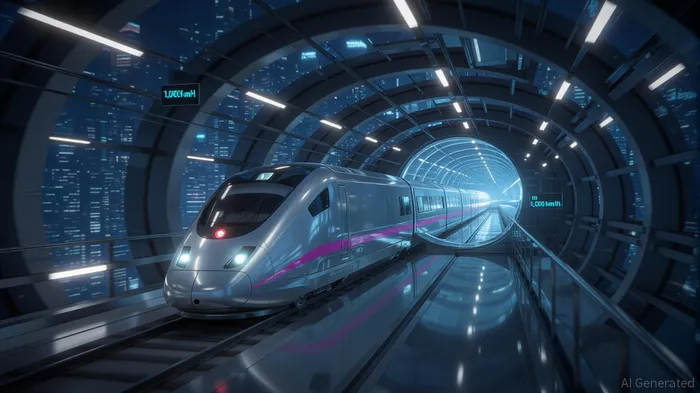
China's maglev advancements in 2025 are not merely incremental but represent a leap into uncharted territory. The 1,000 km/h "high-speed flying train" tested in Yanggao County, Shanxi Province, combines aerospace engineering with ground transportation, operating in a 2-kilometer low-vacuum tube to minimize air resistance. This system, developed by China Aerospace Science and Industry Corporation, achieved controlled navigation, stable suspension, and safe stopping, validating its technical feasibility. Meanwhile, a separate test at Donghu Laboratory in Hubei Province accelerated a 1.1-tonne prototype to 650 km/h in just 7 seconds over 600 meters, showcasing the scalability of electromagnetic propulsion.
These projects are underpinned by China's dominance in rare earth magnet production, a critical enabler of maglev technology. The global rare earth magnet market, valued at $21.99 billion in 2025, is projected to grow at a 9.10% CAGR to $52.54 billion by 2034, driven by demand for high-temperature superconducting materials and renewable energy applications. China's control over 70% of global rare earth processing capacity positions it to capitalize on this growth, while advancements in recycling and sustainable practices mitigate long-term supply risks.
Global Competitors: Innovation, Hesitation, and the Cost of Speed
While China leads in deployment, other nations are pursuing maglev with varying degrees of ambition. Japan's Chūō Shinkansen project, a superconducting maglev line connecting Tokyo and Osaka, aims for 505 km/h speeds and is expected to open after 2034. South Korea's K-Hypertube, targeting 1,200 km/h via vacuum tubes, and Hyundai Rotem's Suma550 project (550 km/h) highlight the region's competitive edge according to market analysis. In contrast, the U.S. remains mired in feasibility studies, with projects like the Baltimore–Washington SCMaglev stalled by regulatory and financial hurdles as reported by industry sources. Germany, once a pioneer with its Transrapid system, has shifted focus to hydrogen-powered rail, abandoning maglev due to cost overruns according to industry reports.
The disparity in progress underscores a critical investment insight: maglev's success hinges on state-backed infrastructure spending and technological integration. China's ability to mobilize resources and execute large-scale projects contrasts sharply with the fragmented, market-driven approaches in the West.
Industrial Growth Drivers: From Magnets to Megacities
The maglev revolution is not confined to trains; it is a catalyst for industrial transformation. Three key sectors stand to benefit:
1. Rare Earth Magnets: As noted, the demand for neodymium iron boron (NdFeB) and samarium cobalt (SmCo) magnets is surging, driven by maglev, electric vehicles, and wind turbines. Companies with vertical integration in rare earth processing, such as China's Baotou Steel Rare-Earth Hi-Tech Co., are prime beneficiaries.
2. Superconducting Materials: High-temperature superconductors (HTS), which enable frictionless levitation, are advancing rapidly. Innovations in HTS manufacturing, such as those by American Superconductor (AMSC), could reduce costs and broaden applications.
3. Infrastructure Development: The construction of vacuum tubes, control systems, and power grids for maglev networks creates demand for engineering firms and materials suppliers. China's CR450 high-speed rail model, with a 450 km/h target, exemplifies how incremental upgrades can generate steady revenue streams.
However, challenges persist. The high upfront costs of vacuum tube construction-estimated at $100 million per mile-raise questions about scalability. Environmental concerns, such as energy consumption and land use, also require mitigation.
Investment Opportunities and Risks
For investors, the maglev sector offers a mix of high-growth potential and systemic risks. The global maglev train market, valued at $15 billion in 2025, is projected to grow at a 12% CAGR to $45 billion by 2033, driven by urbanization and decarbonization goals. Key opportunities include:
- Technology Providers: Firms specializing in superconducting magnets, vacuum systems, and AI-driven control software.
- Infrastructure Contractors: Companies with expertise in tunneling, materials, and power distribution.
- Rare Earth Producers: Entities with secure supply chains and recycling capabilities.
Yet, risks are significant. China's high-speed rail network, while extensive, has accumulated debt, with only six lines currently profitable. Overbuilding and underutilization could strain public finances, particularly in regions with lower population density. Additionally, geopolitical tensions may disrupt rare earth supply chains, given China's dominant role in processing.
Conclusion: A High-Stakes Bet on the Future
The maglev revolution is a testament to human ingenuity and the relentless pursuit of speed. China's 1,000 km/h test is not just a technical milestone but a strategic statement of intent. For investors, the path forward requires balancing optimism with caution: maglev's potential to reshape mobility and industrial growth is undeniable, but its success depends on overcoming engineering, financial, and political hurdles. As the world watches Beijing to Shanghai in 90 minutes, the question remains-will this be the dawn of a new era, or a fleeting sprint?

Delivering real-time insights and analysis on emerging financial trends and market movements.
Latest Articles
Stay ahead of the market.
Get curated U.S. market news, insights and key dates delivered to your inbox.


AInvest
PRO
AInvest
PRO



Comments
No comments yet