
Maduro Captured in Dramatic US Operation: Oil Markets Brace for Venezuela Regime Shift
 Aime Summary
In a stunning escalation of Washington's long-running pressure campaign, President Donald Trump announced early Saturday that U.S. forces had captured Venezuelan President Nicolás Maduro and his wife, Cilia Flores, following a series of airstrikes on targets in Caracas and other regions. The operation, which Trump described as a "large scale strike," marks an unprecedented direct intervention in Latin America and could reshape global oil dynamics given Venezuela's vast crude reserves.
"The United States of America has successfully carried out a large scale strike against Venezuela and its leader, President Nicolas Maduro, who has been, along with his wife, captured and flown out of the Country," Trump posted on Truth Social.
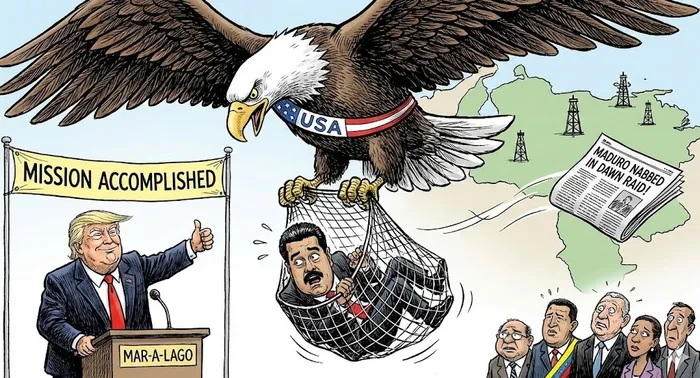
The announcement came hours after residents in Caracas reported multiple explosions around 2 a.m. local time, centered on key military sites including Fuerte Tiuna, the country's largest base. Reports indicate elite U.S. Delta Force units executed the capture, with Maduro—indicted on U.S. narco-terrorism charges since 2020—expected to face trial in the United States.
Timeline of a Rapid Escalation
The operation caps months of intensifying U.S. actions under Trump, including strikes on over 30 alleged drug-smuggling boats, seizures of sanctioned oil tankers, and a December blockade of Venezuelan waters. Secretary of State Marco Rubio has framed Venezuela as a direct national security threat due to alleged ties with narco-traffickers and terrorists.
Maduro's removal echoes the 1990 U.S. invasion of Panama and capture of Manuel Noriega—exactly 35 years to the day. Venezuelan Defense Minister Vladimir Padrino López declared a national emergency and mobilized forces, vowing resistance without acknowledging the capture.
International Backlash and Fractured Alliances
Global reactions were swift and polarized. Russia condemned the move as "armed aggression," while Cuba's President Miguel Díaz-Canel called it "state terrorism." Colombian President Gustavo Petro urged a UN Security Council meeting, rejecting "aggression against the sovereignty of Venezuela and of Latin America."
On the other side, Venezuelan opposition figures like Nobel Peace Prize winner María Corina Machado—currently in hiding—and exiled candidate Edmundo González could emerge as key players in any transition. Argentina's Javier Milei celebrated the news, signaling support from pro-market leaders in the region.
Oil Markets: Short-Term Volatility, Long-Term Supply Boom?
Venezuela sits atop the world's largest proven oil reserves—over 300 billion barrels—yet production has plummeted to under 1 million barrels per day from mismanagement and sanctions. The Maduro era saw hyperinflation, mass migration, and isolation, with U.S. sanctions choking exports.
Immediate Impact: Analysts expect a risk premium to push Brent crude higher in early trading, potentially adding $2-5 per barrel amid uncertainty over retaliation or instability. WTI futures could see similar spikes, though global supply cushions (OPEC+ spare capacity) limit upside.
Key Asset Watch:
Chevron (CVX): The only major U.S. firm operating in Venezuela under a Treasury license, producing around 120,000 b/d with state-owned PDVSA. Shares could rally on prospects of expanded operations if sanctions ease under a post-Maduro government.
Venezuelan Bonds: Heavily discounted sovereign debt and PDVSA notes may surge on regime-change hopes, though default risks linger.
Broader Energy: A stabilized Venezuela could add 2-3 million b/d over a decade with investment—pressuring prices long-term and challenging OPEC+ cohesion.
Exclusive View
This isn't just about drugs or democracy—it's energy realpolitik. Trump has repeatedly highlighted Venezuela's reserves while criticizing past interventions. A successful transition could flood markets with heavy crude ideal for U.S. Gulf Coast refineries, easing import dependence on distant suppliers. But risks abound: protracted chaos or Chinese/Russian-backed resistance could prolong disruptions, keeping premiums elevated.
Markets will watch Trump's 11 a.m. Mar-a-Lago press conference for signals on sanctions relief and transition support.

Tianhao Xu is currently a financial content editor, focusing on fintech and market analysis. Previously, he worked as a full-time forex trader for several years, specializing in global currency trading and risk management. He holds a master’s degree in Financial Analysis.
Latest Articles
Stay ahead of the market.
Get curated U.S. market news, insights and key dates delivered to your inbox.


AInvest
PRO
AInvest
PRO



Comments
No comments yet