
Macroeconomic Volatility and Crypto Market Sensitivity: Navigating Inflation and Geopolitical Risks in 2025


 Aime Summary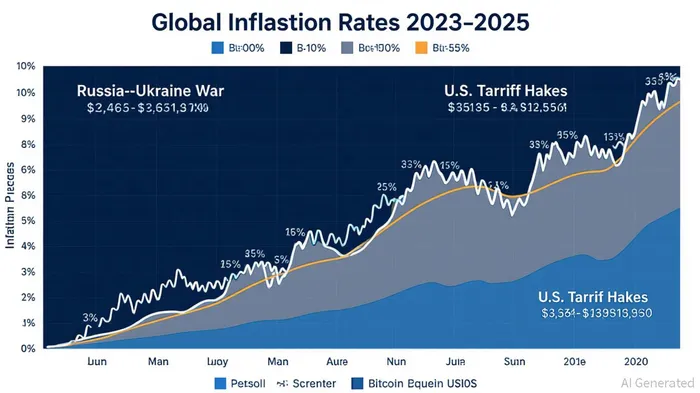
The 2025 macroeconomic landscape is defined by divergent inflation trends, central bank recalibration, and geopolitical turbulence. Global headline inflation, projected at 4.4% by year-end, masks stark regional disparities: the U.S. remains above its 2% target, while the eurozone stabilizes at 2.0% [1]. Meanwhile, Argentina’s 39.4% inflation and Turkey’s 33.52% underscore the fragility of emerging markets [2]. Central banks, particularly the Federal Reserve and European Central Bank (ECB), have adopted a cautious stance. The Fed’s August 2025 policy revision abandoned its "flexible average inflation targeting" framework, opting for a stricter inflation-targeting approach to address persistent price pressures [3]. This shift, coupled with the ECB’s data-dependent rate-holding strategy, has created a mixed-rate environment where crypto markets face heightened sensitivity to macroeconomic signals.
Crypto Market Volatility: A Macro and Geopolitical Barometer
Cryptocurrencies have become increasingly intertwined with traditional financial markets in 2025. Bitcoin’s price movements, for instance, closely track Federal Reserve policy. The Fed’s Q3 2025 rate cut—a 25-basis-point reduction—spurred a 12% surge in BitcoinBTC-- to $116,000, driven by $51 billion in institutional inflows [4]. Conversely, geopolitical tensions, such as U.S. tariffs on China and the Russia–Ukraine war, have triggered flight-to-safety dynamics, with investors shifting capital to gold and U.S. Treasuries rather than crypto [5]. This duality—Bitcoin’s role as both a speculative asset and a macroeconomic proxy—has amplified its volatility.
Ethereum, meanwhile, has gained traction as an institutional asset. Its proof-of-stake model and staking yields attracted $9.5 billion in ETF inflows in July 2025, outpacing Bitcoin’s $5.4 billion [6]. This trend reflects a broader shift toward yield-generating crypto assets, particularly as central banks normalize higher interest rates. However, the market’s correlation with traditional indices has deepened: Bitcoin’s 0.48 correlation with U.S. equities and -0.29 inverse correlation with the U.S. dollar highlight its dual role as a hedge and a speculative play [7].
Risk Mitigation: AI-Driven Tools and Strategic Diversification
Investors navigating 2025’s volatile environment are adopting AI-driven tools to manage exposure. Platforms like Incite AI and 3Commas use machine learning to execute stop-loss orders, analyze sentiment, and identify arbitrage opportunities [8]. These tools have reduced portfolio drawdowns by up to 26% compared to non-AI strategies [9]. Additionally, dollar-cost averaging (DCA) and dynamic diversification frameworks—enhanced by AI—have become standard practices. For example, DCA into blue-chip cryptos like Bitcoin and EthereumETH--, combined with selective altcoin investments, has allowed investors to balance growth potential with downside protection [10].
Diversification strategies now extend beyond asset classes to include geographic and technological hedging. Investors are allocating 5–15% of portfolios to stablecoins to mitigate liquidity risks, while multi-signature wallets and decentralized insurance protocols guard against cybersecurity threats [11]. Geographically diversified staking and exposure to high-conviction altcoins like SolanaSOL-- and $PYTH further insulate portfolios from regional shocks [12].
Strategic Positioning: Regulatory Clarity and Macro Hedges
Regulatory developments in 2025 have reshaped crypto positioning. The Genius Act, passed in July 2025, allowed banks to custody digital assets, legitimizing crypto as a macro hedge [13]. This shift has spurred institutional adoption, with companies like MicroStrategy and DBS Bank accumulating Bitcoin as a treasury asset [14]. Investors are now advised to allocate 5–10% of portfolios to Bitcoin and Ethereum, hedged with long-dated options and TIPS [15].
However, political uncertainties—such as potential Trump-era regulatory crackdowns—remain a wildcard. To mitigate this, investors are combining technical analysis with real-time macroeconomic monitoring, adjusting positions based on PCE inflation data and jobs reports [16]. The rise of Bitcoin treasuries and crypto IPOs (e.g., Twenty One, Nakamoto) also offers new avenues for diversification beyond traditional equities and bonds [17].
Conclusion
The 2025 crypto market is a microcosm of macroeconomic and geopolitical forces. While rising interest rates and inflationary pressures create headwinds, strategic positioning—leveraging AI, diversification, and regulatory tailwinds—can transform volatility into opportunity. As central banks navigate a fragile equilibrium and geopolitical risks persist, investors must balance innovation-driven returns with disciplined risk management. The key lies in aligning crypto allocations with macroeconomic narratives, ensuring resilience in an unpredictable world.
Source:
[1] World Economic Outlook - All Issues, [https://www.imf.org/en/Publications/WEO]
[2] Consumer Prices, OECD - Updated: 5 August 2025, [https://www.oecd.org/en/data/insights/statistical-releases/2025/08/consumer-prices-oecd-updated-5-august-2025.html]
[3] The Fed does listen: How it revised the monetary policy, [https://www.brookings.edu/articles/the-fed-does-listen-how-it-revised-the-monetary-policy-framework/]
[4] Navigating Crypto Volatility: Positioning for Fed Policy, [https://www.ainvest.com/news/navigating-crypto-volatility-positioning-fed-policy-shifts-q3-2025-2509]
[5] The impact of macroeconomic factors on the crypto market in 2025, [https://m.economictimes.com/markets/cryptocurrency/crypto-news/the-impact-of-macroeconomic-factors-on-the-crypto-market-in-2025/articleshow/118207806.cms]
[6] Ethereum's Strategic Ascendancy in Institutional Portfolios, [https://www.ainvest.com/news/ethereum-strategic-ascendancy-institutional-portfolios-2025-analysis-2508/]
[7] Crypto Asset Markets vs. Financial Markets, [https://www.mdpi.com/2673-9909/5/2/36]
[8] Harnessing AI and Diversification for Smarter Crypto, [https://www.ainvest.com/news/harnessing-ai-diversification-smarter-crypto-investing-2025-2509/]
[9] Exploring the Interrelationship Between Energy, [https://onlinelibrary.wiley.com/doi/10.1002/bse.4290]
[10] 2025 Crypto Risk Strategies: Diversification AI Tools 15%..., [https://www.ainvest.com/news/2025-crypto-risk-strategies-diversification-ai-tools-15-stablecoin-hedge-cut-volatility-2507/]
[11] Crypto Security Vulnerabilities and Rising Scam Risks in..., [https://www.ainvest.com/news/crypto-security-vulnerabilities-rising-scam-risks-2025-investor-preparedness-strategic-allocation-cybersecurity-infrastructure-decentralized-insurance-solutions-2508/]
[12] 2025 Fall Investment Directions: Rethinking diversification, [https://www.blackrockBLK--.com/us/financial-professionals/insights/investment-directions-fall-2025]
[13] Policy developments drive crypto markets - Monthly Letters, [https://hashdex.com/en-US/insights/policy-developments-drive-crypto-markets]
[14] Bitcoin's On-Chain Resilience: A New Era of Institutional Accumulation, [https://www.ainvest.com/news/bitcoin-chain-resilience-era-institutional-accumulation-inflation-hedging-2508]
[15] Fed Policy Shifts and Crypto Market Reactions: A New Era, [https://www.ainvest.com/news/fed-policy-shifts-crypto-market-reactions-era-digital-assets-2508]
[16] 2025 Thematic Outlook: AI & Geopolitics - BlackRock, [https://www.blackrock.com/us/financial-professionals/insights/2025-thematic-outlook]
[17] Q2 2025 Review and Look Ahead, [https://www.nydig.com/research/q2-2025-review-and-look-ahead]

Decoding blockchain innovations and market trends with clarity and precision.
Latest Articles
Stay ahead of the market.
Get curated U.S. market news, insights and key dates delivered to your inbox.






Comments
No comments yet