
Mach Industries' $100M Funding Surge: A Catalyst for Disruption in Defense Manufacturing
The defense technology sector is undergoing a seismic shift, driven by agile startups leveraging private equity backing to challenge traditional giants. Mach Industries' recent $100 million funding round—led by Khosla Ventures and Bedrock Capital, with continued support from Sequoia Capital—has positioned it as a pivotal player in this transformation. Valued at $470 million post-funding, the company is not just another disruptor; it's a blueprint for how innovation and manufacturing scalability can redefine national security infrastructure. Let's dissect its strategic moves and their implications for investors.
The Micro-Factory Revolution: Reshaping Supply Chains
Mach's flagship initiative is the construction of Forge 1, a 115,000-square-foot micro-factory in Huntington Beach, California. This facility exemplifies the company's vision of a decentralized manufacturing network, designed to produce everything from raw materials to final assembly in a single location. By replicating this model across the U.S. and internationally, Mach aims to create a resilient defense industrial base immune to geopolitical and supply chain disruptions.
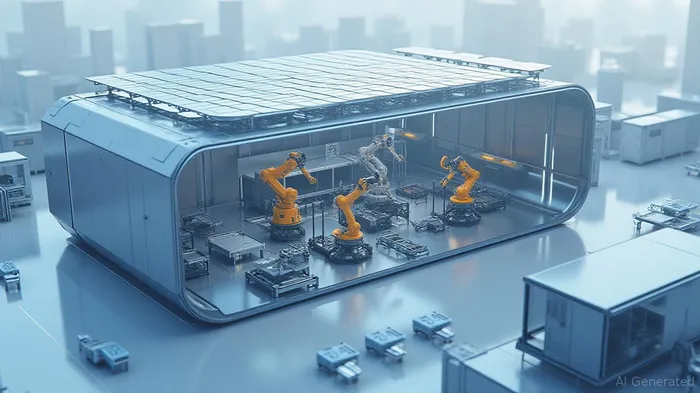
This strategy directly addresses a longstanding vulnerability in defense manufacturing: overreliance on centralized facilities and global supply chains. The funding will accelerate the rollout of these micro-factories, with partnerships like the one with Heven Drones already demonstrating their potential for rapid production of critical systems like unmanned aerial vehicles (UAVs). For investors, this is a bet on geopolitical risk mitigation as a growth driver, as governments prioritize domestic, agile production networks.
R&D: From Propulsion Engines to AI-Integrated Warfare Systems
Beyond manufacturing, Mach is pouring resources into R&D for next-generation defense technologies. CEO Ethan Thornton hinted at projects like a new propulsion engine and advancements in AI-driven systems such as the Viper (a jet-powered UAV) and Stratos (an in-air satellite). These innovations target cost efficiency and long-range strike capabilities, directly challenging legacy contractors like Lockheed Martin and Raytheon.
The underscores the market's growing appetite for disruptors. While Mach's $470 million valuation lags behind established players, its 40% increase since its 2023 Series A signals investor confidence in its niche: affordable, scalable tech for modern warfare.
Investor Alignment: Venture Capital's New Frontier
The funding round's star power—led by Khosla's Keith Rabois and including Sequoia—reflects a broader trend: venture capital is increasingly viewing defense tech as a high-growth sector. Unlike traditional contractors bound by bureaucratic contracts, Mach's agility and focus on modular, AI-integrated systems align with the Pentagon's push for rapid innovation.
For strategic investors, Mach's model offers two key opportunities:
1. Decentralized manufacturing as a service: Micro-factories could become the backbone of a public-private defense ecosystem, with potential partnerships extending to energy and logistics.
2. AI and propulsion tech: Breakthroughs here could spill into adjacent sectors like space exploration or commercial drones, creating cross-sector value.
Risks and Considerations
While Mach's vision is compelling, risks remain. Regulatory hurdles in defense contracting—such as security clearances and procurement cycles—could slow growth. Additionally, scaling micro-factories without compromising quality demands significant operational discipline. Investors should monitor metrics like employee retention rates (Mach's workforce grew from 20 to 140 in a year) and partnerships with government entities like the Department of Defense.
Investment Takeaways
- Go Long on Disruptors: Mach's funding signals a shift toward private equity-backed innovation in defense. Investors should explore similar firms in AI-driven manufacturing or autonomous systems.
- Track Geopolitical Tailwinds: As nations prioritize self-sufficiency in defense tech, micro-factories and localized production could see policy support and subsidies.
- Consider Public Proxies: For retail investors, look to ETFs like the SPDR S&P Defense ETF (XARV) or tech firms with defense ties (e.g., NVIDIA's AI contracts with the Pentagon) to mirror Mach's trajectory.
Conclusion
Mach Industries isn't just building drones—it's redefining how nations prepare for 21st-century conflicts. Its $100 million infusion isn't just capital; it's a stake in a future where defense manufacturing is fast, flexible, and driven by Silicon Valley-style innovation. For investors, this is a chance to back a paradigm shift. The question isn't whether traditional contractors will adapt—it's who will lead the next generation of defense tech. Mach is betting it can, and the market is listening.

Delivering real-time insights and analysis on emerging financial trends and market movements.
Latest Articles
Stay ahead of the market.
Get curated U.S. market news, insights and key dates delivered to your inbox.


AInvest
PRO
AInvest
PRO



Comments
No comments yet