
Macau's Gambling Revenue and Economic Outlook 2025–2026: Navigating Contraction Risks and Sector Realignment


 Aime Summary
Gambling Revenue Performance: A Tale of Two Forecasts
, , according to Melco Resorts & Entertainment. MelcoMLCO-- Resorts & Entertainment, a key player, , according to Melco Resorts & Entertainment. These figures suggest resilience, particularly in the VIP segment, which remains a cornerstone of Macau's gaming model.
However, reflects lingering caution. This downward adjustment, , underscores the sector's vulnerability to external shocks. Yet, . , respectively, (according to Morgan Stanley). Citigroup, meanwhile, , .
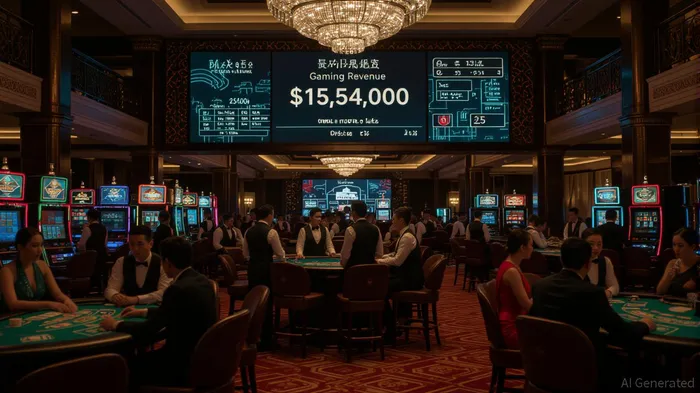
This divergence between government caution and analyst optimism highlights a critical tension: while the gaming sector is rebounding, structural risks-such as shifting consumer preferences and regulatory scrutiny-remain unresolved.
Economic Outlook: Cautious GDP Projections and Sectoral Imbalances
Macau's broader economic outlook for 2026 is marked by prudence. , according to the government's budget. However, Secretary for Economy and Finance Tai Kin Ip has refrained from providing a GDP forecast, . This hesitation contrasts with analysts' more optimistic projections, according to Macau News.
The disconnect between sectoral and macroeconomic forecasts is stark. While gaming revenue appears on a recovery path, . signal a recognition of systemic fragility. For investors, this imbalance raises a critical question: Can Macau's economy sustain growth if diversification efforts remain sluggish?
Regulatory Shifts and Sector Realignment: A New Normal
The 2025–2026 period has seen significant regulatory overhauls reshaping Macau's gaming landscape. The most consequential change is the consolidation of satellite casinos, mandated by the 2022 concession agreements. By the end of 2025, all satellite venues must operate under properties owned by the six major concessionaires (Sands, Galaxy, Wynn, MGM, Melco, and SJM), ending the previous sub-concession model. This shift, while aimed at enhancing transparency, could disrupt supply chains and employment, particularly for smaller operators.
Legislatively, Macau has introduced Law 7/2024 (Credit for Gaming) and Law 20/2024 (Illegal Gambling), which restrict credit extensions to concessionaires and expand enforcement against unlicensed operations. These measures, coupled with the 's (DICJ) restructuring, signal a tightening of regulatory oversight.
Investors must also monitor the government's 2026 performance review of concessionaires under Article 22 of the Macau Gaming Law. This assessment will evaluate compliance with pledges-$19.3 billion in total, with $16 billion earmarked for cultural, tourism, and infrastructure projects according to the government's plan. Failure to meet these targets could trigger policy recalibrations, including adjustments to tax rates or foreign-market incentives.
Investor Positioning: Balancing Growth and Risk
For investors, the key to navigating Macau's evolving landscape lies in hedging against both sectoral concentration and regulatory uncertainty. The satellite casino consolidation, while potentially boosting yield efficiency, may take years to translate into tangible financial gains. Similarly, the government's focus on non-gaming investments-such as family-friendly attractions and cultural initiatives-could diversify revenue streams but requires patience.
Tax stability remains a double-edged sword. The 35% special gaming tax, unchanged in 2025, provides short-term predictability but leaves room for future adjustments. Investors should factor in the possibility of rate changes, particularly if the government seeks to fund diversification initiatives or address fiscal shortfalls.
Finally, the tension between government optimism and cautious GDP projections demands a nuanced approach. While Q4 2025 growth forecasts are encouraging, the broader economic environment-marked by global inflationary pressures and geopolitical risks-remains a wildcard. A diversified portfolio that balances exposure to gaming operators with investments in Macau's nascent non-gaming sectors may offer the best risk-adjusted returns.
Conclusion
Macau's 2025–2026 trajectory is a study in contrasts: a rebounding gaming sector, a cautious macroeconomic outlook, and a regulatory environment in flux. For investors, the path forward requires vigilance. The government's optimism about gaming recovery must be weighed against the fragility of non-gaming industries and the potential for regulatory recalibration. As satellite casinos consolidate and performance reviews loom, the region's ability to balance growth with diversification will determine its long-term resilience. In this environment, patience and adaptability are not just virtues-they are imperatives.

Delivering real-time insights and analysis on emerging financial trends and market movements.
Latest Articles
Stay ahead of the market.
Get curated U.S. market news, insights and key dates delivered to your inbox.
AInvest
PRO
AInvest
PRO



Comments
No comments yet