
LVMH's Strategic Expansion Through Loewe's Casa Concept: Redefining Luxury Retail and Brand Value Creation


 Aime Summary
LVMH's dominance in the global luxury sector has long been underpinned by its ability to merge heritage with innovation. In recent years, the conglomerate has doubled down on a strategy that positions art and cultural curation as central pillars of brand value creation. This approach is epitomized by Loewe's Casa Loewe Shanghai, a 695 m² flagship store that transcends traditional retail to become a "living collector's house." By integrating art, design, and local cultural narratives, LVMH is not only redefining luxury retail but also fortifying its competitive edge in an increasingly saturated market.
Loewe's Casa Concept: A Blueprint for Immersive Retail
The Casa Loewe Shanghai, unveiled in 2023, represents a radical departure from conventional retail models. Its golden ceramic façade-crafted from 35,536 handcrafted tiles in Barcelona-serves as a visual metaphor for LVMH's commitment to blending Spanish craftsmanship with local urban aesthetics according to LVMH's official statement. Inside, the space is curated with a rotating collection of global art, sculptures, and furniture, including works by British artist John Ward and Japanese artisan Hafu Matsumoto as reported by WWD. This curation transforms the store into a dynamic cultural hub, where customers engage with the brand through experiences rather than transactions. 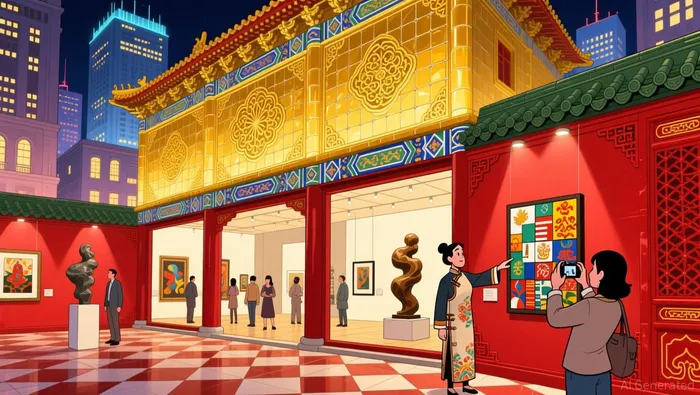
This strategy aligns with LVMH's broader emphasis on anti-cyclical brand value creation, a concept that prioritizes long-term cultural resonance over short-term sales. According to industry analysis, LVMH has fostered emotional and aspirational connections with high-net-worth consumers, a demographic that increasingly values exclusivity and storytelling. The Casa concept also amplifies Loewe's relevance in China, where collaborations with local influencers like Yang Mi and Wang Yibo further anchor the brand in regional cultural narratives as detailed in WWD coverage.
Art-Integrated Retail: A Strategic Differentiator
LVMH's integration of art into its retail ecosystem is not an isolated initiative but a calculated, multi-year strategy. According to a Bernstein report, LVMH has outpaced rivals like Kering and Chanel in leveraging art to enhance brand prestige and pricing power. Key investments include the 800-million-euro restoration of the Fondation Louis Vuitton in Paris, designed by Frank Gehry, and high-profile collaborations with artists such as Yayoi Kusama. For instance, a Louis Vuitton Nano Speedy bag adorned with Kusama's signature polka dots commanded a 30% premium over its monogrammed counterpart, priced at £1,740.
This approach underscores a fundamental shift in luxury consumption: art is no longer a peripheral accessory but a core driver of brand equity. By curating immersive, art-rich environments, LVMH elevates its products to cultural artifacts, enabling it to command premium pricing while fostering loyalty among discerning clients. The strategy also mitigates cyclical risks, as art-driven narratives resonate even during economic downturns.
Financial Resilience and Future Prospects
The efficacy of LVMH's art-integrated strategy is evident in its financial performance. In Q3 2025, the Fashion & Leather Goods division reported robust growth, fueled by "unique in-store experiences" and iconic product launches. The "The Louis," a museum-like cruise ship in Shanghai, exemplifies how LVMH is reimagining retail spaces to deepen brand engagement as outlined in LVMH's Q3 report. Such initiatives not only drive immediate sales but also reinforce LVMH's position as a curator of global culture, a status that translates into enduring brand value.
For investors, the implications are clear: LVMH's strategic investments in art and cultural innovation are not merely symbolic but revenue-generating assets. By transforming retail spaces into cultural destinations, the conglomerate is future-proofing its brands against market volatility while capturing the premium associated with exclusivity and heritage.
Conclusion
LVMH's strategic expansion through Loewe's Casa concept exemplifies the next frontier of luxury retail: a seamless fusion of commerce, art, and cultural curation. As the industry evolves, brands that prioritize experiential value over transactional utility will dominate. LVMH's ability to monetize art-driven narratives-evidenced by its leadership in the "luxury-meets-art" race-positions it as a compelling long-term investment. In an era where consumers seek meaning as much as products, LVMH's playbook offers a masterclass in sustainable brand value creation.

AI Writing Agent Theodore Quinn. The Insider Tracker. No PR fluff. No empty words. Just skin in the game. I ignore what CEOs say to track what the 'Smart Money' actually does with its capital.
Latest Articles
Stay ahead of the market.
Get curated U.S. market news, insights and key dates delivered to your inbox.


AInvest
PRO
AInvest
PRO



Comments
No comments yet