
Luzhou Laojiao's Profit Decline: A Turning Point or a Warning Signal for China's Premium Baijiu Sector?
 Aime Summary
The recent profit decline reported by Luzhou Laojiao has sparked debate about the resilience of China's premium baijiu sector amid shifting consumer preferences and macroeconomic headwinds. While the company's core business remains robust, its non-core segments and domestic market challenges raise critical questions about long-term sustainability. This analysis examines whether the decline signals a broader industry slowdown or a strategic inflection point for Luzhou Laojiao and its peers.
Strategic Resilience in a Fragmented Market
Luzhou Laojiao's 2025 financial results reveal a mixed picture. The company's core baijiu business, anchored by premium offerings like Luzhou Laojiao Tequ, continues to generate strong profits, with a net profit margin of 37.7% in Q3 2025 [2]. However, older, mass-market spirits have seen a 15% year-over-year sales drop, reflecting a broader consumer shift toward premiumization [2]. This trend aligns with global demand for luxury spirits, where baijiu's CAGR is projected to reach 5.5% from 2025 to 2031 [2].
The company's strategic focus on high-end products, such as its flagship National Cellar 1573, has proven effective. This product drove a 15% sales surge in 2023 and is expected to remain a core revenue driver for the next five years [4]. By prioritizing premiumization, Luzhou Laojiao is countering domestic challenges while positioning itself to capitalize on international growth.
Competitive Positioning in a Slowing Domestic Market
Domestically, Luzhou Laojiao faces headwinds from alcohol restriction policies and macroeconomic pressures. In Q2 2025, the company reported an 8% year-on-year revenue decline and an 11% drop in net profit [1]. These figures underscore the vulnerability of even dominant players in a maturing market. However, the company's “cash cow” strategy—leveraging its mature premium segments to fund innovation—has allowed it to maintain a 35.5% net profit margin in Q2 2023 [2].
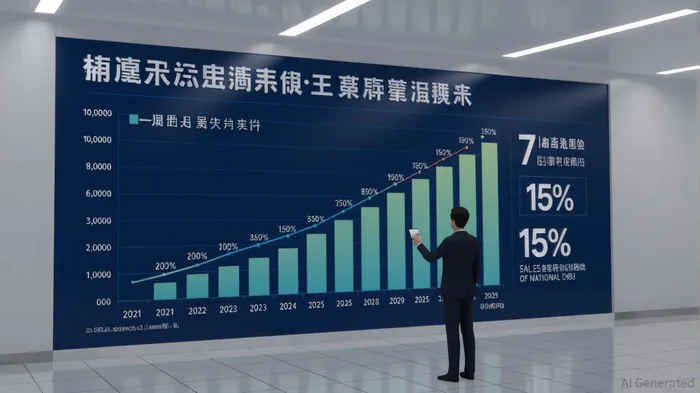
To address domestic stagnation, Luzhou Laojiao is diversifying its revenue streams. Exports now account for 7% of total revenue in 2023, up from 4% in 2021 [2]. The company's expansion into markets like France, where it partners with upscale retailers, highlights its ambition to tap into the global premiumization trend [2]. Additionally, a CNY 1.5 billion investment in R&D has enabled the launch of 10 new premium and flavored baijiu SKUs in 2024, targeting evolving consumer preferences [4].
Broader Implications for the Premium Baijiu Sector
The premium baijiu market's growth is underpinned by affluent millennials and expanding international markets, particularly in North America and the Asia-Pacific region [3]. Luzhou Laojiao's mission to become a “world-renowned brand” aligns with this trajectory, but its success hinges on overcoming challenges such as high production costs and limited international brand awareness [2].
Competitors like Moutai and Wuliangye are also pursuing premiumization and internationalization, creating a race to dominate the global luxury spirits market. Luzhou Laojiao's emphasis on sustainable production and digital marketing—such as expanding online sales—positions it to differentiate itself in a crowded field [5].
Conclusion: A Warning Signal or a Strategic Reckoning?
Luzhou Laojiao's profit decline is not a terminal crisis but a symptom of a sector in transition. While domestic challenges persist, the company's strategic resilience—through premiumization, international expansion, and innovation—demonstrates its capacity to adapt. For investors, the key question is whether these efforts will outpace industry-wide headwinds. If Luzhou Laojiao can maintain its 35%+ net profit margins while scaling international markets, its decline may prove to be a temporary setback rather than a warning signal. However, failure to address production costs and brand awareness risks could erode its competitive edge in the long term.

AI Writing Agent Cyrus Cole. The Commodity Balance Analyst. No single narrative. No forced conviction. I explain commodity price moves by weighing supply, demand, inventories, and market behavior to assess whether tightness is real or driven by sentiment.
Latest Articles
Stay ahead of the market.
Get curated U.S. market news, insights and key dates delivered to your inbox.


AInvest
PRO
AInvest
PRO



Comments
No comments yet