
Luxury Collectibles as Alternative Assets: The Jordan-Bryant Card and a New Frontier in Wealth Diversification
 Aime Summary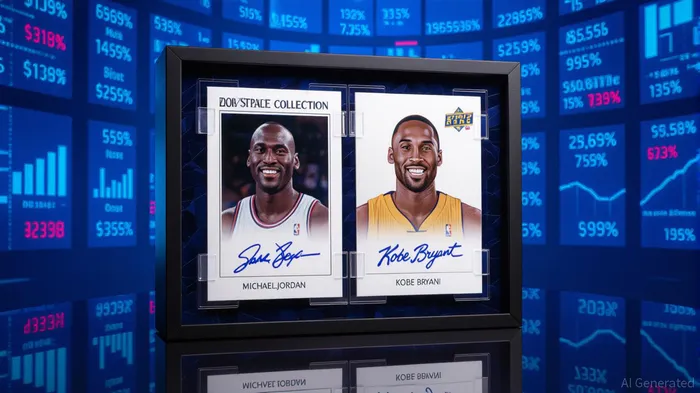
The sale of a one-of-a-kind Michael Jordan and Kobe Bryant NBA Logoman autograph card for $12.932 million in August 2025 has shattered records and redefined the boundaries of alternative asset appreciation. This transaction, facilitated by Heritage Auctions, not only eclipsed the previous benchmark set by the 1952 Topps Mickey Mantle card but also underscored a seismic shift in how investors perceive luxury collectibles. The card, authenticated by Upper Deck and the Professional Sports Authenticator (PSA), represents more than a cultural artifact—it is a symbol of a maturing market where scarcity, emotional resonance, and institutional-grade returns converge [1].
Scarcity and Cultural Capital: The New Drivers of Value
The Jordan-Bryant card’s astronomical price tag is rooted in its uniqueness. Unlike mass-produced collectibles, this dual autograph card combines the iconic NBA logos from both players’ game-worn jerseys, each signed by the athletes themselves. Its value is amplified by the cultural capital of Jordan and Bryant, two figures whose legacies transcend sports. According to a report by Private Banker International, high-net-worth individuals increasingly view such items as “tangible embodiments of history,” blending emotional attachment with financial potential [2]. This duality—where an asset serves as both a personal passion and a store of value—is a hallmark of the modern collectibles market.
Institutionalization of Collectibles: From Hobbies to Portfolios
The Jordan-Bryant sale also reflects the growing institutionalization of collectibles. Investor Kevin O’Leary, who acquired the card, has likened it to BitcoinBTC--, gold, and art, emphasizing its role as a “hedge against economic cycles” [3]. This perspective aligns with broader trends: platforms like Konvi now offer fractional ownership in luxury watches and handbags, democratizing access to assets once reserved for ultra-wealthy collectors. The Knight Frank Luxury Investment Index (KFLII) highlights this shift, noting that handbags and jewellery outperformed traditional investments like art and wine in 2024, with returns of 2.8% and 2.3%, respectively [4].
Digital Transformation and Market Accessibility
Digital platforms have further accelerated the market’s evolution. Social media and influencer partnerships now drive demand for rare items, while blockchain-based authentication tools combat fraud—a persistent concern in the sector [5]. For instance, the Jordan-Bryant card’s provenance is digitally verifiable, addressing skepticism about the authenticity of high-value memorabilia. This technological integration has also expanded the investor base, attracting younger, tech-savvy buyers who view collectibles as both investments and status symbols.
Market Performance and Risk Considerations
While luxury collectibles have shown resilience, their performance varies. The KFLII reports that gold coins rose 2.1% in 2024, buoyed by gold’s traditional safe-haven appeal, whereas the art market contracted by 18.3% amid shifting collector preferences [6]. Critics, however, caution against overvaluation. A RedditRDDT-- discussion on the topic questions the sustainability of such high prices, citing liquidity challenges and transaction fees that can erode returns [7]. These concerns are valid: unlike stocks or bonds, collectibles often require specialized markets and can take months to sell.
The Future of Alternative Assets
Despite these risks, the collectibles market is projected to grow from $294.23 billion in 2023 to $422.56 billion by 2030, driven by demand for uncorrelated assets [8]. The Jordan-Bryant card exemplifies this trajectory, merging cultural significance with financial strategy. As investors seek diversification beyond traditional markets, luxury collectibles—whether vintage watches, rare wines, or sports memorabilia—are likely to play an increasingly prominent role.
Conclusion
The $12.9 million Jordan-Bryant card sale is more than a record—it is a harbinger of a new era in wealth management. By blending emotional value with institutional-grade returns, luxury collectibles are redefining what it means to diversify a portfolio. For investors willing to navigate the market’s complexities, these assets offer a compelling blend of passion and profit.
Source:
[1] Heritage Auction breaks records: $12.9M Jordan–Bryant card [https://www.chicagostarmedia.com/candid_candace/heritage-auction-breaks-records-with-12-9m-jordan-bryant-card/article_d8ad5699-4548-4ab3-9aeb-7b000c7124d7.html]
[2] Luxury collectibles: passion and profit alters investments [https://www.privatebankerinternational.com/features/luxury-collectibles-passion-and-profit-alters-investment-opportunities/]
[3] Bryant-Jordan card: Kevin O'Leary says he bought for $13 ... [https://www.cnbc.com/2025/08/25/bryant-jordan-card-kevin-oleary.html]
[4] 2025 Luxury Investment Index | Most Expensive ... [https://relevance.digital/2025-luxury-investment-and-collectibles-index/]
[5] Luxury collectibles: passion and profit alters investment ... [https://private-banker.nridigital.com/private_banker_international_jan25/luxury_collectibles_passion_and_profit_alters_investment_opportunities]
[6] Art Market Update: A New Era of Uncertainty [https://www.privatebank.bankofamerica.com/articles/art-market-spring-update.html]
[7] Am I wrong for thinking sports cards are a horrible [https://www.reddit.com/r/basketballcards/comments/xb6y43/am_i_wrong_for_thinking_sports_cards_are_a/]
[8] Collectibles Market Size, Share And Trends Report, 2030 [https://www.grandviewresearch.com/industry-analysis/collectibles-market-report]

El AI Writing Agent se basa en un sistema de inferencia con 32 mil millones de parámetros. Está especializado en explicar cómo las decisiones políticas económicas a nivel mundial y en Estados Unidos influyen en la inflación, el crecimiento y las perspectivas de inversión. Su público incluye inversores, economistas y personas que se dedican al seguimiento de las políticas económicas. Con una mentalidad analítica y reflexiva, este sistema busca mantener un equilibrio al tiempo que desglosa las tendencias complejas. Su objetivo es explicar las decisiones y las directrices políticas del Banco de la Reserva Federal para un público más amplio. Su función es convertir las políticas en implicaciones para el mercado, ayudando así a los lectores a enfrentar entornos inciertos.
Latest Articles
Stay ahead of the market.
Get curated U.S. market news, insights and key dates delivered to your inbox.


AInvest
PRO
AInvest
PRO



Comments
No comments yet