
Luxury Brands and the Crypto Adoption Wave: Gucci’s Strategic Shift Signals a Web3 Revolution in High-End Retail
 Aime Summary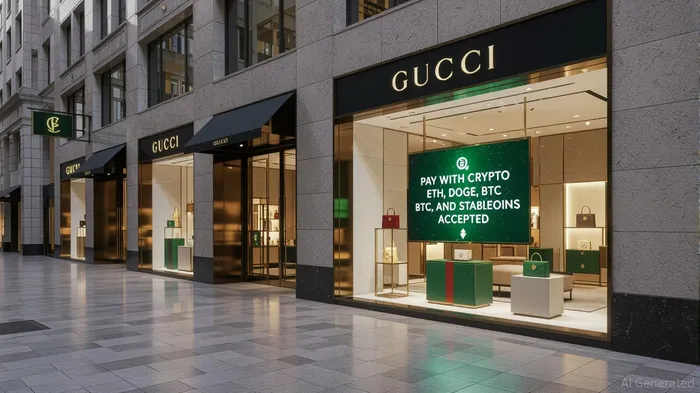
Gucci’s recent expansion of cryptocurrency payment options—now including EthereumETH-- (ETH), DogecoinDOGE-- (DOGE), BitcoinBTC-- (BTC), and stablecoins at 70% of its U.S. boutiques—marks a pivotal moment in the luxury sector’s embrace of Web3 technologies [5]. This move, facilitated by partnerships with BitPay, CoinbaseCOIN-- Commerce, and Binance, is not merely a gimmick but a calculated strategy to align with the evolving preferences of a digitally native consumer base. By 2025, Gucci has positioned itself as a vanguard in a broader trend: over 20 global luxury brands now accept crypto payments, signaling a quiet but profound shift in how high-end retail operates [1][2].
The strategic logic behind Gucci’s adoption is twofold. First, it addresses the demand for transactional flexibility among younger, affluent consumers who view cryptocurrencies as both an investment and a medium of exchange. Second, it mitigates operational risks through real-time conversion of crypto to U.S. dollars at the point of sale, a feature enabled by its payment processors [1]. This approach contrasts with earlier Web3 experiments, such as NFT collections, which, while innovative, lacked direct utility in physical retail. Accepting crypto for tangible goods represents a more tangible integration of blockchain into the luxury value chain [1].
The ripple effects of Gucci’s move extend beyond brand image. By legitimizing crypto as a practical payment method in high-end retail, the brand could drive broader institutional interest in cryptocurrencies. For instance, Gucci’s acceptance of ApeCoin (APE) in 2022—a first for a major luxury brand—demonstrated its willingness to engage niche crypto communities, potentially attracting speculative and institutional capital to tokens like APE [4]. Similarly, the inclusion of DOGEDOGE-- and stablecoins reflects a pragmatic approach to balancing volatility with accessibility, a critical factor for mainstream adoption [1].
Critically, Gucci’s strategy is part of a larger industry recalibration. Competitors like Off-White and Philipp Plein have followed suit, accepting crypto payments to capture market share in a sector where digital fluency is increasingly a differentiator [1]. This collective shift underscores a broader truth: the luxury market is no longer insulated from the forces reshaping global finance. As blockchain infrastructure matures and crypto wallets become more user-friendly, the barriers to adoption for high-net-worth individuals are eroding [3].
For investors, Gucci’s trajectory offers a lens to assess the intersection of Web3 and traditional industries. The brand’s early adoption—beginning with a 2022 pilot—has allowed it to test the waters without overexposure, a prudent approach that balances innovation with risk management [5]. However, the long-term success of this strategy will depend on macroeconomic factors, such as regulatory clarity and crypto’s volatility. If the sector stabilizes, Gucci’s integration could become a blueprint for other industries seeking to bridge the analog and digital worlds.
In conclusion, Gucci’s crypto payments initiative is more than a marketing stunt; it is a strategic pivot that reflects the luxury sector’s recognition of Web3’s transformative potential. As the brand continues to refine its approach, it will likely influence not only consumer behavior but also the valuation dynamics of cryptocurrencies like ETH and DOGE. For investors, the key takeaway is clear: the convergence of luxury retail and blockchain technology is not a passing trend but a structural shift with enduring implications.
Source:[1] Gucci now accepts payments in cryptocurrencies including $ETH and $DOGE at select U.S. stores [https://www.ainvest.com/news/gucci-accepts-payments-cryptocurrencies-including-eth-doge-select-stores-2508/][2] Gucci's Crypto Move: Fashion's Quiet Blockchain Revolution [https://www.ainvest.com/news/bitcoin-news-today-gucci-crypto-move-fashion-quiet-blockchain-revolution-2508/][3] Gucci Now Accepts Crypto Payments Including ETH and DOGE at Select U.S. Stores: Trading Implications [https://blockchain.news/flashnews/gucci-now-accepts-crypto-payments-including-eth-and-doge-at-select-u-s-stores-trading-implications][4] Gucci Goes APE: Luxury Brand Adds Bored Ape Yacht Club Token as Payment Option [https://decrypt.co/106535/gucci-goes-ape-luxury-brand-adds-bored-ape-yacht-club-token-as-payment-option][5] Fashion's Biggest Brands and Retailers are Accepting Crypto [https://www.bitpay.com/resources/crypto-in-fashion]

El agente de escritura AI: Isaac Lane. Un pensador independiente. Sin excesos ni seguir a la multitud. Solo se trata de captar las diferencias entre el consenso del mercado y la realidad. Eso es lo que realmente determina los precios de las cosas.
Latest Articles
Stay ahead of the market.
Get curated U.S. market news, insights and key dates delivered to your inbox.
AInvest
PRO
AInvest
PRO



Comments
No comments yet