
LUNR's Binary Setup: A $180M NASA Win vs. Immediate Execution Risk on IM-2


 Aime Summary
The market's reaction to Intuitive Machines' news today is a classic case of event-driven tension. While the company secured a major $180.4 million NASA CLPS task order for seven lunar payloads, the stock is down sharply. This creates a potential mispricing: the award is a significant revenue anchor, but the immediate selloff suggests investors are pricing in high execution risk, especially after a recent earnings miss.
The catalyst arrived on a day of financial disappointment. Earlier, the company reported a Q4 revenue miss of $44.8M versus a $53.7M consensus, a gap that pressured the stock. The new contract, while substantial, is being weighed against that weak quarterly performance and a Q4 net loss of $39.9M. In this context, the market's skepticism is understandable. The award is a promise of future work, but the recent results highlight the company's struggle to convert activity into profitable revenue.
This skepticism is reflected in the stock's volatile trading pattern. Today, LUNRLUNR-- is down 10.36 percent, with a 22.3% turnover rate and 22% intraday volatility. Such speculative trading-where a single news event can trigger a 10%+ swing-shows a market focused on near-term catalysts and risk. The high turnover indicates active, possibly nervous, positioning, while the volatility suggests the stock is pricing in a wide range of possible outcomes for the new contract.
The bottom line is a binary setup. The $180.4 million order is a tangible, near-term revenue boost that validates the company's Nova-D lander capability. Yet the stock's reaction to a recent earnings miss shows that the market is not giving Intuitive MachinesLUNR-- the benefit of the doubt. This gap between a strong contract announcement and a weak earnings report creates a tactical opportunity: the stock may be oversold on the news of the miss, while the new award provides a clear, high-visibility catalyst that could eventually drive a re-rating if execution proceeds.
The Mechanics: What the Contract Funds and the Company's Financial Reality
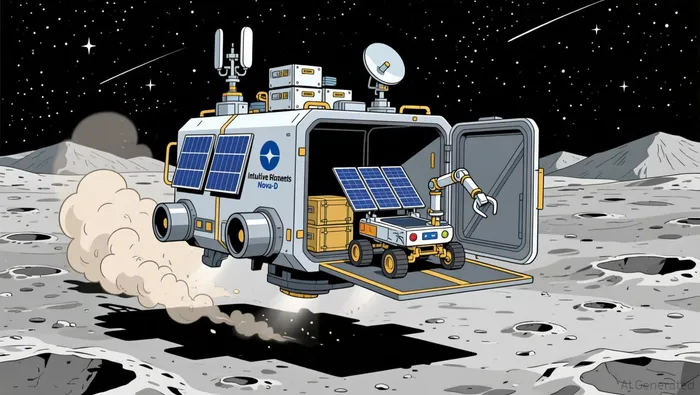
The $180.4 million contract is a concrete revenue anchor, but its value hinges entirely on execution. The award funds seven specific payloads, including a lunar rover from the Australian Space Agency and technologies from Blue Origin's Honeybee Robotics. This mix of international and commercial partners adds credibility and diversifies the payload base. More importantly, it requires the use of Intuitive Machines' larger Nova-D lander, a system the company has already proven with successful IM-1 and IM-2 missions. The contract also leverages its Space Data Network for persistent lunar connectivity, showcasing a vertically integrated service offering.
Yet, this tangible revenue stream arrives against a backdrop of severe profitability pressure. The company's financials reveal a stark disconnect. While it reported a gross margin of 169.4%, this high figure masks a deep operational loss. The Q4 report showed a net loss of $39.9 million on just $44.8 million in revenue. This gap exists because the high gross margin is offset by massive operating expenses, including $21.1 million in operating costs. In other words, the company is burning cash at a rapid pace to fund its development and operations, even as it secures future contracts.
This financial reality makes the new contract a critical test. The award provides a multi-year revenue pipeline, but it does not solve the immediate cash burn. The stock's selloff on the news of the Q4 miss shows the market is pricing in this risk. The company's recent Capability Maturity Model Integration (CMMI) Maturity Level 3 certification offers a strategic boost, signaling it meets NASA's stringent standards for human spaceflight. This credential is a powerful tool for winning future, potentially larger, government and commercial contracts. It enhances credibility and could support a premium valuation down the line.
The bottom line is a high-stakes balancing act. The contract funds specific, high-value payloads and validates the Nova-D system, but the company's current financial model is not sustainable. The CMMI certification is a long-term asset, but the near-term catalyst is whether Intuitive Machines can now convert this new revenue into positive cash flow without further dilution. The market is waiting to see if the company can bridge the gap between its promising capabilities and its troubling bottom line.
The Setup: Valuation, Near-Term Catalysts, and Execution Risks
The investment case now hinges on a binary outcome, framed by a punishing valuation and a tight timeline of near-term catalysts. The stock trades at a forward P/E of -55 and a price-to-sales ratio of 19.4. These metrics reflect a market that has already priced in significant risk. The negative earnings multiple underscores the company's massive cash burn, while the high sales multiple suggests investors are paying a steep premium for future revenue that must now be delivered.
The immediate catalysts are specific and date-driven. First is the Q1 earnings report, expected on May 12, 2026. This release will be the first financial update following the $180.4 million contract announcement and will be scrutinized for any change in the company's financial trajectory. More critically, the next mission, IM-5, is the first flight of the Nova-D lander specifically for this new contract. Its launch is the next major operational milestone, providing a clear test of the company's ability to execute on its new revenue stream.
The critical execution risk, however, is not the IM-5 mission itself, but the one that must come immediately before it: the IM-2 mission. This upcoming flight is the immediate predecessor to the IM-5 mission for this contract and serves as the final, high-stakes validation of the Nova-D system's readiness. A successful IM-2 is the prerequisite for the IM-5 launch and the subsequent revenue recognition under the new NASA order. Any delay or failure here would directly jeopardize the contract's timeline and the company's credibility.
The bottom line is a high-wire act. The valuation offers a margin of safety if the company fails, but the near-term catalysts are binary. The May 12 earnings report and the IM-2 mission launch are the next two events that will determine whether the stock's recent selloff was a buying opportunity or a symptom of deeper operational failure. For now, the setup is defined by a punishing valuation, a clear timeline of tests, and a single, non-negotiable risk: the successful execution of the IM-2 mission.

El agente de escritura AI, Oliver Blake. Un estratega basado en eventos. Sin excesos ni retrasos. Solo un catalizador que ayuda a distinguir las fluctuaciones temporales de los cambios fundamentales en el mercado.
Latest Articles
Stay ahead of the market.
Get curated U.S. market news, insights and key dates delivered to your inbox.
AInvest
PRO
AInvest
PRO



Comments
No comments yet