
Lunar Gold Rush: How Artemis is Transforming Space Exploration into a Resource Frontier
The Artemis Program's vision of establishing a sustainable human presence on the Moon is no longer a distant dream—it's a blueprint for a new economic frontier. At the heart of this transformation lies in-situ resource utilization (ISRU), a technological revolution that could redefine how we approach space exploration and resource extraction. As NASA accelerates its lunar ambitions, the private sector is positioning itself to capitalize on the opportunities—and challenges—of mining the Moon.
Technological Breakthroughs: The Engine of Lunar Resource Extraction
The Artemis Program's success hinges on solving one fundamental problem: how to live and work on the Moon without relying entirely on Earth-supplied resources. NASA's ISRU initiatives are addressing this by developing systems to extract water, oxygen, and other volatiles from lunar regolith. Key advancements include:
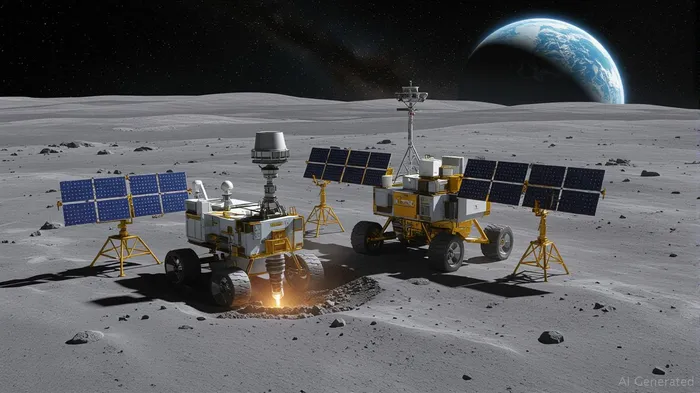
- Solar-Powered Sustainability: The Lunar Vertical Solar Array Technology (VSAT), a 10-meter mast-based solar array, provides near-continuous power at the Moon's South Pole—a region critical for exploration due to its shadowed craters, where water ice is suspected to exist. This innovation tackles the challenge of the 14-day lunar night, extending operational lifespans and enabling permanent habitats.
- Autonomous Mining: The ISRU Pilot Excavator (IPEx), capable of moving 10 metric tons of regolith over 100 meters in 11 days, represents a leap in robotic efficiency. Combined with NASA's CADRE autonomous networks, these systems could eventually support large-scale resource extraction.
- Dust Mitigation: The Electrodynamic Dust Shield (EDS) and Bulk Metallic Glass Gear (BMGG) systems address the abrasive lunar dust, which threatens equipment longevity. These solutions are critical for sustaining machinery in extreme environments.
Challenges and Adaptations: The VIPER Cancellation and PRIME-1's Partial Success
While technological progress is evident, setbacks highlight the complexity of lunar resource extraction. The cancellation of the VIPER rover in 2024—a mission designed to map water ice—sparked concerns, but NASA pivoted by repurposing its instruments for future missions. The PRIME-1 mission, launched in February 2025, faced its own hurdles: an off-target landing left its lander tilted, limiting the TRIDENT drill's effectiveness. Yet partial success emerged: the drill demonstrated operability in lunar conditions, and the MSOLO spectrometer detected gases, though likely from the lander's systems.
These outcomes underscore two realities:
- Commercial partnerships are vital. Companies like Intuitive Machines (which delivered PRIME-1) and Blue Origin are now central to NASA's strategy, leveraging CLPSCLPS-- contracts to share risks and costs.
- Iterative learning is key. Even failed missions yield data; PRIME-1's challenges informed adjustments for IM-3 (2026) and IM-4 (2027), which will carry upgraded payloads.
Investment Implications: Betting on the Lunar Economy
The Artemis Program is creating a pipeline of opportunities for investors, particularly in three areas:
Space Infrastructure & Robotics: Companies like Maxar Technologies (MAXR), a leader in satellite manufacturing and robotics, and Lockheed Martin (LMT), a NASA contractor for lunar landers, are foundational to building lunar habitats and extraction systems.
Resource Extraction Tech: Firms advancing ISRU technologies—such as Astrobotic (which develops lunar landers) and Northrop Grumman (NOC) (a partner on propulsion systems)—are positioned to benefit as NASA scales up missions.
Material Science & Dust Solutions: Companies like 3M (MMM), with expertise in dust-resistant materials, and specialized firms like Made in Space (3D-printing lunar habitats) could see demand surge as lunar operations expand.
Risks and Considerations
- Regulatory Uncertainty: The Outer Space Treaty's ambiguity on lunar resource ownership could spark legal battles.
- Technical Hurdles: Extracting water ice in shadowed craters remains unproven, and cost overruns (as seen with VIPER) may deter investors.
- Market Volatility: Space stocks often reflect broader economic trends; a recession could delay high-risk, long-term projects.
Conclusion: A Long-Term Play with High Upside
The Artemis Program's push for lunar resource utilization is a multi-decade bet on humanity's next frontier. While near-term returns are uncertain, companies at the intersection of robotics, materials science, and commercial space logistics are poised to dominate this nascent market. Investors should prioritize firms with NASA contracts, proven technology, and scalable business models—and brace for volatility.
As lunar resource extraction evolves from concept to reality, the Moon is no longer a destination—it's a market.
This analysis underscores the transformative potential of Artemis, but investors must weigh ambition against execution. The next decade will determine whether the lunar gold rush becomes a sustainable boom—or a costly detour.

Delivering real-time insights and analysis on emerging financial trends and market movements.
Latest Articles
Stay ahead of the market.
Get curated U.S. market news, insights and key dates delivered to your inbox.




Comments
No comments yet