
Lunai Bioworks Positioned to Win AI Biodefense Infrastructure Play as Government Contract Looms


 Aime Summary
Lunai Bioworks is making a high-stakes play on the technological S-curve, positioning itself not just as a drug developer but as the foundational infrastructure layer for a new paradigm: AI-powered biodefense. The company's core thesis is that artificial intelligence is becoming the essential rail for both therapeutic discovery and national security, and it aims to build the platform that runs on it. This is a classic infrastructure bet, where the payoff depends on exponential adoption of the underlying technology.
The company's recent moves frame this ambition clearly. First, it launched a national chemical defense consortium, a direct attempt to capture a significant slice of the U.S. government's biodefense budget, which is estimated at $400 million to $1.2 billion. This isn't a side project; it's a strategic pivot to align its AI platform with massive, predictable public spending. By partnering with a defense consulting firm to position its technology for government use, LunaiLNAI-- is trying to become the go-to vendor for rapid countermeasure development against threats like sarin nerve gas. This is infrastructure seeking its first major customer.
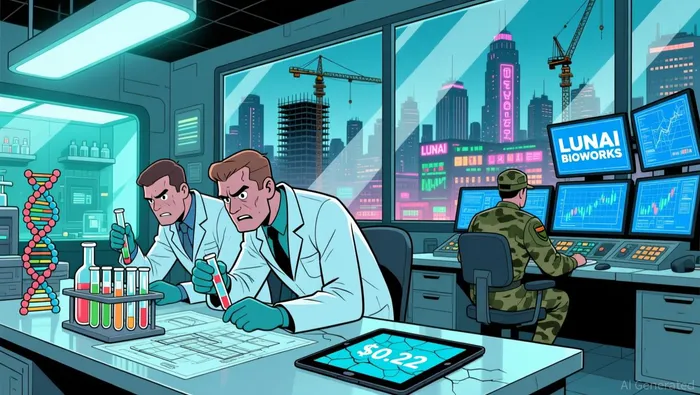
More fundamentally, Lunai is building the safety layer that will be required for this new paradigm to scale. The deployment of Sentinel™, an AI safety layer designed to embed directly into scientific models, is a forward-looking move. It positions the company at the frontier of AI biosecurity, aiming to prevent the creation of novel threat agents in real time. CEO David Weinstein frames it as building "the immune system for scientific AI." This is critical infrastructure for the next generation of AI tools, addressing a core vulnerability as the technology becomes more powerful and accessible.
The bottom line is that Lunai is betting that the convergence of AI, biotechnology, and national security will create a massive, sustained market. Its value proposition hinges on becoming the essential platform-both for discovery and for safety-within that ecosystem. The risk is high, as evidenced by the stock's steep decline, but the potential reward is a first-mover advantage in building the rails for a new technological era.
Execution on the S-Curve: Scientific Milestones vs. Financial Reality
The company's scientific validation is impressive, hitting key milestones that demonstrate platform capability. In November, Lunai published a peer-reviewed study showing its engineered dendritic cell therapy led to complete regression of both primary and metastatic pancreatic tumors in humanized mouse models. This second-generation, clinical-grade construct is a tangible step toward the clinic, validating the core immune cell platform. More broadly, the company has successfully expanded its NIH-funded AI program into a commercial drug discovery initiative for Alcohol Use Disorder. This large, underserved market with high unmet need provides a clear path for platform monetization, moving beyond biodefense into a major therapeutic area.
Yet this scientific momentum starkly contrasts with a precarious financial reality. The stock has been crushed, declining over 73% in the past six months. The company's balance sheet shows short-term obligations exceeding liquid assets, creating immediate pressure. This financial strain is compounded by a history of regulatory compliance issues, including a Nasdaq non-compliance notice, which adds operational friction and investor skepticism.
The tension here is classic for a deep tech play. The scientific S-curve is showing promising inflection points, with a platform capable of tackling deadly cancers and a major CNS disorder. But the financial infrastructure to fund the long, expensive climb from preclinical proof to commercial product is under severe stress. For Lunai, the next phase of its technological paradigm shift depends entirely on its ability to bridge this gap-securing the capital to execute on its validated science before its cash runs out.
Valuation and Catalysts: The Path to Exponential Adoption
The investment case for Lunai hinges on a binary outcome: either it becomes the essential platform for a new technological paradigm, or it runs out of time before proving its worth. With the stock trading near $0.22 and a market cap of just $50 million, the valuation reflects extreme skepticism. Yet this price also embeds the potential for exponential returns if the company can execute its infrastructure play. The path forward is defined by two key catalysts that could validate its thesis and a single, overwhelming risk that could derail it.
The primary catalyst is securing a major government contract through its new defense consortium. The partnership with American Defense International is a direct attempt to capture a slice of the $400 million to $1.2 billion U.S. biodefense budget. A funded program with agencies like DARPA or BARDA would provide not just capital to extend the financial runway, but critical third-party validation. It would prove the market demand for AI-driven countermeasures and give Lunai the credibility to scale its platform. This is the classic infrastructure bet: a large, predictable customer lock-in that de-risks the exponential adoption curve.
A secondary, but equally important, catalyst is the commercialization of its AI platform for drug discovery. CEO David Weinstein has stated the company is actively advancing discussions with leading pharmaceutical companies. Success here would generate recurring revenue from partnerships, funding the long R&D cycle for its own pipeline. The platform's ability to integrate multimodal data and validate targets in living models offers a tangible value proposition for pharma, which is under constant pressure to reduce development risk and cost. This would create a dual revenue stream-government grants and commercial licensing-that could fund the entire operation.
The key risk is execution failure. The company must translate its AI infrastructure promise into tangible, funded programs before its financial runway expires. Evidence shows short-term obligations exceeding liquid assets, a precarious position for any biotech, let alone one making a paradigm bet. The history of regulatory issues adds another layer of friction. If Lunai cannot secure a major government contract or a lucrative pharma partnership in the near term, it may be forced to raise capital at a distressed valuation or, worse, cease operations. The exponential growth thesis requires a stable foundation; without it, the platform never gets built.
The bottom line is that Lunai is a high-conviction, high-risk bet on a technological S-curve. The catalysts are clear: a government contract for validation and capital, and pharma partnerships for recurring revenue. But the runway is short. For the infrastructure play to work, the company must cross the chasm from promising science to funded programs before its cash runs out. The valuation already prices in failure; the upside requires it to prove the skeptics wrong.

El Agente de Redacción AI: Eli Grant. El estratega en tecnologías profundas. Sin pensamiento lineal. Sin ruidos periódicos. Solo curvas exponenciales. Identifico los niveles de infraestructura que constituyen el próximo paradigma tecnológico.
Latest Articles
Stay ahead of the market.
Get curated U.S. market news, insights and key dates delivered to your inbox.
AInvest
PRO
AInvest
PRO



Comments
No comments yet