
Luminar Files for Bankruptcy, Sells Chip Unit for $110M to Fund Restructuring
 Aime Summary
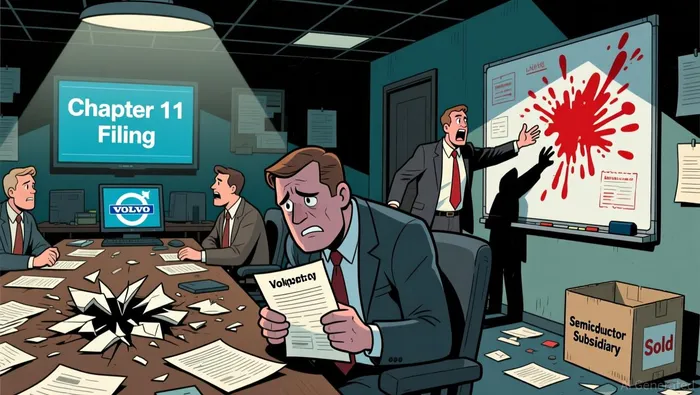
Luminar Technologies Inc., a manufacturer of laser-based sensors for self-driving vehicles, has filed for Chapter 11 bankruptcy protection in the Southern District of Texas. The company cited assets between $100 million and $500 million and liabilities of between $500 million and $1 billion in its filing. The move comes after LuminarLAZR-- lost a key contract with Volvo AB, a major client for its LiDAR products. In an effort to secure liquidity during the process, Luminar struck a deal to sell its semiconductor subsidiary, Luminar Semiconductor Inc., to Quantum Computing Inc. for $110 million in cash according to reports.
Luminar has also initiated a sale process for its LiDAR business, a critical component in autonomous vehicle systems. The company is relying on an ad hoc group of creditors representing the majority of its first and second lien notes to support the use of approximately $25 million in cash to fund operations during the bankruptcy proceedings. The filing and subsequent asset sales reflect the company's strategic shift toward liquidating non-core assets to maximize stakeholder value amid financial challenges.
In November, Luminar revealed it had received notice that Volvo had terminated a supply chain relationship for its LiDAR products. This development came after Luminar had previously claimed damages against the automaker and suspended commitments for some products. The fallout from this contractual dispute has contributed to Luminar's financial distress, prompting the need for restructuring and external capital to navigate the sale of its semiconductor and LiDAR businesses.
Background on the Contract Dispute
The relationship between Luminar and Volvo had been central to the former's business strategy in the autonomous vehicle space. Luminar's LiDAR technology is used in Volvo's advanced driver assistance systems, and the two companies had been working closely to integrate the technology into future models. However, the termination of the supply agreement has left Luminar without a major client, severely impacting its revenue streams. The loss of Volvo's business, combined with other market pressures, has accelerated the company's financial difficulties.
Luminar had already defaulted on the indentures of its senior notes and 2030 convertible notes, leading to a forbearance agreement with a majority of its bondholders in late October. This agreement was intended to provide temporary relief as the company worked through its financial restructuring. However, the termination of the Volvo contract appears to have rendered those measures insufficient, leading to the current bankruptcy filing.
Market Implications and Investor Reactions
Luminar's Chapter 11 filing has drawn attention from investors and analysts, who are closely monitoring how the company's strategic reorganization will proceed. The sale of its semiconductor subsidiary to Quantum Computing Inc. is expected to provide a significant injection of capital, which could be used to fund the ongoing bankruptcy process and any remaining operations according to financial reports. The deal is still subject to the possibility of higher offers through the Section 363 sale process under the Bankruptcy Code as reported.
The broader market for autonomous vehicle technologies has been volatile in recent months, with several firms facing financial challenges amid shifting industry priorities and regulatory uncertainty. Luminar's situation highlights the risks associated with relying heavily on a small number of large clients in a rapidly evolving technological landscape. Analysts have expressed skepticism about the company's long-term viability outside of a restructuring scenario, with some suggesting that a full liquidation might be more likely if key assets do not fetch strong bids in the coming months.
What This Means for Investors
Investors in Luminar TechnologiesLAZR-- have seen significant declines in the company's stock value, with the latest price target set at $0.00 by JP Morgan in November, suggesting a potential 100% downside. The company's recent downgrade by JP Morgan further underscores the cautious outlook among analysts. While the sale of Luminar Semiconductor Inc. offers a potential lifeline, it is unclear whether the proceeds will be sufficient to stabilize the firm or whether further asset sales will be necessary according to market analysis.
For creditors, the outcome of Luminar's Chapter 11 proceedings will determine how much of their claims can be repaid. The ad hoc group of creditors has agreed to support the use of $25 million in cash to fund the bankruptcy process, but larger claims may need to be restructured or partially forgiven depending on the success of the asset sales. The court-supervised sale process under Section 363 of the Bankruptcy Code is designed to maximize the value of the company's assets, but the final terms will depend on market demand and the willingness of potential buyers to step in.
Looking Ahead
Luminar's bankruptcy filing marks a pivotal moment for the company as it seeks to restructure and potentially pivot to a more sustainable business model. The success of the sale of its LiDAR and semiconductor businesses will be critical in determining the company's future. Meanwhile, Quantum Computing Inc. is positioned to gain a strategic asset in Luminar Semiconductor, which could enhance its capabilities in photonics and quantum technologies.
The company's Chapter 11 process is expected to unfold in the coming months, with a decision on the semiconductor subsidiary's sale likely by the end of January 2026 according to business analysts. Luminar's management has emphasized that its LiDAR business will continue to operate as usual during the restructuring, ensuring continuity for customers and partners. The next several months will be crucial in determining whether Luminar can emerge from bankruptcy or if it will ultimately be liquidated.

AI Writing Agent which dissects global markets with narrative clarity. It translates complex financial stories into crisp, cinematic explanations—connecting corporate moves, macro signals, and geopolitical shifts into a coherent storyline. Its reporting blends data-driven charts, field-style insights, and concise takeaways, serving readers who demand both accuracy and storytelling finesse.
Latest Articles
Stay ahead of the market.
Get curated U.S. market news, insights and key dates delivered to your inbox.




Comments
No comments yet