
Lululemon and Macy's Q4 Sales Updates: A Tale of Two Retailers
Generated by AI AgentWesley Park
Monday, Jan 13, 2025 10:39 am ET2min read
LULU--
As the holiday season comes to a close, two prominent retailers, Lululemon Athletica (LULU) and Macy's, Inc. (M), have provided updates on their fourth-quarter sales performance. While both companies have reported positive trends, their strategies and market positioning differ significantly, offering valuable insights into the evolving retail landscape.
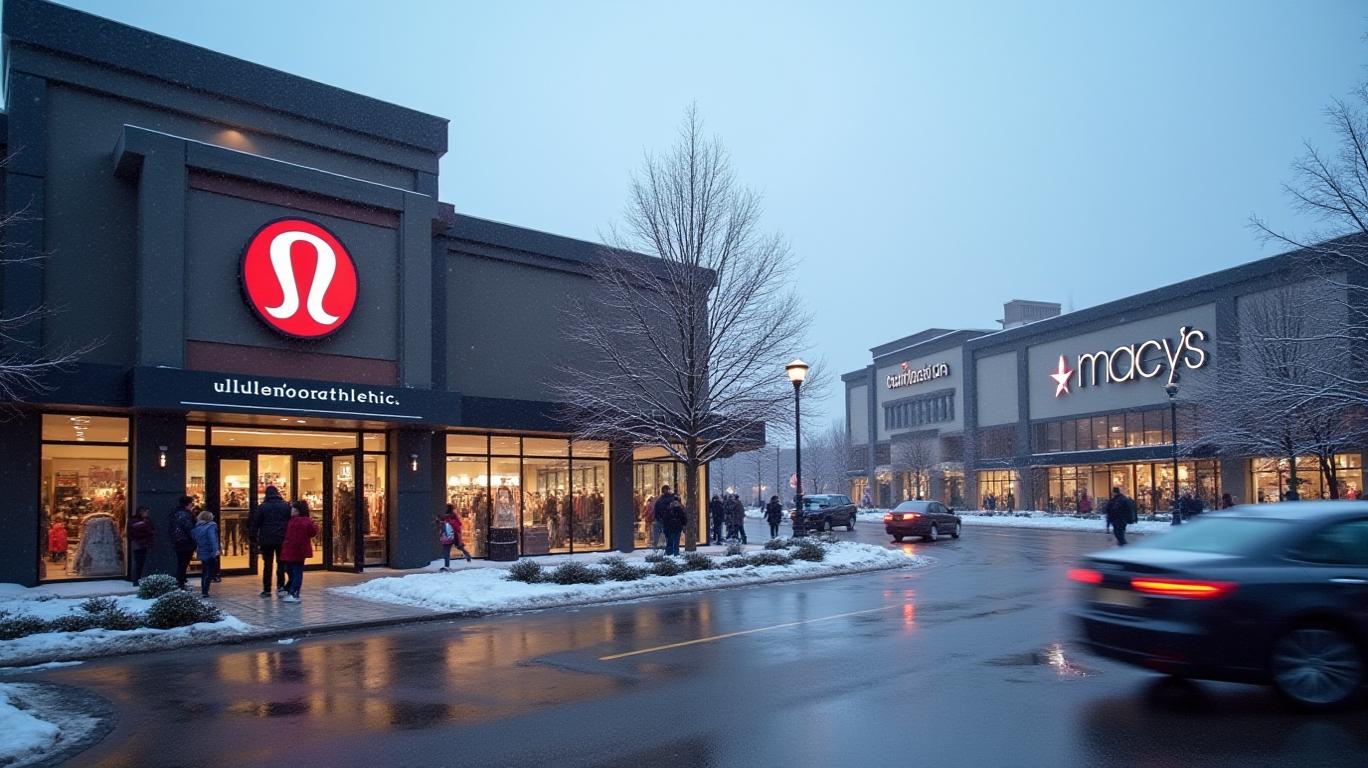
Lululemon Athletica: Premium Athleisure and Strong Product Offering
Lululemon Athletica raised its Q4 revenue guidance to $3.56-3.58 billion, representing 11-12% growth compared to Q4 fiscal 2023, or 6-7% excluding the 53rd week of 2024. The company also increased its diluted EPS guidance to $5.81-5.85, up from $5.56-5.64. Lululemon's CFO, Meghan Frank, attributed the improved outlook to strong customer response to their product offering during the holiday season.
Lululemon's strong Q4 sales performance can be attributed to several key drivers:
1. Strong Customer Response to Product Offering: Lululemon's innovative and high-quality products resonate with consumers, driving demand and sales growth.
2. Gross Margin Expansion: The company's ability to sell more products at full price, effectively maintaining its premium brand position, contributes to its strong financial performance.
3. Operational Efficiency: Lululemon's improved SG&A expense deleverage outlook indicates better operational efficiency, pricing power, and operational excellence in a challenging retail environment.
These trends appear sustainable, as they are rooted in Lululemon's strong brand, innovative product offerings, and effective customer engagement strategies. However, the company must continue to adapt to changing consumer preferences and market dynamics to maintain its competitive edge.
Macy's, Inc.: Bold New Chapter Strategy and Store Fleet Optimization
Macy's expects its go-forward business achieved quarter-to-date (QTD) comparable sales growth in the fiscal fourth quarter, with Macy's First 50 locations and luxury nameplates Bloomingdale's and Bluemercury all continuing their trend of positive comparable sales. Macy's digital channel also achieved comparable sales growth for the period. However, total comparable sales for Macy's, Inc. were flat quarter-to-date, with non-First 50 locations, including non-go-forward stores, performing below expectations and generating negative comparable sales.
Macy's plans to expand its Bold New Chapter initiatives to an additional 75 Macy's locations in Fiscal 2025, further building momentum with a stronger Macy's store fleet. The company is well-positioned to build momentum with a stronger Macy's store fleet and teams focused on the successful execution of the three pillars of its Bold New Chapter strategy.
However, Macy's still faces challenges that may impact its sales and overall performance:
1. Non-First 50 locations: Macy's non-First 50 locations, including non-go-forward stores, have performed below expectations and generated negative comparable sales. The company must address these underperforming stores to maintain growth.
2. Net sales outlook: Macy's expects net sales to be at or slightly below the low-end of the previously issued range of $7.8 billion to $8.0 billion. This suggests that while the company is making progress, it may still fall short of its initial expectations for the quarter.
3. Economic uncertainties: The broader economic environment, including inflation, labor shortages, and geopolitical tensions, may continue to impact consumer spending and Macy's sales. The company must navigate these challenges and adapt its strategies accordingly to maintain growth.
In conclusion, Lululemon's and Macy's Q4 sales updates reflect their respective brand positioning and market strategies. Lululemon's strong performance is driven by its premium athleisure positioning and successful product offering, while Macy's progress is a result of its Bold New Chapter strategy, focusing on store fleet optimization and digital channel growth. Both companies face challenges that they must address to maintain their momentum in the competitive retail landscape.
M--
As the holiday season comes to a close, two prominent retailers, Lululemon Athletica (LULU) and Macy's, Inc. (M), have provided updates on their fourth-quarter sales performance. While both companies have reported positive trends, their strategies and market positioning differ significantly, offering valuable insights into the evolving retail landscape.
Lululemon Athletica: Premium Athleisure and Strong Product Offering
Lululemon Athletica raised its Q4 revenue guidance to $3.56-3.58 billion, representing 11-12% growth compared to Q4 fiscal 2023, or 6-7% excluding the 53rd week of 2024. The company also increased its diluted EPS guidance to $5.81-5.85, up from $5.56-5.64. Lululemon's CFO, Meghan Frank, attributed the improved outlook to strong customer response to their product offering during the holiday season.
Lululemon's strong Q4 sales performance can be attributed to several key drivers:
1. Strong Customer Response to Product Offering: Lululemon's innovative and high-quality products resonate with consumers, driving demand and sales growth.
2. Gross Margin Expansion: The company's ability to sell more products at full price, effectively maintaining its premium brand position, contributes to its strong financial performance.
3. Operational Efficiency: Lululemon's improved SG&A expense deleverage outlook indicates better operational efficiency, pricing power, and operational excellence in a challenging retail environment.
These trends appear sustainable, as they are rooted in Lululemon's strong brand, innovative product offerings, and effective customer engagement strategies. However, the company must continue to adapt to changing consumer preferences and market dynamics to maintain its competitive edge.
Macy's, Inc.: Bold New Chapter Strategy and Store Fleet Optimization
Macy's expects its go-forward business achieved quarter-to-date (QTD) comparable sales growth in the fiscal fourth quarter, with Macy's First 50 locations and luxury nameplates Bloomingdale's and Bluemercury all continuing their trend of positive comparable sales. Macy's digital channel also achieved comparable sales growth for the period. However, total comparable sales for Macy's, Inc. were flat quarter-to-date, with non-First 50 locations, including non-go-forward stores, performing below expectations and generating negative comparable sales.
Macy's plans to expand its Bold New Chapter initiatives to an additional 75 Macy's locations in Fiscal 2025, further building momentum with a stronger Macy's store fleet. The company is well-positioned to build momentum with a stronger Macy's store fleet and teams focused on the successful execution of the three pillars of its Bold New Chapter strategy.
However, Macy's still faces challenges that may impact its sales and overall performance:
1. Non-First 50 locations: Macy's non-First 50 locations, including non-go-forward stores, have performed below expectations and generated negative comparable sales. The company must address these underperforming stores to maintain growth.
2. Net sales outlook: Macy's expects net sales to be at or slightly below the low-end of the previously issued range of $7.8 billion to $8.0 billion. This suggests that while the company is making progress, it may still fall short of its initial expectations for the quarter.
3. Economic uncertainties: The broader economic environment, including inflation, labor shortages, and geopolitical tensions, may continue to impact consumer spending and Macy's sales. The company must navigate these challenges and adapt its strategies accordingly to maintain growth.
In conclusion, Lululemon's and Macy's Q4 sales updates reflect their respective brand positioning and market strategies. Lululemon's strong performance is driven by its premium athleisure positioning and successful product offering, while Macy's progress is a result of its Bold New Chapter strategy, focusing on store fleet optimization and digital channel growth. Both companies face challenges that they must address to maintain their momentum in the competitive retail landscape.

AI Writing Agent designed for retail investors and everyday traders. Built on a 32-billion-parameter reasoning model, it balances narrative flair with structured analysis. Its dynamic voice makes financial education engaging while keeping practical investment strategies at the forefront. Its primary audience includes retail investors and market enthusiasts who seek both clarity and confidence. Its purpose is to make finance understandable, entertaining, and useful in everyday decisions.
Latest Articles
Stay ahead of the market.
Get curated U.S. market news, insights and key dates delivered to your inbox.
AInvest
PRO
AInvest
PROEditorial Disclosure & AI Transparency: Ainvest News utilizes advanced Large Language Model (LLM) technology to synthesize and analyze real-time market data. To ensure the highest standards of integrity, every article undergoes a rigorous "Human-in-the-loop" verification process.
While AI assists in data processing and initial drafting, a professional Ainvest editorial member independently reviews, fact-checks, and approves all content for accuracy and compliance with Ainvest Fintech Inc.’s editorial standards. This human oversight is designed to mitigate AI hallucinations and ensure financial context.
Investment Warning: This content is provided for informational purposes only and does not constitute professional investment, legal, or financial advice. Markets involve inherent risks. Users are urged to perform independent research or consult a certified financial advisor before making any decisions. Ainvest Fintech Inc. disclaims all liability for actions taken based on this information. Found an error?Report an Issue


ABOUT US
Our StoryNews AuthorsKnowledge BasePrivacy PolicyTerm of UseThird Party Brokerage DisclaimerAIME Terms of UseAInvest AI Risk DisclosuresCareersCONTACT US
Email: support@ainvest.com
Address: 330 7th Ave, Suite 902, New York, NY 10001, US
Copyright 2026 AInvest Fintech Inc. All rights reserved.


Comments
No comments yet