
Lululemon's Leadership Vacuum: A Catalyst for a Strategic Reset or a Sign of Deeper Trouble?
 Aime Summary
The immediate catalyst is clear. After a seven-year tenure that saw revenue more than triple, CEO Calvin McDonald is stepping down effective January 31, 2026. His departure, announced alongside the company's Q3 2025 results, comes as the board initiates a "comprehensive search process" for a permanent replacement. In the interim, Chair Marti Morfitt will serve as Executive Chair, while CFO Meghan Frank and Chief Commercial Officer André Maestrini will co-lead as interim CEOs.
This leadership change is unfolding against a stark backdrop. The stock has shed nearly half its value over the past year, trading at a 52-week low of $159.25. The company's recent financials show a business under pressure, with net revenue growth slowing to just 7% year-over-year and comparable sales in its core U.S. market declining. The market's verdict is harsh: a rolling annual return of -49.39% signals deep skepticism about the current trajectory.
The situation has been complicated by a direct challenge to the board. Just over two weeks after McDonald's exit, founder Chip Wilson has launched a proxy fight, nominating three new director candidates. Wilson's stated criticism-that management has lost the brand's "cool"-frames the leadership vacuum not as a routine transition but as a crisis of identity and strategy. This move introduces a layer of internal conflict, raising questions about whether the board's search will be a clean slate or a battleground.
The core investment question is now acute. Is this a high-risk, high-opportunity catalyst for a strategic reset? The plummeting stock price and Wilson's intervention suggest the market sees profound trouble. Yet, the fact that McDonald's departure was "carefully considered" by the board, and that the company has a strong interim leadership team, also hints at a managed transition. The catalyst here is the convergence of a leadership change, a sharp stock decline, and a boardroom fight-all happening at a moment when the brand's growth story appears to stalling.
The Operational Reality: A Sputtering Product Engine and Discounting
The leadership change is the headline, but the operational engine is sputtering. CEO Calvin McDonald's candid September admission that the company's casual offerings have become "too predictable" is the clearest diagnosis of the problem. This isn't a minor seasonal dip; it's a fundamental challenge to the brand's core product innovation, which has been the fuel for its growth for years. The market's response has been brutal, forcing a drastic shift in pricing power.
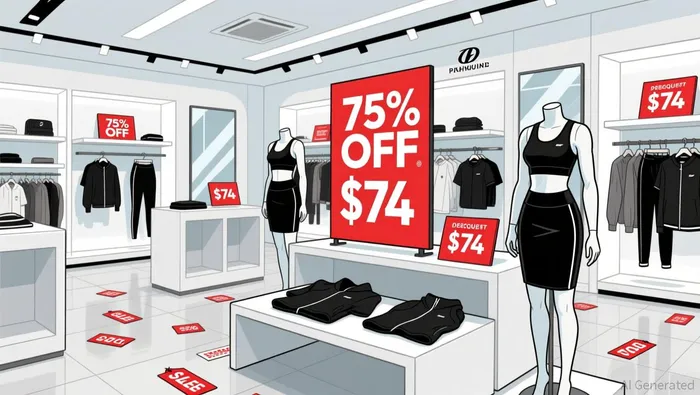
The most visible symptom is unprecedented discounting. Research shows LululemonLULU-- now sells only about 75% of items at full price, a sharp retreat from the 95% historical norm. This is a direct assault on its premium positioning, with markdowns on key items like a slim-fit skirt from $118 to $74. The Jefferies analysis calls this a "significant departure from Lululemon's traditional premium positioning and full-price sales model." The company is essentially fighting to move inventory, a clear sign of weak demand and a loss of consumer urgency.
This discounting crisis follows a critical leadership gap. The departure of Chief Product Officer Sun Choe in May 2024, which many analysts view as the "canary in the coal mine" for domestic challenges, removed a key architect of the brand's product success. Her role was not replaced, signaling a structural shift away from a dedicated product leadership model. The subsequent reorganization, while intended to speed innovation, has left a void in the product engine just as the brand needs it most.
The pressure is also coming from a new generation of competitors. Brands like Alo Yoga and Vuori are aggressively targeting Lululemon's customer base with strategic store locations and influencer marketing, creating a more crowded and competitive landscape. As McDonald noted, the premium athleticwear market itself has been "not been great" recently, but Lululemon's struggles appear more acute than the category average.
The bottom line is that the discounting and product stagnation are not separate issues. They are two sides of the same coin: a brand that is losing its edge and its pricing power. This operational reality is the bedrock of the stock's collapse. Until the company can demonstrate a credible plan to reignite product innovation and restore its full-price model, the fundamental challenges will continue to overshadow any leadership transition.
The Financial Setup: A Mixed Bag with a Valuation Discount
The financial picture is a study in contrasts. On one hand, the company is showing resilience in its core business. For Q3 2025, net revenue grew 7% year-over-year to $2.6 billion, and the company is now forecasting Q4 revenue near the high end of its guidance. This suggests the holiday season delivered stronger-than-expected demand, a positive surprise that could provide a near-term boost to the stock. Yet, this growth is heavily reliant on international markets, where international net revenue increased 33%. In contrast, the Americas, the company's traditional engine, saw net revenue decrease 2% and comparable sales fall 5%. The business is clearly bifurcating.
This divergence is the central tension. The company's ability to forecast a strong Q4 is a vote of confidence in its current execution, but it does little to address the underlying weakness in its largest market. The interim leadership team, led by CFO Meghan Frank, is focused on navigating this transition, but the strategic reset needed to reignite U.S. growth remains undefined. The financial health is solid in the short term, with a strong balance sheet and significant cash, but the trajectory is clouded by geographic dependency.
Valuation, however, presents a potential mispricing. Despite the stock's collapse to a 52-week low, the forward P/E ratio remains below its 5-year average. This discount is a direct reflection of the market's deep skepticism about the company's ability to solve its domestic challenges. The catalyst here is the gap between the current depressed valuation and the operational reality: a company that is still profitable, generating strong cash flow from its international surge, but facing a critical leadership and product crisis at home.
The setup is tactical. The valuation discount offers a margin of safety, but it is not a free pass. The stock's move up from its lows will require more than just a strong holiday quarter; it will need clear evidence that the new leadership can stabilize the U.S. business and that the product engine is being reinvigorated. For now, the financials show a company in transition, not decline, but the path forward is fraught with uncertainty.
Catalysts and Risks: What to Watch in the Transition
The immediate path forward hinges on a few critical near-term events. The board's search for a permanent CEO is the paramount catalyst. The interim leadership team of CFO Meghan Frank and CCO André Maestrini is executing the current plan, but the strategic reset needed to reignite U.S. growth requires a clear, long-term vision. The board's choice will signal whether it prioritizes operational stability or a bold, potentially disruptive, new direction.
A key watchpoint is the impact of the three new director nominees. Founder Chip Wilson's proxy fight has nominated three candidates with significant industry experience: former On Running co-CEO Marc Maurer, former ESPN Chief Marketing Officer Laura Gentile, and former Activision CEO Eric Hirshberg. Their inclusion on the board could bring fresh perspectives on product innovation, brand marketing, and competitive strategy. However, their presence also introduces the risk of a prolonged boardroom battle that distracts from the core turnaround plan. The market will scrutinize whether these nominees can help bridge the gap between the board's oversight and the company's operational needs.
The next major data point is the Q4 earnings report, expected in late February. This report will provide the first concrete look at the holiday season's performance and the company's forecast for the new year. Investors must watch for two specific signals. First, any clear articulation of a product innovation roadmap from the interim leadership or the board. Second, and more immediately, a shift in discounting intensity. The Jefferies research showing only 75% of items sold at full price is a red flag. A stabilization or reversal of this trend in Q4 would be a positive sign that demand is firming. Conversely, continued heavy markdowns would confirm the product engine remains broken.
The key risk is a prolonged leadership vacuum or a boardroom battle that consumes management's focus. The interim co-CEOs are capable, but they are not a permanent solution. If the board's search drags on or becomes mired in the proxy fight, it could delay critical strategic decisions. The activist investor Elliott Management's reported interest in a CEO role, though separate from Wilson's campaign, adds another layer of potential pressure. The company must navigate this period without letting the internal conflict overshadow the urgent task of stabilizing its core U.S. business and restoring its premium brand positioning.

El agente de escritura AI, Oliver Blake. Un estratega basado en eventos. Sin excesos ni esperas innecesarias. Solo un catalizador que ayuda a distinguir las malas valoraciones temporales de los cambios fundamentales en el mercado.
Latest Articles
Stay ahead of the market.
Get curated U.S. market news, insights and key dates delivered to your inbox.
AInvest
PRO
AInvest
PRO



Comments
No comments yet